Choosing the right load matters as much as choosing the right power supply. For accurate bench work, you want stable control, clear readouts, and enough headroom for the voltage, current, and power you test most often.
This roundup of electronic loads for power supply testing focuses on practical features that help with lab validation, battery work, and everyday troubleshooting.
Best 10 Electronic Loads for Power Supply Testing Picks for 2026
Automated Bench Tester
OWON OEL1530 Programmable DC Electronic Load

- USB, RS232, and RS485 with SCPI support
- Up to 150V, 30A, and 300W operation
- Dynamic testing to 5kHz with adjustable slew rate
Best For: R&D benches, automated testing, and transient response checks
Compact Repair Load
RK6012 720W DC Electronic Load Tester

- Up to 60V, 12A, and 720W output
- 1mV/1mA readout on a 1.54-inch LCD
- CV/CC modes with preset memory
Best For: Electronics repair, battery testing, and high-wattage bench use
Precision Lab Load
Rigol DL3031 Programmable DC Load

- Up to 150V, 60A, and 350W single-channel load
- Dynamic mode up to 15kHz with fast slew control
- RS232, USB, and LAN for lab integration
Best For: Lab validation, automated test systems, and high-current characterization
Programmable Test Bench

- 200W programmable load with CC, CV, CR, CP, and more
- USB remote control support for computer-based testing
- Protection features include overcurrent, overvoltage, and overtemperature
Best For: Users who want a programmable bench load with USB control and broader test-mode coverage
Mini Field Tester
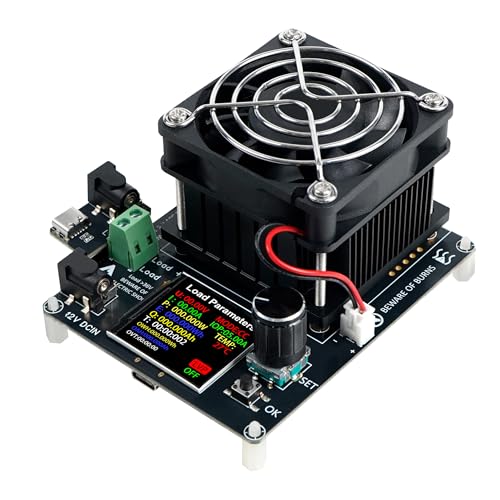
- Compact 120W load with 50V, 15A support
- Color screen tracks voltage, energy, capacity, and temperature
- Dual 12V power options for portable use
Best For: Portable discharge testing of batteries, chargers, and power banks
Advanced Bench Tester
OWON OEL1520 300W Programmable DC Load

- 0-150V, 0-20A, 300W output range
- 5kHz dynamic testing with adjustable slew rate
- USB/RS232/RS485 and SCPI for automation
Best For: R&D and production testing with automated control and transient analysis
Feature-Rich Test Tool
ET5406A+ USB DC Load Tester 200W
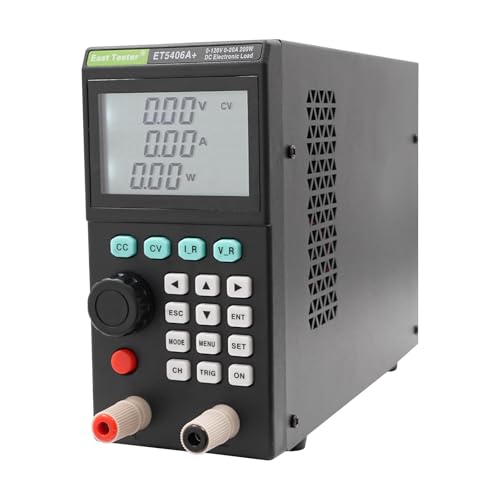
- CC, CV, CR, and CP plus advanced test modes
- USB remote control and external trigger input
- Power-off data saving with buzzer and key lock
Best For: Compact bench testing with lots of test modes and simple USB control
High-Capacity Programmable Load
400W DC Electronic Load Tester 150V 40A

- 400W capacity with 150V, 40A maximum ratings
- CC, CV, CR, CP plus combined and advanced modes
- USB control with remote compensation and protections
Best For: Higher-power supply, charger, and battery testing on the bench or line
Automated Bench Tester – OWON OEL1530 Programmable DC Electronic Load
If you need electronic loads for power supply testing with strong automation support, the OWON OEL1530 is built for bench and production use. It offers wide-range DC loading, SCPI control over USB/RS232/RS485, and fast dynamic testing for checking how supplies respond to changing current demands.
Best For: R&D benches, automated test setups, and supply characterization with dynamic loading.
Pros:
- Supports USB, RS232, and RS485 with full SCPI protocol for automated control.
- Wide operating range up to 150V, 30A, and 300W for flexible lab testing.
- Dynamic mode switches up to 5kHz with adjustable current rise rate.
- Includes CV, CC, CR, and CP modes plus battery charge/discharge testing.
Cons:
- 300W capacity is more suited to bench testing than high-power loads.
- Advanced features may be more than casual users need.
This is a strong choice if you want a programmable load that can do more than simple steady-state draws. The combination of connectivity, protection features, and battery test functions makes it especially useful in test environments where repeatability matters.
Compact Repair Load – RK6012 720W DC Electronic Load Tester
For practical electronic loads for power supply testing in repair shops and DIY workspaces, the RK6012 focuses on straightforward CV and CC operation with a high 720W ceiling. Its LCD readout shows voltage, current, power, temperature, and capacity, making it easy to monitor a test at a glance.
Best For: Electronics repair, battery-related testing, and bench work that needs higher wattage.
Pros:
- Delivers up to 60V, 12A, and 720W for heavier bench loads.
- 1mV/1mA resolution with real-time readings on the 1.54-inch LCD.
- CV and CC dual modes cover common repair and charging tests.
- Preset memory and Type-C connectivity add convenience for repeat tasks.
Cons:
- Only CV and CC modes are listed, so it is less versatile than multi-mode units.
- Positioning and naming suggest a hybrid supply/load tool, which may not suit every workflow.
The RK6012 makes sense when you want a compact tester with strong output capability and simple operation. It is especially appealing if your work leans toward repair, battery checks, and frequently repeated load settings.
Precision Lab Load – Rigol DL3031 Programmable DC Load
The Rigol DL3031 is a capable pick for electronic loads for power supply testing when you need higher power, fast dynamic behavior, and detailed readback. With support for multiple static and dynamic modes plus built-in communications, it fits well in lab and factory test workflows.
Best For: Lab validation, automated testing, and power supply characterization at higher current levels.
Pros:
- Handles up to 150V, 60A, and 350W on a single channel.
- Dynamic mode reaches up to 15kHz with adjustable current rise speed.
- Includes CC, CV, CR, and CP modes plus pulsed and toggled dynamics.
- RS232, USB, and LAN interfaces support integration into test systems.
Cons:
- Heavier and larger than compact bench loads.
- May be more load tester than a casual hobbyist needs.
This model stands out if you need a serious programmable load for repeatable validation work. The combination of high-frequency dynamic testing, protection features, and network connectivity makes it a strong lab instrument.
Budget Discharge Meter – 150W 20A CNC Electronic Load
If you are comparing electronic loads for power supply testing on a tighter budget, this 150W unit focuses on battery capacity monitoring and straightforward load control. Its color display and four working modes give you the basics needed for discharge testing and general bench use.
Best For: Battery capacity checks, light bench testing, and users who want an affordable CNC load.
Pros:
- Offers constant current, constant voltage, constant power, and constant resistance modes.
- Displays voltage, current, power, capacity, internal resistance, and protection status.
- Supports up to 150W and 20A with adjustable protections and stop conditions.
- External NTC sensor support adds temperature monitoring capability.
Cons:
- Lower power rating than larger bench loads.
- Battery-powered design may not suit every fixed lab setup.
This is a practical option if your testing is centered on battery discharge and lower-power load work. It is less feature-rich than premium lab units, but it covers the essentials clearly on the front panel.
Compact Lab Load – 120W CC/CV/CR/CP Tester
If you need electronic loads for power supply testing in a simple desktop format, this 120W unit covers the basics well. It supports CC, CV, CR, and CP modes plus short-circuit testing, with a 0 to 150V range and up to 20A for checking batteries, DC sources, and power supplies.
Best For: Bench testing of small power supplies, batteries, and DC sources where multiple load modes matter.
Pros:
- Supports CC, CV, CR, CP, and short-circuit testing modes
- Clear LED display shows real-time voltage and current readings
- Includes watt-hour and amp-hour timing measurements for battery checks
- Front-panel controls make setup straightforward
Cons:
- 120W max power is best suited to lighter-duty testing
- Desktop design is less portable than mini module-style loads
- Basic display and controls may not suit advanced remote workflows
This is a practical choice if you want a straightforward programmable load with broad mode support and easy front-panel operation. It fits well in a home lab or light bench-testing setup where versatility matters more than raw power.
Programmable Test Bench – 200W USB-Control Load
For electronic loads for power supply testing that need more flexibility, this 200W tester adds remote communication and several test modes. It supports CC, CV, CR, and CP operation, plus battery, dynamic, transient, list, and short-circuit tests for chargers, switching supplies, and linear power supplies.
Best For: Users who want a programmable bench load with USB control and broader test-mode coverage.
Pros:
- 200W output with up to 120V and 30A support in the listed style
- USB communication enables computer-based remote control
- High-resolution 1mV/10mV and 1mA/10mA step capability
- Includes overcurrent, overvoltage, overpower, and overtemperature protection
Cons:
- Remote software and SCPI require contacting the supplier
- More functions may be more than needed for basic load testing
- More complex interface than a simple manual tester
This model stands out if you want a programmable load for repeatable testing and computer control. Its broader mode set makes it a stronger fit for validation work, especially when you need to test power supplies under changing conditions.
Mini Field Tester – 120W Portable Battery Load
If you want electronic loads for power supply testing in a compact handheld form, this mini tester is built for portability. It handles up to 50V, 15A, and 120W, while monitoring voltage, current, power, energy, capacity, discharge time, and temperature on a color screen.
Best For: Portable discharge testing of batteries, chargers, and power banks.
Pros:
- Very compact size with a 1.54-inch color display
- Tracks voltage, current, power, energy, capacity, time, and temperature
- Supports safety protections for over-voltage, under-voltage, over-current, and over-power
- Dual power options include DC 12V and Type-C to Type-C PD 12V input
Cons:
- 50V maximum is lower than some bench electronic loads
- Cannot be powered via Type-C to Type-A cables
- Best suited to lighter portable testing rather than larger supply verification
This is the easiest option to carry around when you need quick discharge checks on batteries or adapters. It favors convenience and real-time monitoring over the deeper bench features of larger programmable loads.
Advanced Bench Tester – OWON OEL1520 300W Programmable DC Load
If you need electronic loads for power supply testing that can handle both routine bench checks and more advanced characterization, the OWON OEL1520 is built for flexible lab use. It covers CC, CV, CR, and CP operation, adds fast dynamic testing up to 5kHz, and supports USB, RS232, and RS485 control with SCPI for automated setups.
Best For: R&D labs and production test stations that need programmable control, dynamic testing, and battery charge/discharge analysis.
Pros:
- Wide 0-150V, 0-20A range with 300W capacity for many bench test tasks
- Up to 5kHz dynamic switching with adjustable current rise rate for transient testing
- USB, RS232, and RS485 connectivity with full SCPI support for automation
- Battery charge/discharge testing with PC software and curve output
Cons:
- 300W rating may be limiting for higher-power loads
- More advanced than a basic manual-only load tester
- Best value is strongest when you need automation or dynamic testing
This model stands out if your testing workflow goes beyond simple current sinking and into repeatable, computer-controlled measurements. The display, protection set, and flexible operating modes make it a practical choice for serious power supply and battery work.
Feature-Rich Test Tool – ET5406A+ USB DC Load Tester 200W
For buyers comparing electronic loads for power supply testing, the ET5406A+ offers a broad feature set without moving into heavy lab equipment territory. It supports CC, CV, CR, and CP modes plus battery testing, dynamic testing, scanning, list programming, and short-circuit testing, making it a versatile option for chargers, power supplies, and batteries.
Best For: Users who want a compact USB-controlled load tester with multiple test modes and data-retention features.
Pros:
- Four core modes plus advanced battery, dynamic, scan, list, and short-circuit tests
- USB remote control from a computer for easier operation
- External trigger input supports controlled loading by outside signals
- Built-in buzzer, key lock, and power-off data saving add convenience
Cons:
- 200W output is more modest than higher-power programmable loads
- Best suited to moderate-duty test work rather than large power systems
- Focused on bench and production testing rather than portability
The ET5406A+ is a good fit if you want a practical tester with enough modes to cover most common lab and production checks. Its remote control and memory features make it especially useful where repeatable testing matters.
High-Capacity Programmable Load – 400W DC Electronic Load Tester 150V 40A
If you need electronic loads for power supply testing with extra headroom, this 400W programmable load raises the ceiling to 150V and 40A. It supports CC, CV, CR, CP, CC+CV, and CR+CV modes, plus battery and power supply internal testing, dynamic, scan, list, and short-circuit functions for broader bench and line work.
Best For: Higher-power chargers, power supplies, batteries, and production-line aging tests.
Pros:
- 400W rating with 150V and 40A capability for higher-demand tests
- Multiple operating modes including CC+CV and CR+CV
- USB remote use, external trigger input, and software-based remote compensation
- Protection features include OVP, OCP, OPP, OTP, short-circuit, and reverse polarity warnings
Cons:
- More load capability may be unnecessary for smaller bench projects
- Feature set is broad, so setup may be more involved than a basic tester
- Designed as a bench tool, not a lightweight portable unit
This model is the strongest option here when you need more voltage, current, and power margin for demanding test scenarios. The combination of remote control, data retention, and safety features makes it well suited to development and production environments.
How We Picked the Best Electronic Loads for Power Supply Testing
We prioritized Electronic Loads for Power Supply Testing that balance measurement range, total wattage, control stability, and usability. The strongest options offer programmable modes, sensible display feedback, and interfaces that fit both bench and service work. We also favored models with enough margin for real-world testing, not just ideal lab conditions.
Quick Comparison
For light bench checks and battery diagnostics, compact 120W to 200W units can be a good fit. For general-purpose lab use, 300W to 400W models offer more flexibility. If you need higher current, faster dynamic response, or better resolution for development work, higher-end programmable units are the better choice.
Key Buying Factors for Electronic Loads for Power Supply Testing
Voltage, Current, and Power Ratings
Make sure the load covers your highest expected voltage and current with room to spare. Power rating is often the limiting factor, so a unit that looks sufficient on current alone may still fall short in practice.
Operating Modes
CC, CV, CR, and CP modes are useful for different test scenarios. Constant current is the most common for power supply evaluation, while constant resistance and constant power can help simulate more realistic or specialized conditions.
Dynamic Performance and Resolution
If you test transient response or switching behavior, look for higher dynamic frequency and finer readback resolution. Better resolution makes it easier to spot small changes and verify regulation accurately.
Connectivity and Control
USB and RS232 support can make automated testing easier, especially in development or production environments. Manual controls still matter, but remote control is a big advantage if you repeat the same load profiles often.
Display and Workflow
A clear screen, intuitive menus, and fast adjustment controls save time on the bench. For battery and charger testing, visible live data and capacity monitoring can be especially helpful.
Who Should Buy Which Electronic Loads for Power Supply Testing?
If you mainly test small adapters, chargers, or battery packs, a 120W to 200W model is usually enough. Engineers and advanced hobbyists working on bench supplies, higher-current DC rails, or repeated validation tasks should lean toward 300W to 400W programmable units. For automation, frequent repeat tests, or tighter measurement needs, choose a model with stronger interface support and better dynamic performance.
In short, the best Electronic Loads for Power Supply Testing are the ones that match your workload, not just your budget. Start with the wattage you truly need, then narrow by modes, control options, and readability.