If you are looking for a straightforward Gigabit Dual NIC for a server, lab box, or workstation, this Gigabit Dual NIC with Intel 82576 Chip review is about fit rather than hype.
The appeal is simple: dual RJ45 ports, Intel controller support, broad OS compatibility, and low-profile hardware for compact builds.
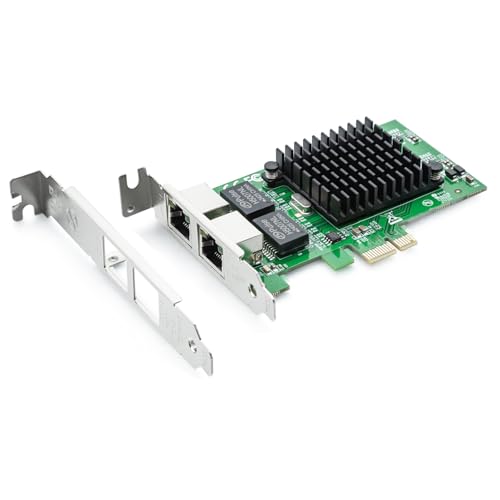
Gigabit Dual NIC Review Summary
This Gigabit Dual NIC makes sense for buyers who want a dependable wired adapter for a machine that needs more than one Ethernet connection.
The listing points to an Intel 82576 controller, dual 1Gb RJ45 ports, PCIe x1 compatibility, and support for both full-height and low-profile installs, so the product is aimed squarely at practical networking jobs rather than consumer flash.
The strongest case for it is compatibility and flexibility.
It is listed for Windows, Windows Server, Linux distributions, FreeBSD, and VMware ESXi 5/6, which makes it useful in mixed environments where a generic adapter can become a problem.
The low-profile bracket matters too, because it gives the card a legitimate place in slim desktops and rack-style systems where height clearance is tight.
The main limitation is that this is still a 1Gb card.
That is not a flaw if your switch, cabling, and workflow are built around gigabit Ethernet, but it does mean the card is not a future-proof pick for buyers who are already moving to 2.5Gb or faster networking.
The other caution is that the listing itself is doing a lot of the heavy lifting on quality claims, so the safest reading is to treat it as a feature-complete, compatibility-first option rather than a premium enthusiast card.
Review Scorecard
| Category | Score | Why it scores this way |
|---|---|---|
| OS compatibility | 9/10 | The listing covers Windows, Windows Server, Linux, FreeBSD, and older ESXi support. |
| Installation flexibility | 9/10 | Both low-profile and full-height brackets are included for different chassis types. |
| Network utility | 8/10 | Dual RJ45 ports are valuable for routing, bridging, failover, or separate networks. |
| Future-proofing | 5/10 | It is limited to gigabit speeds, so it fits current 1Gb setups better than next-gen ones. |
| Value for practical builds | 8/10 | The feature set is focused and useful if you need reliable wired connectivity. |
| Setup simplicity | 7/10 | PCIe x1 support and broad driver support suggest an easier install path. |
| Buyer confidence | 7/10 | The hardware claims are specific, but the listing leans more on specs than on nuanced product detail. |
Key Features and Specifications of Gigabit Dual NIC
The core identity of this Gigabit Dual NIC is a dual-port Intel-based PCI Express network card.
The listing names the Intel 82576 controller and compares it to the Intel E1G42ET NIC, which signals that it is intended for buyers who already know the value of Intel Ethernet hardware in mixed desktop and server environments.
It has two RJ45 ports rated for 10/100/1000Mbps data rates.
That gives it the expected gigabit bandwidth for mainstream wired networking, while also making it appropriate for jobs that benefit from separate uplink and local-network paths.
The card is described as PCI Express 2.0 x1, with compatibility for x1, x4, x8, and x16 slots.
That is useful because it keeps the adapter easy to place in systems where slot layout is constrained.
The listing also says it supports Cat5e cable and notes up to 100 meters, which matches standard gigabit Ethernet expectations.
Compatibility is one of its biggest selling points.
The supported platforms listed include Windows 7/8/10/11, Windows Server 2008/2012/2016/2019, CentOS/RHEL 6/7/8, Ubuntu 16/18/19/20, Debian 9/10/11, FreeBSD 10/11/12, VMware ESXi 5/6, and SLSE 11/12.
The listing explicitly says it does not support VMware ESXi 7.0, Mac OS, or bypass mode.
For installation, the card includes both a low-profile bracket and a full-height bracket.
That matters in real buying decisions because many network cards look fine on paper but become annoying the moment they need to fit a compact case.
The included bracket options make this product more deployment-friendly than a bare-bones adapter.
The manufacturer also states that driver download instructions are available through Intel’s site or by QR code on the card.
That is not a performance claim, but it is useful because driver access is often the difference between a painless install and a frustrating one.
Pros and Cons of Gigabit Dual NIC
Pros
- Dual RJ45 ports give you more flexibility than a single-port adapter.
- Intel 82576 branding will appeal to buyers who prefer Intel-based networking hardware.
- Broad OS support makes it a better fit for labs, servers, and mixed-use systems.
- Low-profile and full-height brackets increase the chance that it will physically fit your build.
- PCIe x1 support keeps installation simple in crowded systems.
Cons
- It is limited to gigabit speeds, so it will not satisfy buyers chasing multi-gig networking.
- The listing is broad on compatibility but not very deep on performance nuance.
- VMware ESXi 7.0 and Mac OS are explicitly not supported.
- Buyers who only need one Ethernet port may not benefit from the second port.
Who Should Buy Gigabit Dual NIC?
This Gigabit Dual NIC is best for buyers who value utility over novelty.
If you are building or maintaining a home server, a small business machine, a lab system, or a workstation that needs two wired network interfaces, the dual-port layout gives you real deployment options.
It is also a sensible choice for mixed operating system environments.
The listed support for Windows, Windows Server, Linux, FreeBSD, and older VMware ESXi releases makes it practical for people who do not want to gamble on a generic NIC with spotty driver support.
You should also consider it if your case is compact.
The included low-profile bracket makes it relevant for slim desktops and server chassis where a full-height card would simply be awkward or unusable.
Who should skip it?
Anyone building around 2.5Gb, 5Gb, or 10Gb networking should look elsewhere.
The same is true for Mac users, buyers who rely on VMware ESXi 7.0, or anyone who only wants a single-port adapter and does not need the extra interface.
Network Planning for Gigabit Dual NIC
Dual-Port Use Cases
The two RJ45 ports are the main reason to buy this card.
They make sense for separate networks, router or firewall projects, virtualized lab setups, and machines that need one port for upstream traffic and another for a private subnet.
PCIe and Chassis Fit
PCIe x1 compatibility keeps installation easy, but the bigger win is the included bracket set.
A low-profile bracket expands the number of cases where this card can be used without improvisation.
Driver and OS Fit
The listed operating system support is unusually broad for a card in this class.
That does not guarantee every setup will be frictionless, but it does mean the product is aimed at real compatibility needs rather than narrow consumer use.
Speed Expectations
This is a 1Gb adapter, so expectations should stay grounded.
It is a good fit when your network infrastructure is already gigabit-based, but it is not the right answer if your bottleneck is moving beyond gigabit.
Alternatives to Gigabit Dual NIC
If you want a simpler single-port Intel card, look at the Intel I350-T1.
If you want a dual-port step-up with strong enterprise credibility, the Intel I350-T2 is a common comparison point.
If you need a cheaper generic dual-port option for a lab or spare build, search for a dual port gigabit PCIe NIC and compare bracket support and OS compatibility carefully.
Is Gigabit Dual NIC Worth It?
For the right buyer, yes.
This Gigabit Dual NIC is worth considering if you need dual wired ports, Intel-based network hardware, and broad support for Windows or Linux systems in a compact or server-style build.
It is not the best answer for everyone, because the gigabit ceiling and the explicit lack of support for some newer or niche platforms will matter to certain buyers.
But if your goal is stable, practical networking rather than chasing the fastest headline speed, this is a focused and reasonable choice.