Digitizing an archival collection means balancing image quality, handling safety, speed, and long-term file flexibility. The right scanner can preserve family photographs, negatives, documents, and oversized originals while reducing the risk of repeated handling.
This roundup compares 10 photo scanners for archival collections, including automatic-feed models for large batches and flatbed scanners designed for detailed, carefully controlled captures.
Best 10 Photo Scanners for Archival Collections Picks for 2026
High-Volume Pick

- Batch-scans up to 36 photos
- Duplexes photos and handwritten backs
- Offers 600 dpi TIFF and 1200 dpi modes
Best For: Large mixed-photo collections and efficient family archiving
Simple Desktop Option

- Scans 4 x 6 photos in about two seconds
- Supports up to 600 dpi
- Works with Mac and PC
Best For: Smaller home collections and uncomplicated photo scanning
Professional Flatbed Choice

- Scans media up to 12.2 x 17.2 inches
- Includes a transparency unit and film holders
- Provides 2400 x 4800 dpi resolution
Best For: Large-format prints, slides, negatives, and professional archival work
Professional Detail
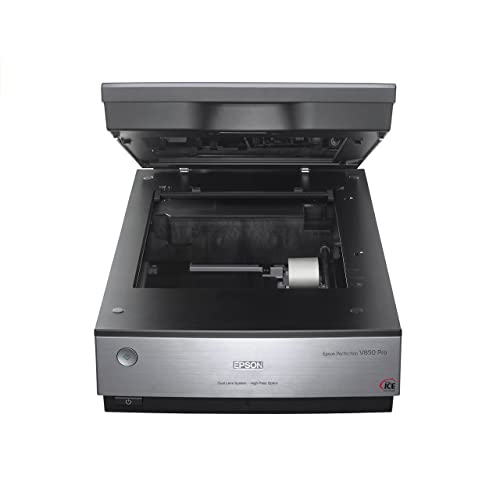
- 6400 dpi resolution with 4.0 Dmax
- Dual-lens system and CCD sensor
- Digital ICE supports restoration work
Best For: High-detail archival photo scanning
Compact Convenience

- 4800 x 4800 dpi photo scanning
- Lightweight 3.6-pound slim design
- USB Type-C data and power connection
Best For: Space-conscious home archival projects
Film and Print Versatility
Epson Perfection V600 Photo Scanner

- Scans prints, slides, negatives, and medium-format film
- 6400 x 9600 dpi maximum resolution
- Built-in Digital ICE and transparency unit
Best For: Mixed photo and film collections
Professional Archival Workhorse

- Large-format bed supports media up to 12.2 x 17.2 inches
- 2400 x 4800 dpi with 48-bit color and 3.8 Dmax
- Batch scanning and restoration tools support archival workflows
Best For: Institutions and collectors scanning large originals in volume
Film and Photo Restoration Pick

- 6400 dpi optical resolution for detailed photo enlargements
- Built-in transparency unit handles 35mm film, slides, and negatives
- Digital ICE and Easy Photo Fix support restoration
Best For: Mixed photo and 35mm film archival projects
Compact Everyday Archivist

- 4800 dpi resolution for detailed photo scans
- USB-powered, 3.1-pound design with vertical storage
- One-touch scanning and faded-photo restoration simplify home archiving
Best For: Personal photo archives and small workspaces
High-Volume Pick – Epson FastFoto FF-680W
For photo scanners for archival collections that need to process large batches efficiently, the Epson FastFoto FF-680W combines a 36-photo feeder with fast duplex scanning. It can scan at up to 1 photo per second at 300 dpi, while 600 dpi TIFF and 1200 dpi options support more detailed archival work.
Best For: Families, estates, and small archival projects digitizing large collections of mixed-size photos.
Pros:
- Batch-scans up to 36 photos and reaches up to 45 ppm/90 ipm for documents.
- Duplex scanning captures handwritten notes on photo backs in one pass.
- Supports photos up to 8 x 10 inches, panoramas, postcards, and Polaroids.
- Includes enhancement features such as color restoration, red-eye reduction, cropping, and deskewing.
Cons:
- The automatic feeder is less suited to unusually fragile or irregular materials than a flatbed.
- Its listed dimensions and 8.2-pound weight require dedicated workspace.
- Some sharing and backup features depend on the Epson FastFoto app or cloud services.
The FF-680W is a strong workflow choice when throughput matters without giving up archival-resolution options. Its carrier sheet and SafeTouch technology add useful safeguards for delicate photos, while wireless and USB connectivity make placement flexible.
Simple Desktop Option – Plustek ePhoto Z300
The Plustek ePhoto Z300 is a straightforward choice among photo scanners for archival collections when ease of use and compact operation matter. It scans a 4 x 6 photo in about two seconds and supports common photo sizes from 3 x 5 through 8 x 10 inches.
Best For: Home users and smaller projects that want quick, one-at-a-time photo scanning on Mac or PC.
Pros:
- Scans 4 x 6 photos in about two seconds at 300 dpi.
- Supports 300 and 600 dpi settings with a CCD sensor.
- Handles 3 x 5, 4 x 6, 5 x 7, 8 x 10, letter, and A4 media.
- Includes auto-crop, deskew, and image-enhancement functions for faded photos.
Cons:
- Photos must be inserted one at a time, so it is less efficient for very large batches.
- USB is the listed connection type; there is no stated wireless option.
- It does not list dedicated film or transparency scanning support.
The Z300 favors a simple feed-and-scan workflow over advanced archival flexibility. Its 600 dpi maximum and restoration tools are useful for everyday photo preservation, though high-volume users may prefer an automatic feeder.
Professional Flatbed Choice – Epson Expression 12000XL-PH
For archival collections containing oversized prints, negatives, slides, and transparencies, the Epson Expression 12000XL-PH provides a large-format flatbed workflow. Its 2400 x 4800 dpi resolution, 3.8 Dmax, and included transparency unit are aimed at detailed, high-quality capture rather than rapid feeder scanning.
Best For: Professional archives, studios, and collections requiring large-format reflective and film scanning.
Pros:
- Accommodates reflective media up to 12.2 x 17.2 inches.
- Includes holders and a transparency unit for 35mm slides, film strips, 4 x 5 transparencies, and medium-format strips.
- Provides 2400 x 4800 dpi resolution and a 3.8 Dmax for detailed scans.
- Offers color restoration, dust removal, and grain reduction features for film scanning.
Cons:
- At 31.5 pounds, it is substantially heavier and less portable than the other listed options.
- Its flatbed design is slower for very large stacks of standard prints.
- USB is the listed connection type, with no wireless connectivity noted.
The 12000XL-PH is the most capable fit here for oversized originals and mixed film formats. It requires more space and a more deliberate workflow, but its resolution, transparency accessories, and SilverFast Ai software support demanding archival digitization.
Mixed-Media Feeder – Canon imageFORMULA RS40
The Canon imageFORMULA RS40 suits photo scanners for archival collections that also need to handle everyday paperwork. Its automatic feeder scans both sides of photos and documents at up to 40 items per minute, and it supports varied media including Polaroids, cards, receipts, and IDs.
Best For: Users digitizing family photos alongside documents, receipts, cards, and other office records.
Pros:
- Scans both sides through an automatic feeder at up to 40 items per minute.
- Handles varied photo and document sizes, including Polaroids and cards.
- Bundled software provides photo enhancement, red-eye correction, and face smoothing.
- Supports Windows and Mac and saves to JPG, TIF, BMP, PNG, PDF, and PPTX.
Cons:
- The listed optical resolution is not specified beyond selectable scan settings, with 1200 dpi identified as interpolated.
- Its feeder-based design may be less appropriate for fragile or unusually shaped originals.
- USB is the listed connection type, without a stated wireless option.
The RS40 is a practical hybrid for collections that mix photographs with paperwork. It emphasizes convenient feeding, broad file-format support, and bundled editing tools, making it especially useful when archival scanning is part of a wider digitization project.
Professional Detail – Epson Perfection V850 Pro
For photo scanners for archival collections, the Epson Perfection V850 Pro is built around high-resolution capture and tonal control. Its 6400 dpi resolution, 4.0 Dmax, CCD sensor, Digital ICE, and dual-lens system make it a strong choice when preserving fine detail and shadow information matters.
Best For: Archival workflows requiring high-quality scans of photographs and demanding image detail.
Pros:
- 6400 dpi resolution and 4.0 Dmax support detailed scans and smooth gradations.
- Dual-lens system selects between lenses for optimized results.
- Digital ICE helps support restoration-oriented scanning.
- CCD sensor and LED light source are suited to photo scanning.
Cons:
- At 20.9 pounds, it is relatively heavy for a flatbed scanner.
- Its 23-watt power rating is higher than some smaller models.
- USB connectivity requires a computer-based setup.
The V850 Pro is the most specialized option here for users prioritizing image quality, tonal range, and archival-oriented control over portability or simplicity.
Compact Convenience – Canon CanoScan LiDE 400
Canon CanoScan LiDE 400 Slim Scanner, 7.7" x 14.5" x 0.4", Document & Photo Scanner, Black
Check Price On AmazonThe Canon CanoScan LiDE 400 offers a compact, straightforward option for photo scanners for archival collections when space and ease of use are priorities. It provides 4800 x 4800 dpi scanning, color restoration and dust removal features, and a single USB Type-C cable for data and power.
Best For: Home archivists and small collections needing a lightweight scanner for prints and documents.
Pros:
- Lightweight 3.6-pound design is easy to move or store.
- 4800 x 4800 dpi resolution supports detailed photo scans.
- Color restore and dust removal can improve aging images.
- Auto Scan Mode and EZ Buttons simplify routine scanning.
Cons:
- CIS sensor is less specialized for archival photography than the CCD models listed here.
- Standard sheet capacity is limited to one sheet.
- Its listed media sizes focus on photos and letter-sized documents.
The LiDE 400 is a practical pick for accessible, occasional digitization, especially when a slim footprint and simple controls matter more than film support or advanced tonal specifications.
Film and Print Versatility – Epson Perfection V600 Photo Scanner
The Epson Perfection V600 is a versatile choice among photo scanners for archival collections, supporting prints, 35mm slides, negatives, and medium-format film. Its 6400 x 9600 dpi maximum resolution, built-in transparency unit, CCD sensor, and Digital ICE make it useful for mixed-format digitization.
Best For: Collections containing both photographic prints and multiple types of film.
Pros:
- Built-in transparency unit scans mounted 35mm slides, negatives, and medium-format film.
- 6400 x 9600 dpi resolution supports enlargements up to 17 x 22 inches.
- Digital ICE helps with dust and scratch removal.
- ReadyScan LED technology avoids warm-up time and reduces power consumption.
Cons:
- Its wired USB 2.0 connection is older and less flexible than newer interfaces.
- At 19 inches deep, it requires substantial desk space.
- The listed minimum system requirement is Windows 7.
The V600 stands out for format flexibility: it is a strong middle-ground option for archives that need film holders and restoration tools without moving to the V850 Pro’s more specialized positioning.
Professional Archival Workhorse – Epson Expression 13000XL
For institutions and serious collectors comparing photo scanners for archival collections, the Epson Expression 13000XL stands out with its large-format bed, high-resolution CCD sensor, and batch-scanning workflow. It accommodates reflective media up to 12.2 by 17.2 inches and includes SilverFast Ai software with calibration targets.
Best For: Archives, libraries, studios, and collectors digitizing large photographs, artwork, or multiple images at a time.
Pros:
- Large 12.2 by 17.2-inch reflective scanning area
- 2400 x 4800 dpi resolution, 48-bit color depth, and 3.8 Dmax for detailed scans
- Easy Photo Fix offers one-touch color restoration and automatic dust removal
- Batch scanning, SilverFast Ai, and TWAIN support suit demanding workflows
Cons:
- Large and heavy at 31.5 pounds
- Optional transparency unit for film scanning is sold separately
- USB connectivity may be less convenient than wireless operation
The 13000XL is an investment-oriented choice for archival digitization, especially when oversized originals and productivity matter more than a compact footprint.
Film and Photo Restoration Pick – Epson Perfection V550
The Epson Perfection V550 is a versatile option among photo scanners for archival collections when the project includes prints, 35mm slides, negatives, and film. Its 6400 dpi optical resolution, built-in transparency unit, and restoration features make it suitable for mixed-media family and collection archives.
Best For: Home archivists, researchers, and small collections digitizing photos alongside 35mm film, slides, and negatives.
Pros:
- 6400 dpi optical resolution supports detailed enlargements up to 17 by 22 inches
- Built-in transparency unit scans 35mm slides, negatives, and film
- Digital ICE reduces the appearance of dust and scratches on film
- Easy Photo Fix and automatic edge detection simplify restoration and batch photo scanning
Cons:
- Standard sheet capacity is one item
- USB 2.0 connectivity lacks wireless convenience
- At 9.6 pounds, it is less portable than compact flatbed models
With dedicated film capability and photo-restoration tools, the V550 offers broad archival flexibility without requiring a separate transparency scanner.
Compact Everyday Archivist – Epson Perfection V19 II
For smaller projects, the Epson Perfection V19 II is a compact, USB-powered choice among photo scanners for archival collections. It combines 4800 dpi optical resolution with one-touch scanning, faded-photo restoration, and a removable lid for books and photo albums.
Best For: Individuals and small offices digitizing prints, albums, documents, and occasional artwork in limited workspace.
Pros:
- 4800 dpi optical resolution provides clear detail for photo enlargements
- One-touch buttons and Epson ScanSmart software simplify scanning
- Easy Photo Fix restores color to faded photos with one click
- Lightweight 3.1-pound design is USB powered and supports vertical storage
Cons:
- Designed for letter-sized documents rather than large-format originals
- CIS sensor and lower external color depth may be less suited to demanding professional workflows
- It does not list dedicated film or negative scanning support
The V19 II is a practical entry point for personal archives, particularly when portability, simple controls, and space-saving storage outweigh advanced media handling.
How We Picked the Best Photo Scanners for Archival Collections
We focused on scanners suited to real preservation workflows rather than occasional document scanning. The selection considers optical resolution, scanning technology, media compatibility, feeding options, software features, operating-system support, and the physical size of originals each model can accommodate.
High-speed sheet-fed scanners are useful for organized stacks of loose prints and documents, while flatbed models generally provide better control for fragile, curled, mounted, or irregularly sized material. Film-capable scanners receive additional consideration for negatives and slides, and large-format units are included for oversized photographs, artwork, and archival documents.
Quick Comparison
| Best For | Recommended Type | What to Prioritize |
|---|---|---|
| Large batches of loose prints | Automatic document/photo feeder | Feed reliability, speed, batch handling, and correction software |
| Fragile or valuable photographs | Flatbed scanner | Gentle handling, color accuracy, and adjustable settings |
| Negatives and slides | Film-capable flatbed | Film holders, optical resolution, and dust or scratch correction |
| Oversized originals | Large-format flatbed | Scan bed dimensions, optical uniformity, and file-size support |
| Everyday home archiving | Compact flatbed | Ease of use, footprint, connectivity, and practical resolution |
Key Buying Factors for Photo Scanners for Archival Collections
Optical Resolution
Optical resolution is more important than an inflated interpolated resolution figure. For standard prints, 300 to 600 dpi is often sufficient for basic preservation, while 600 to 1,200 dpi can provide useful cropping and enlargement flexibility. Film and small originals may benefit from higher true optical resolution, provided your storage system can handle the larger files.
Flatbed Versus Automatic Feeding
An automatic feeder can dramatically reduce the time required to scan hundreds of loose photographs, but it is not ideal for brittle, torn, curled, or highly valuable originals. A flatbed takes longer but offers more control and generally reduces the mechanical stress placed on each item.
Color, Detail, and Restoration Tools
Look for accurate color reproduction, adjustable exposure, and software that supports cropping, deskewing, dust removal, or scratch correction. Digital correction can help with film and heavily handled prints, but it should not replace keeping an untouched master scan.
File Formats and Workflow
For archival masters, choose lossless formats such as TIFF when practical, then create smaller JPEG or PDF copies for sharing. Confirm that the scanner software supports the resolution, color mode, naming, and batch options your collection requires.
Size, Connectivity, and Support
Check the scan bed dimensions before buying, especially for albums, artwork, newspapers, or oversized documents. USB connectivity is common, but operating-system compatibility and current driver availability matter just as much. A scanner that fits your workspace and remains supported is more useful than one with impressive specifications you cannot conveniently operate.
Who Should Buy Which Photo Scanners for Archival Collections?
Choose a high-speed feeder model if you have hundreds or thousands of loose, reasonably flat prints and want efficient batch processing. Choose a film-capable flatbed if negatives, slides, or small originals are central to the collection. A standard flatbed is the safer all-purpose choice for mixed household archives, delicate photographs, and documents.
For professional repositories, libraries, or collections containing oversized material, a large-format flatbed is usually the most versatile option. If space and budget are limited, a compact flatbed can still produce strong results when you are willing to scan items individually. Regardless of model, create consistent filenames, maintain multiple backups, and preserve an unedited master alongside access copies.