The best camera flashes for portraits give you more control over light, skin tones, and background separation than an on-camera pop-up flash. The right choice depends on your camera system, shooting style, and whether you need portability or maximum output.
This roundup compares 10 options ranging from compact TTL speedlights to powerful studio strobes, with practical guidance to help you choose a flash that fits your portrait workflow.
Best 10 Camera Flashes for Portraits Picks for 2026
Best All-Around TTL Choice

- Canon E-TTL II and manual modes
- 1/8000s HSS and 1.5s recycle time
- 2.4G wireless control with modeling lamp
Best For: Canon portrait photographers wanting flexible TTL and off-camera control
Best Studio Strobe Value

- 300W output with GN58 guide number
- Bowens mount for broad modifier compatibility
- Wireless control and adjustable 150W modeling lamp
Best For: Studio portrait setups using manual exposure and Bowens modifiers
Best Feature-Rich Canon Speedlite
NEEWER Z2PRO-C TTL Round Head Flash

- 76Ws output with TTL and 1/8000s HSS
- 600 full-power flashes and 1.5s recycle time
- Long-range 2.4G wireless control
Best For: Canon shooters needing extended battery life and advanced flash control
Best Modular Pick

- TTL, manual, and stroboscopic modes
- Flexible head with magnetic accessories
- Compatible with Godox wireless triggers
Best For: Compact TTL portrait setups and expandable Godox lighting systems
Best Wireless Value

- GN60 output for strong portrait illumination
- Built-in 2.4 GHz Godox X wireless system
- Supports five groups and 32 channels
Best For: Manual portrait lighting and budget-friendly multi-flash setups
Best Manual Control

- 22-level manual power adjustment
- LCD display with four flash modes
- Includes stand, pouch, and 12 filters
Best For: Precise manual portrait lighting and simple off-camera setups
Best Lightweight Nikon Flash
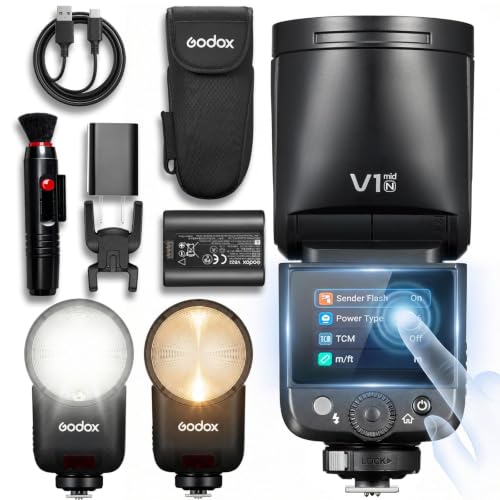
- Nikon i-TTL and 1/8000s HSS
- 650+ full-power flashes with USB-C charging
- 413g body with touchscreen and wireless X system
Best For: Portable Nikon portrait and event lighting
Best Canon Round-Head Flash

- Canon TTL and 1/8000s HSS
- About 450 full-power flashes per charge
- 2.4G wireless control up to 100 meters
Best For: Canon portrait and off-camera lighting
Best All-Around TTL Choice – Godox V1-C Round Head Flash
For photographers looking at camera flashes for portraits, the Godox V1-C is a versatile Canon-compatible option with TTL automation, a round head for softer-looking illumination, and wireless off-camera control. Its built-in LED modeling lamp also helps preview light placement before shooting.
Best For: Canon users who want a rechargeable, TTL-capable flash for portraits, events, and on- or off-camera lighting.
Pros:
- Round flash head distributes light evenly from center to edge.
- Supports Canon E-TTL II, manual flash, HSS up to 1/8000s, exposure compensation, and second-curtain sync.
- Built-in Godox 2.4G wireless X system supports remote operation.
- Offers a 1.5-second recycle time and about 480 full-power flashes.
Cons:
- Designed specifically for Canon-compatible cameras rather than universal TTL use.
- Not water resistant.
The V1-C is a strong choice when convenience matters: TTL handles changing conditions, while the round head, modeling lamp, and wireless system give portrait shooters room to refine their lighting.
Best Studio Strobe Value – Godox MS300V 300W Strobe
The Godox MS300V is a compact manual studio strobe for photographers building a dedicated portrait setup. Its 300W output, Bowens mount, adjustable LED modeling lamp, and wireless power control make it better suited to controlled studio sessions than quick on-camera work.
Best For: Portrait photographers working in a studio who need strong output and compatibility with Bowens-mount modifiers.
Pros:
- 300W output with a GN58 guide number for studio portrait lighting.
- Bowens mount works with a wide range of light modifiers and accessories.
- 150W LED modeling lamp adjusts from 5% to 100%.
- 0.1- to 1.8-second recycle time and wireless control of power, modeling lamp, and buzzer.
Cons:
- Manual exposure control rather than TTL automation.
- Does not support HSS.
- Requires removing the lamp cover before use.
Choose the MS300V when you want consistent, modifier-friendly studio lighting and do not need HSS or portable speedlite operation. Its compact design keeps it practical for portrait setups with controlled ambient light.
Best Feature-Rich Canon Speedlite – NEEWER Z2PRO-C TTL Round Head Flash
The NEEWER Z2PRO-C combines 76Ws output with Canon TTL support, high-speed sync, a rechargeable battery, and a round head. Among camera flashes for portraits, it stands out for its fast recycle performance, broad wireless range, and one-touch TTL-to-manual conversion.
Best For: Canon portrait, event, and studio photographers who want a high-capacity speedlite with advanced wireless and control features.
Pros:
- 76Ws output with TTL, manual power from 1/1 to 1/256, and HSS up to 1/8000s.
- Rechargeable battery provides up to 600 full-power flashes with a 1.5-second recycle time.
- 330° rotation and -7° to 120° tilt support direct and bounce lighting.
- Wireless control reaches up to 328 feet with 32 channels and 99 IDs.
Cons:
- Canon R50 users need the separately sold AD-E1 adapter.
- Q and X wireless systems cannot be used simultaneously.
- USB-C charging requires a 5V/2A charger, which is not included.
This is a capable option for demanding portrait work, especially when long battery life and wireless flexibility are priorities. Check camera compatibility and the adapter requirement before buying.
Best Budget Manual Flash – Godox TT600 Thinklite Flash
The Godox TT600 is a straightforward manual speedlite for photographers who want reliable power without built-in TTL automation. Its GN60 output, flexible bounce head, diffuser, and Godox 2.4G wireless compatibility make it useful for affordable portrait lighting setups.
Best For: Budget-conscious photographers using standard hot-shoe cameras who are comfortable setting flash power manually.
Pros:
- GN60 output provides strong illumination for portraits and events.
- Supports Godox 2.4G wireless master and slave operation with up to five groups and 32 channels.
- Tilts from -7° to 90° and rotates 360° for bounce lighting.
- Includes a diffuser for softer light and reduced harsh shadows.
Cons:
- HSS is available only off-camera with a compatible Godox wireless trigger sold separately.
- Uses four AA batteries, which are not included.
- Not compatible with several cameras, including Canon R6, R50, 3000D, 1500D, and 200DII.
The TT600 is a practical entry point for manual portrait flash, particularly when paired with a Godox trigger and diffuser. Confirm your camera’s hot-shoe compatibility before ordering.
Best Modular Pick – Godox IT32 Mini TTL Flash
For photographers comparing camera flashes for portraits, the Godox iT32 is a compact TTL option with a flexible head and a touchscreen interface. Keep in mind that the X5 trigger is sold separately; the flash can also work with compatible Godox triggers such as the X2T, Xpro II, and X3.
Best For: Portrait photographers who want TTL control and a compact flash that can grow into off-camera and multi-light setups.
Pros:
- TTL, manual, and stroboscopic shooting modes support varied portrait lighting.
- Flexible flash head and magnetic accessories support adaptable on-camera setups.
- Works with the Godox 2.4 GHz X system when paired with a compatible trigger.
- Can support wireless control and multi-light setups with compatible Godox equipment.
Cons:
- The X5 trigger needed for the featured modular setup is sold separately.
- Its guide number of 18 is lower than that of larger speedlites.
- It is not water resistant.
The iT32 stands out for portability and modularity rather than maximum output. It is a practical choice when you value TTL convenience and a flexible path from on-camera portraits to wireless lighting.
Best Wireless Value – Godox TT600 Manual Speedlite
The Godox TT600 is a strong value among camera flashes for portraits when you want high output and wireless flexibility without built-in TTL on the flash itself. Its GN60 output, 2.4 GHz Godox X compatibility, and broad camera compatibility make it suitable for controlled portrait lighting.
Best For: Portrait photographers who prefer manual flash control, high output, and wireless multi-light capability.
Pros:
- GN60 output provides substantial illumination for portrait work.
- Built-in 2.4 GHz wireless system supports remote control with compatible Godox triggers.
- Offers control of up to five groups and 32 channels.
- Provides approximately 230 full-power flashes with a 0.1–2.6-second recycle time.
Cons:
- Four AA batteries are required and are not included.
- HSS is not available when the flash is mounted directly on the camera hot shoe.
- TTL functionality requires a compatible TTL wireless trigger rather than the flash alone.
The TT600 is especially compelling for photographers building a manual portrait-lighting kit. It delivers more reach than the other listed options, while compatible Godox triggers can add remote control and high-speed-sync functions.
Best Manual Control – PHOTOOLEX FK310 Speedlite
The PHOTOOLEX FK310 is a straightforward choice among camera flashes for portraits, combining a GN33 output with an LCD display and fine manual power adjustment. Its single-contact hot shoe, S1/S2 triggering, and included color filters make it useful for basic on-camera or off-camera setups.
Best For: Portrait photographers who want precise manual output control, simple wireless triggering, and a complete starter kit.
Pros:
- 22-level power adjustment from 1/128 to 1/4 enables fine exposure control.
- Manual, Multi, S1, and S2 modes support varied creative setups.
- LCD display shows operating mode, power level, and battery status.
- Includes a stand, protective pouch, and 12 color filters.
Cons:
- GN33 output is lower than the Godox TT600’s GN60 rating.
- It uses manual exposure control rather than TTL.
- Its stated sync speed is 1/200 second.
The FK310 is best suited to photographers who want hands-on control and useful accessories without relying on a dedicated radio trigger. Its precise power steps and S1/S2 modes make it a practical entry point for deliberate portrait lighting.
Best Lightweight Nikon Flash – Godox V1 MID N
For photographers comparing camera flashes for portraits, the Godox V1 MID N is a strong Nikon option when portability, flattering round-head light, and wireless control matter. It offers native Nikon i-TTL, 1/8000s HSS, a 55Ws output, and a lightweight 413g design suited to portraits, events, and travel.
Best For: Nikon mirrorless users and portrait photographers who want a compact, TTL-capable flash with long battery life.
Pros:
- Native Nikon i-TTL, TCM, and 1/8000s HSS support.
- 650+ full-power flashes with USB-C battery charging.
- 2-inch OLED color touchscreen and built-in 2.4G wireless X system.
- Round head works with AK-R1 accessories.
Cons:
- Requires the newer Godox S3 bracket; it does not fit the older S2 bracket.
- Some listed accessories, including AK-R21, AK-R22, and ML-CS1625, are incompatible.
The V1 MID N stands out for Nikon shooters who want modern controls and reliable off-camera expansion without the bulk of a larger speedlight. Check accessory compatibility before buying if you already own Godox modifiers.
Best Canon Round-Head Flash – Godox V1-C
The Godox V1-C is a versatile choice among camera flashes for portraits, combining a round flash head with Canon TTL support, fast recycling, and wireless control. Its softer, more even light distribution is designed to produce natural-looking results, while HSS helps with bright outdoor portraits.
Best For: Canon photographers seeking a rechargeable, TTL-enabled round-head flash for portraits and creative off-camera setups.
Pros:
- Canon TTL, manual, exposure compensation, exposure lock, and second-curtain sync.
- 1/8000s HSS and recycling as quick as 1.5 seconds.
- Approximately 450 full-power flashes from the lithium battery.
- Built-in 2.4G Wireless X system supports setups up to 100 meters.
Cons:
- Canon R50 users need a separately sold AD-E1 adapter.
- It is not water resistant.
With its round head and broad Canon compatibility, the V1-C is a practical all-around portrait flash. It is especially appealing if you want TTL convenience on camera and the option to control lighting wirelessly off camera.
Best Simple Pick – Godox TT520III
The Godox TT520III is a straightforward, budget-friendly option for camera flashes for portraits when manual control is enough. Its GN33 output, bounce/swivel head, diffuser kit, and broad standard-hot-shoe compatibility make it useful for learning flash technique or building a simple multi-light setup.
Best For: Beginners and photographers using standard hot-shoe cameras who want an affordable manual flash for bounced or off-camera portrait lighting.
Pros:
- Works with Canon, Nikon, Sony, Fuji, Olympus, Panasonic, Pentax, Leica, and Ricoh standard hot shoes.
- GN33 output with eight power levels from 1/128 to full power.
- 330° horizontal rotation and 120° tilt for bounce lighting.
- Includes a diffuser kit, mini stand, transmitter, and storage bag.
Cons:
- Manual flash only; it does not provide TTL automation.
- Uses four AAA batteries, which are sold separately.
- Wireless operation uses a 433MHz system rather than the more advanced Godox 2.4G X system.
The TT520III offers useful fundamentals at a lower-complexity price: adjustable output, bounce positioning, and optical slave modes. Choose it when you are comfortable setting exposure manually and do not need camera-specific TTL communication.
How We Picked the Best Camera Flashes for Portraits
We focused on the features that matter most for portrait work: exposure control, light quality, recycle performance, wireless capability, compatibility, and ease of use. The selection includes TTL flashes for fast-moving sessions, manual models for controlled setups, round-head designs for softer-looking direct light, and studio strobes for consistent power.
We also considered whether each flash suits beginners, enthusiasts, or photographers building a more repeatable lighting system. Compatibility is especially important, so confirm the exact Canon, Nikon, Sony, or universal version before ordering.
Quick Comparison
| Flash type | Best for | Main advantage |
|---|---|---|
| TTL speedlight | Events and changing conditions | Automatic exposure assistance |
| Manual speedlight | Budget portrait setups | Low cost and consistent output |
| Round-head TTL flash | Portable portrait work | Flexible control with attractive light spread |
| Studio strobe | Home studios and planned sessions | Higher output and dependable recycling |
Key Buying Factors for Camera Flashes for Portraits
TTL and Manual Control
TTL can save time when your subject or camera position changes, making it useful for weddings, family sessions, and location portraits. Manual control is often preferable in a fixed setup because it provides repeatable brightness from shot to shot.
Power and Recycle Time
Guide number and watt-seconds provide useful power clues, but real performance also depends on modifiers, ISO, aperture, and distance. Choose a higher-powered flash when you need to overpower daylight, use a large softbox, or maintain comfortable shooting distances. Fast recycling matters when photographing expressions or changing poses.
Wireless Features and HSS
Built-in radio systems simplify off-camera lighting and can support multiple flashes. High-speed sync, or HSS, is valuable for using wide apertures outdoors, although it reduces effective power and can increase battery drain.
Shape, Modifiers, and Power Source
Round-head models can provide an even spread and often support magnetic modifiers. A conventional rectangular speedlight may be easier to bounce from ceilings and walls. Check whether the flash uses AA batteries or a dedicated lithium-ion pack, and factor in spare batteries and charging time.
Who Should Buy Which Camera Flashes for Portraits?
For Beginners
Choose a simple manual or universal flash if you are learning bounce techniques and basic off-camera lighting. These models keep costs down, but verify hot-shoe compatibility and be prepared to set power manually.
For Fast-Paced Portrait Sessions
A TTL round-head speedlight is a strong fit for photographers who need quick exposure adjustments, wireless control, and portable equipment. It is especially useful for location portraits and event-style shooting.
For Controlled Studio Portraits
A compact studio strobe is usually the better choice when you work indoors with softboxes, umbrellas, and consistent subject positioning. Its greater output and modeling-light options can make shaping portraits easier.
For Budget Off-Camera Lighting
Look for a wireless manual flash with a built-in receiver or compatible trigger system. It can deliver reliable results at a lower price, provided you are comfortable metering or adjusting power yourself.
Before buying, confirm camera compatibility, trigger support, flash orientation, modifier availability, and return coverage. Those details often matter more to a portrait workflow than the maximum advertised guide number.