The right tripod can make handheld camera shake, awkward framing, and inconsistent videos much easier to manage. This roundup compares 10 camera tripods selected for different shooting styles, budgets, and portability needs.
Whether you need a lightweight travel stand, a taller video tripod, a phone-ready setup, or a flexible monopod option, use the guide below to narrow down the features that matter most.
Best 10 Camera Tripods Picks for 2026
Best Lightweight Travel Tripod
K&F Concept 64-inch Aluminum Tripod

- Folds to 15.5 inches and weighs 2.53 pounds
- 360-degree ball head supports up to 17.6 pounds
- Includes phone holder and carrying bag
Best For: Travel, landscapes, and low-angle photography
Best Tall Budget Tripod
VICTIV 74-inch Camera and Phone Tripod
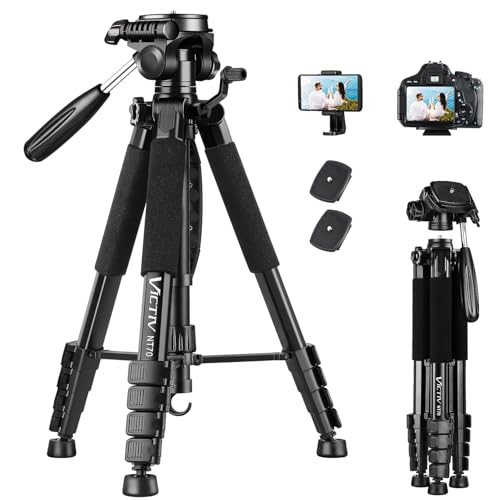
- Reaches 74 inches and folds to 20 inches
- Includes a 3-way pan head and phone holder
- Supports cameras, phones, scopes, and projectors
Best For: Vlogging, live streaming, and everyday shooting
Best Simple Everyday Tripod
Amazon Basics 60-inch DSLR Tripod

- Lightweight 2.7-pound aluminum construction
- 3-way head supports portrait and landscape shots
- Includes bubble levels, quick-release plate, and case
Best For: Casual photography and lighter camera setups
Best Heavy-Duty Video Tripod
NEEWER 79-inch Fluid-Head Tripod

- 17.6-pound load capacity with double-tube aluminum legs
- Fluid head pans 360 degrees and tilts from -70 to 90 degrees
- Reaches 78.7 inches and includes a dual-screw quick-release plate
Best For: Heavy cameras, camcorders, and smooth video movement
Best All-Around Pick

- Extends from 19 to 74 inches
- Supports cameras, phones, GoPros, and ring lights
- Lightweight 2.8-pound design with carry bag
Best For: Travelers, vloggers, and everyday creators
Best Heavy-Duty Option
SmallRig CT-10 Tripod and Monopod

- Supports up to 33 pounds vertically
- Converts into a monopod
- 360-degree ball head with accessory threads
Best For: Photographers using heavier camera and accessory setups
Best for Overhead Shots
K&F Concept 76-Inch Tripod

- Includes a removable rotating extension boom arm
- Reaches 76.7 inches and folds to 15.3 inches
- 360-degree ball head supports panoramic positioning
Best For: Overhead photography, panoramas, and flexible studio setups
Best Lightweight Pick

- Lightweight 1.23-pound aluminum build
- Adjusts from 16.1 to 50 inches
- Includes quick-release plate and carry bag
Best For: Travel photography and lighter camera setups
Best Versatile Tall Tripod

- Reaches 75 inches and folds to 14.17 inches
- Converts to a monopod or selfie stick
- Includes remote, phone holder, and accessory mount
Best For: Outdoor creators using cameras and phones
Best Travel Video Tripod
K&F CONCEPT 75-Inch Tripod

- Extends from 18.9 to 75 inches
- Supports cameras, phones, and tablets
- Includes pan head, remote, plates, and bag
Best For: Travel video, vlogging, and hybrid device setups
Best Lightweight Travel Tripod – K&F Concept 64-inch Aluminum Tripod
For photographers who want portable camera tripods without giving up height, the K&F Concept model extends to 64.1 inches while folding down to 15.5 inches. Its 360-degree ball head, quick flip locks, and included phone holder make it a flexible option for travel photography, vlogging, and landscape work.
Best For: Travelers, landscape photographers, and creators who need a lightweight tripod with a versatile ball head.
Pros:
- Lightweight 2.53-pound design folds compactly for transport.
- 360-degree ball head supports precise positioning and loads up to 17.6 pounds.
- Height adjusts from 20.4 to 64.1 inches, with an inverted center-column option for low-angle shots.
- Includes a phone holder, quick-release plate, Allen wrench, and carrying bag.
Cons:
- Aluminum construction is not as light as a comparable carbon-fiber tripod.
- It is not water resistant.
This is a strong all-around choice among portable camera tripods, especially when compact storage and flexible shooting angles matter more than video-specific controls.
Best Tall Budget Tripod – VICTIV 74-inch Camera and Phone Tripod
The VICTIV NT70 is a practical pick for shoppers seeking tall camera tripods that also work with phones and other compatible devices. It reaches 74 inches, includes a 3-way pan head and phone holder, and packs into its carrying bag for indoor or outdoor shooting.
Best For: Video bloggers, live streamers, and photographers who want one tripod for cameras and smartphones.
Pros:
- Adjusts from 19.5 to 74 inches for flexible shooting height.
- 3-way pan head supports horizontal panoramas, vertical portraits, and up/down tilting.
- Compatible with cameras, phones, projectors, spotting scopes, and other devices using a standard 1/4-inch mount.
- Includes a phone holder, extra quick-release plate, handle, non-slip pads, and carrying bag.
Cons:
- At about 3.14 pounds, it is heavier than the lightest travel models.
- Its maximum recommended load is 9.5 pounds, below some heavy-duty options.
- It is not water resistant.
With its tall maximum height and broad device compatibility, the VICTIV offers useful versatility for everyday content creation without requiring separate camera and phone tripods.
Best Simple Everyday Tripod – Amazon Basics 60-inch DSLR Tripod
The Amazon Basics WT3540 keeps camera tripods straightforward with adjustable aluminum legs, a 3-way head, and a quick-release mounting plate. It reaches 60 inches, weighs 2.7 pounds, and includes a carrying case, making it suited to basic photography setups and occasional transport.
Best For: Casual photographers who want an uncomplicated tripod for cameras, GoPro devices, scopes, or compatible smartphone adapters.
Pros:
- Lightweight 2.7-pound aluminum design includes a carrying case.
- Height adjusts from 23.2 to 60 inches.
- 3-way head supports tilt, swivel, portrait, and landscape positioning.
- Built-in bubble levels and a quick-release plate simplify setup and framing.
Cons:
- Recommended maximum load is 6.6 pounds, limiting heavier camera setups.
- Smartphone adapters are not included.
- It lacks the specialized fluid head or ball-head controls found on some alternatives.
This model is a sensible entry-level option among camera tripods when you prioritize basic adjustability, low weight, and a familiar 3-way head over advanced features.
Best Heavy-Duty Video Tripod – NEEWER 79-inch Fluid-Head Tripod
For demanding video work, the NEEWER TP-M200 is one of the more substantial camera tripods in this group. Its double-tube aluminum legs, 70mm bowl base, fluid drag head, and 17.6-pound load capacity are designed for stable camera and camcorder setups, while the flip locks allow height adjustment up to 78.7 inches.
Best For: Videographers and creators using heavier cameras or camcorders who need smooth panning and a tall, stable platform.
Pros:
- Heavy-duty aluminum double-tube design supports up to 17.6 pounds.
- Fluid head pans 360 degrees and tilts from -70 to 90 degrees for controlled video movement.
- Height adjusts from 34.6 to 78.7 inches, with a 70mm bowl base for leveling.
- Large quick-release plate includes 1/4-inch and 3/8-inch screws and the tripod comes with a carrying bag.
Cons:
- At approximately 5.58 kilograms, it is much heavier than travel-oriented tripods.
- Its 35.8-inch folded length is less convenient for compact transport.
- It is not water resistant.
The NEEWER is best viewed as a stability-first video support system rather than an everyday travel tripod, particularly for users who value fluid movement and high load capacity.
Best All-Around Pick – CAMBOFOTO 74-Inch Tripod
For shoppers comparing camera tripods, the CAMBOFOTO offers a useful blend of height, portability, and device flexibility. Its aluminum construction extends from 19 to 74 inches, while the included phone mount and quick-release plate make it practical for cameras, smartphones, GoPros, vlogs, and everyday content creation.
Best For: Travelers, vloggers, and photographers who want one lightweight tripod for cameras and phones.
Pros:
- Adjusts from tabletop-friendly heights to 74 inches for varied shooting positions.
- Supports up to 8.8 pounds and works with cameras, smartphones, GoPros, and ring lights.
- Weighs 2.8 pounds, folds to 20.5 inches, and includes a carry bag.
- Pan-and-tilt head supports 360-degree movement for panoramas and video.
Cons:
- It is not water resistant.
- Its 8.8-pound capacity may be limiting for heavier professional setups.
The CAMBOFOTO is a versatile choice when portability matters as much as reach. It is especially appealing for mixed camera-and-phone use, though demanding heavy-lens setups may require a more specialized tripod.
Best Heavy-Duty Option – SmallRig CT-10 Tripod and Monopod
Among camera tripods for demanding equipment, the SmallRig CT-10 stands out for its high stated load capacity and convertible design. It works as either a full tripod or monopod, adjusts from 16 to 71 inches, and uses a 360-degree ball head for flexible landscape, portrait, and low-angle shooting.
Best For: Photographers and content creators who need a sturdy, adaptable support system for cameras and accessories.
Pros:
- Supports up to 33 pounds vertically, with an 11-pound tilt rating.
- Converts from a tripod to a monopod for hiking and travel.
- 360-degree ball head and reversible center column support varied shooting angles.
- Three additional 1/4-inch threaded holes accommodate accessories such as magic arms and monitors.
Cons:
- At 3.4 pounds, it is heavier than some lightweight travel tripods.
- Telephoto lenses may need an additional tripod mount ring for better balance.
- Its folded length is about 16.9 inches, which may be less compact for some bags.
The CT-10 is a strong fit for users who value stability, accessory mounting, and tripod-to-monopod flexibility. Its extra capability makes it less focused on ultralight travel, but useful for more substantial camera kits.
Best for Overhead Shots – K&F Concept 76-Inch Tripod
For camera tripods designed around flexible positioning, the K&F Concept model adds a removable extension boom arm to its tall aluminum platform. The arm moves from 0 to 180 degrees and rotates horizontally, while the 360-degree ball head and four-section legs support panoramas, overhead compositions, and general photography.
Best For: Creators who need overhead, panoramic, or multi-angle positioning for cameras, phones, projectors, or telescopes.
Pros:
- Extension boom arm enables overhead and multi-angle shooting.
- Reaches 76.7 inches and folds to a compact 15.3 inches.
- 360-degree ball head and panning dial support precise positioning.
- Weighs 3.63 pounds and includes a tripod bag.
Cons:
- Its stated load capacity is 17.6 pounds, so very heavy setups may not be suitable.
- It is not water resistant.
- The boom arm adds functionality but may require extra setup compared with a basic tripod.
The K&F Concept is the most specialized option here, offering positioning flexibility that standard tripods may lack. It is a compelling choice for overhead work and panoramas while remaining portable enough for travel.
Best Lightweight Pick – Amazon Basics 50-Inch Tripod
If you want a simple, travel-friendly option among camera tripods, the Amazon Basics 50-inch model keeps setup straightforward. Its lightweight aluminum construction, quick-release plate, adjustable legs, and three-way head suit everyday photography with lighter equipment.
Best For: Travel photography, hiking, camping, and casual camera use with equipment weighing up to 4.4 pounds.
Pros:
- Lightweight 1.23-pound design folds into a compact 16.9-inch size.
- Adjusts from 16.1 to 50 inches with three-section lever-lock legs.
- Three-way head supports tilt, swivel, portrait, and landscape positioning.
- Includes a quick-release plate, bubble level, and zippered storage bag.
Cons:
- Not recommended for heavy, high-end DSLRs, long lenses, or large telescopes.
- Maximum equipment weight is limited to 4.4 pounds.
- It is not water resistant.
This is a practical budget-style tripod for portability and basic positioning rather than heavy-duty support. Choose it when low carry weight matters more than maximum stability or load capacity.
Best Versatile Tall Tripod – XXZU 75-Inch Camera Tripod
The XXZU stands out among camera tripods for its tall 75-inch height and flexible 3-in-1 design. It can function as a tripod, monopod, or selfie stick, while its adjustable legs and ball head make it useful for outdoor shooting on uneven terrain.
Best For: Content creators, hikers, vloggers, and photographers who need tall, flexible support for cameras, phones, projectors, webcams, or ring lights.
Pros:
- Extends to 75 inches and folds to 14.17 inches for transport.
- Detachable center column converts it to a monopod or selfie stick.
- Three leg-angle settings support low-angle shots and uneven ground.
- Includes a phone holder, remote control, accessory mount, and carrying bag.
Cons:
- Its 2.18-pound weight is heavier than the most minimalist travel tripods.
- The stated maximum load varies by shooting position, from 3 pounds at a 45-degree tilt to 17.64 pounds vertically.
- It is not water resistant.
With its height, remote operation, accessory mounting, and convertible center column, this is the most adaptable choice of the three. It is especially appealing when one stand needs to handle phones, cameras, and creator-focused setups.
Best Travel Video Tripod – K&F CONCEPT 75-Inch Tripod
For shoppers comparing camera tripods for travel, video, and mobile content, the K&F CONCEPT combines a 75-inch reach with a compact 20-inch folded size. Its 3-way pan head, phone-and-tablet holder, bubble level, and wireless remote support a broad range of shooting tasks.
Best For: Travel photographers, vloggers, livestreamers, and users who want one tripod for cameras, smartphones, and tablets.
Pros:
- Adjusts from 18.9 to 75 inches and weighs 2.6 pounds.
- Pentagonal tube design is built for portability and durability.
- 360-degree 3-way pan head supports panning, tilting, and vertical shooting.
- Includes phone/tablet clip, two quick-release plates, Bluetooth remote, and bag.
Cons:
- Its 2.6-pound weight is not the lightest option for minimalist travel.
- The five-section legs may require more adjustments than simpler three-section designs.
- It is not water resistant.
This model offers a strong balance of height, portability, and device compatibility. Its 8.8-pound weight limit and included mobile accessories make it a useful all-purpose choice, particularly for travel video and hybrid camera-phone workflows.
How We Picked These Camera Tripods
We focused on practical features that affect stability, setup speed, portability, and compatibility. The selection includes lightweight aluminum models for travel, taller tripods for standing-height composition, video-oriented designs, phone-compatible options, and models that convert to monopods or support overhead shooting.
We also considered stated maximum height, folded portability, included accessories, adjustment flexibility, and the needs of photographers, creators, travelers, and casual phone users. A higher maximum height is useful, but it can also increase weight and reduce compactness, so the best choice depends on how and where you shoot.
Quick Comparison
| Best For | Look For | Shortlist Options |
|---|---|---|
| Travel photography | Low weight, compact folded size, carry bag | K&F Concept travel models, Amazon Basics portable models |
| Phone and camera use | Phone holder, remote, adaptable mount | VICTIV, CAMBOFOTO, XXZU |
| Video and taller setups | Greater height, stronger legs, smooth head movement | NEEWER 79-inch, VICTIV 74-inch |
| Overhead compositions | Extended center column or overhead-capable design | K&F Concept 76-inch Overhead |
| Monopod flexibility | Convertible leg or center-column design | SmallRig CT-10, XXZU |
Key Buying Factors for Camera Tripods
Height and Stability
Choose a tripod that reaches a comfortable working height without requiring the center column to be fully extended. Taller columns are convenient, but they can make the setup more vulnerable to vibration. For heavier cameras or outdoor use, prioritize thicker leg sections and a stronger locking system.
Weight and Folded Size
Travelers should compare both the listed weight and the folded length. A tripod that is easy to carry is more likely to be used, while an ultra-light model may trade away rigidity. Aluminum is generally affordable and durable, though it can be heavier than carbon fiber.
Head, Plate, and Compatibility
Check whether the tripod uses a ball head, video-style head, or another adjustment system. Ball heads are versatile for photography; video heads can provide smoother pans and tilts. Confirm that the quick-release plate fits your camera setup and that included phone holders support your device.
Setup Details
Look for independently adjustable legs, secure locks, a useful center column, rubber feet, and a carry bag. A remote shutter accessory can be helpful for phone photography, while a monopod conversion adds flexibility for events, wildlife, or fast-moving shoots.
Who Should Buy Which Camera Tripods?
Choose a compact Amazon Basics or K&F Concept travel model if portability and value are your priorities. Pick VICTIV, CAMBOFOTO, or XXZU if you want one setup for a phone and camera. The NEEWER is better suited to users who need added height and a more video-focused format. SmallRig’s CT-10 is a strong fit for creators who value a ball head and monopod conversion, while the K&F Concept overhead model makes more sense for tabletop, product, or elevated-angle work.
Before buying, match the tripod’s load capacity and mounting system to your heaviest camera and lens combination. For occasional family photos, streaming, or phone content, convenience may matter most; for long exposures or professional video, prioritize rigidity and head control.