A fast wireless adapter can give a desktop or older PC the connection it needs for smoother streaming, online gaming, large downloads, and everyday networking. The best WiFi adapters with gigabit speeds combine modern wireless standards, dependable range, and a USB or PCIe design that fits your setup.
This roundup compares 10 options spanning WiFi 6, WiFi 6E, and WiFi 7, including USB adapters, Ethernet bridge devices, and internal PCIe cards. Use the guide below to match speed, compatibility, and features to your network.
Best 10 Wifi Adapters with Gigabit Speeds Picks for 2026
Best Wi-Fi 6E USB Adapter

- Tri-band Wi-Fi 6E with 6GHz support
- Up to 3000Mbps combined throughput
- Detachable 5dBi high-gain antennas
Best For: Streaming, gaming, and large file transfers
Best Wi-Fi-to-Ethernet Bridge
BrosTrend AX1500 Gigabit Adapter

- 1Gbps Gigabit Ethernet port
- Wi-Fi 6 bridge with 5GHz support
- Works with TVs, consoles, printers, and more
Best For: Giving wired devices wireless network access
Best Wi-Fi 7 PCIe Adapter

- Up to 5800Mbps wireless speed
- Supports tri-band Wi-Fi and 320MHz channels
- Adds Bluetooth 5.3 compatibility
Best For: High-speed desktop networking upgrades
Best Plug-and-Play Wi-Fi 6 Adapter

- Up to 1.8Gbps AX1800 dual-band speed
- USB 3.0 connection for Windows PCs
- Flippable high-gain external antenna
Best For: Windows desktops needing an easy Wi-Fi upgrade
Best WiFi 6E Upgrade
ALFA AWUS036AXM AXE3000 USB Adapter

- Tri-band WiFi 6E performance up to 3 Gbps
- Detachable high-gain antennas
- Windows and Linux support
Best For: WiFi 6E users seeking high throughput and antenna flexibility
Best for Whole-Home Coverage
TP-Link Archer TX30U Plus AX1800

- AX1800 dual-band speeds
- Two adjustable high-gain antennas
- WPA3 and easy driver setup
Best For: Windows users needing stronger dual-band reception
Fastest WiFi 7 Option
BrosTrend BE6500 Tri-Band USB Adapter

- Advertised tri-band speeds up to 6.5 Gbps
- WiFi 7 features and 6 GHz support
- Dual external antennas with beamforming
Best For: Windows users with WiFi 7 networks and demanding workloads
Best Windows 11/10 Upgrade
TP-Link Archer TX20U Plus AX1800

- AX1800 dual-band Wi-Fi 6 performance
- Adjustable antenna with 1-meter USB 3.0 cable
- Supports WPA3, MU-MIMO, and OFDMA
Best For: Windows users upgrading desktop or laptop Wi-Fi
Best Wi-Fi 6E Value
PLERY AX5400 Tri-Band USB Adapter
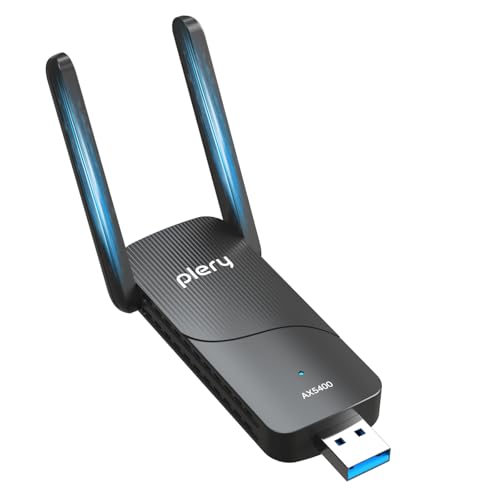
- AX5400 tri-band performance with 6GHz support
- Dual adjustable high-gain antennas
- USB 3.0 with WPA3 and pre-loaded drivers
Best For: Windows 11 systems paired with Wi-Fi 6E or Wi-Fi 7 routers
Best Wi-Fi 7 Performance

- BE6500 Wi-Fi 7 speeds up to 6,500 Mbps
- Supports 6GHz, MLO, 160MHz, and 4K-QAM
- Compatible with USB Type-A and Type-C
Best For: Windows users with Wi-Fi 7 networks seeking maximum USB adapter performance
Best Wi-Fi 6E USB Adapter – ALFA AWUS036AXML AXE3000
If you want wifi adapters with gigabit speeds for demanding wireless tasks, the ALFA Network AWUS036AXML combines Wi-Fi 6E with tri-band connectivity and a rated throughput of up to 3Gbps. Its detachable high-gain antennas make it a strong fit for desktops and laptops that need flexible placement and improved signal reach.
Best For: High-definition streaming, online gaming, large file transfers, and users who want access to the 6GHz band.
Pros:
- Tri-band Wi-Fi 6E support across 2.4GHz, 5GHz, and 6GHz.
- Rated combined throughput of up to 3000Mbps.
- Two detachable 5dBi high-gain antennas.
- Supports Windows and Linux systems, including Windows 10 and Ubuntu 20.04.
Cons:
- Its 6GHz benefits require compatible networking equipment.
- The larger external antennas may be less convenient than a compact dongle.
With USB 3.0 connectivity, a MediaTek MT7921AU chipset, and broad desktop and laptop compatibility, this is a performance-oriented choice for users who prioritize speed and signal flexibility.
Best Wi-Fi-to-Ethernet Bridge – BrosTrend AX1500 Gigabit Adapter
For wired devices that need wifi adapters with gigabit speeds, the BrosTrend AX1500 creates a Wi-Fi 6 bridge with a 1Gbps Gigabit Ethernet port. It can connect TVs, game consoles, printers, computers, and other Ethernet-equipped devices without requiring driver installation.
Best For: Adding wireless connectivity to smart TVs, game consoles, printers, network switches, and other wired devices.
Pros:
- Gigabit LAN port supports speeds up to 1Gbps.
- Connects to a 5GHz router band at up to 1201Mbps.
- Works with a broad range of wired devices.
- WPS pairing and included Ethernet cable simplify setup.
Cons:
- It is a wireless bridge rather than a direct USB Wi-Fi adapter.
- Actual performance depends on router placement, interference, and the wireless connection.
This adapter is practical when a device has Ethernet but lacks built-in Wi-Fi. Its Gigabit port helps preserve available bandwidth, while the included cable and WPS support keep installation straightforward.
Best Wi-Fi 7 PCIe Adapter – GIGABYTE GC-WIFI7
GIGABYTE WiFi 7 GC-WIFI7 (802.11/ Tri-Band WiFi/Bluetooth 5.3/ 4K-QAM/PCIe Expansion Card)
Check Price On AmazonDesktop builders seeking wifi adapters with gigabit speeds should consider the GIGABYTE GC-WIFI7, a PCIe expansion card rated for wireless speeds up to 5800Mbps. Wi-Fi 7 features such as 320MHz channel support, 4K-QAM, and Multi-Link Operation are designed for high-capacity wireless networking when paired with compatible equipment.
Best For: Desktop PCs needing a high-speed Wi-Fi 7 upgrade plus Bluetooth 5.3 compatibility.
Pros:
- Rated wireless speed of up to 5800Mbps.
- Supports 2.4GHz, 5GHz, and 6GHz bands with up to 320MHz bandwidth.
- Includes Wi-Fi 7 features such as 4K-QAM and MLO.
- Provides Bluetooth 5.3 compatibility.
Cons:
- Requires a desktop with an available PCIe x1 slot.
- Its advanced Wi-Fi 7 features require compatible routers and client devices.
With a PCIe interface and a three-year warranty, the GC-WIFI7 is aimed at desktop users who want substantial wireless headroom and modern Wi-Fi features rather than a simple plug-in USB solution.
Best Plug-and-Play Wi-Fi 6 Adapter – NETGEAR Nighthawk A7500
The NETGEAR Nighthawk A7500 is a convenient option for Windows users comparing wifi adapters with gigabit speeds. This USB 3.0 adapter delivers dual-band Wi-Fi 6 performance rated up to 1.8Gbps, with a flippable external antenna intended to help improve range and connection reliability.
Best For: Windows 10 and 11 desktop users upgrading an older PC for streaming, video calls, gaming, and everyday connectivity.
Pros:
- Wi-Fi 6 dual-band performance up to 1.8Gbps.
- USB 3.0 connection supports faster data transfer than USB 2.0.
- Flippable high-gain external antenna helps optimize signal position.
- Supports WPA3 and works with routers, mesh systems, and ISP equipment.
Cons:
- Compatibility is limited to Windows 10 and 11 systems according to the supplied specifications.
- It is a dual-band adapter without 6GHz support.
Easy setup, backward compatibility with Wi-Fi 5, and automatic dual-band connectivity make the A7500 a balanced upgrade for a busy home network, especially when a desktop needs a stronger USB-based connection.
Best WiFi 6E Upgrade – ALFA AWUS036AXM AXE3000 USB Adapter
The ALFA AWUS036AXM is a strong choice for anyone seeking wifi adapters with gigabit speeds and next-generation wireless support. Its tri-band WiFi 6E design can reach up to 3 Gbps, while the 6 GHz band helps reduce congestion when paired with a compatible router.
Best For: Windows 11 or Linux users with a WiFi 6E router who want high throughput and flexible antenna options.
Pros:
- AXE3000 tri-band performance with advertised speeds up to 3 Gbps.
- Supports the 6 GHz band, WPA3 security, and USB 3.0.
- Includes two detachable 5 dBi antennas and an L connector for flexible placement.
- Works with Windows 10, Windows 11, and newer Linux kernels.
Cons:
- Windows 11 is required for 6 GHz access; Windows 10 supports only 2.4 GHz and 5 GHz.
- No support for macOS versions beyond 10.15 or Apple M1/M2 chipsets.
- Requires a compatible WiFi 6E router and strong internet service to approach its rated speed.
With broad operating-system support and upgradeable antennas, this adapter is a capable high-speed receiver for desktops and laptops. Its main limitation is the need for newer hardware and Windows 11 to use the 6 GHz band.
Best for Whole-Home Coverage – TP-Link Archer TX30U Plus AX1800
The TP-Link Archer TX30U Plus is a practical pick among wifi adapters with gigabit speeds, offering dual-band AX1800 connectivity through USB 3.0. Its two high-gain antennas and beamforming are designed to improve reception across rooms, while the 5 GHz band reaches up to 1,201 Mbps.
Best For: Windows 10 and 11 desktop or laptop users who need stronger dual-band coverage for streaming, gaming, or video calls.
Pros:
- Dual-band speeds up to 1,201 Mbps on 5 GHz and 574 Mbps on 2.4 GHz.
- Two adjustable high-gain antennas and beamforming support stronger reception.
- USB 3.0 connection, WPA3 security, MU-MIMO, and OFDMA support.
- Preloaded internal driver simplifies installation.
Cons:
- Supports Windows 10 and Windows 11 only.
- Does not provide 6 GHz connectivity.
- Actual performance varies with distance, walls, interference, and network conditions.
This adapter balances speed, coverage, and straightforward setup without requiring a WiFi 6E or WiFi 7 router. It is especially sensible for users who want reliable dual-band performance rather than the newest frequency band.
Fastest WiFi 7 Option – BrosTrend BE6500 Tri-Band USB Adapter
The BrosTrend BE6500 targets demanding users comparing wifi adapters with gigabit speeds. Its tri-band WiFi 7 design advertises up to 6.5 Gbps across 6 GHz, 5 GHz, and 2.4 GHz, with features such as 4K-QAM, 160 MHz channels, and beamforming for compatible networks.
Best For: Windows 10 and 11 PC users with a high-end WiFi 7 router who want strong performance for gaming, multitasking, or 4K/8K streaming.
Pros:
- Tri-band advertised speeds up to 6.5 Gbps.
- Supports WiFi 7 features including 4K-QAM, 160 MHz channels, Multi-RU, and Preamble Puncturing.
- Dual external antennas and beamforming help target the router for steadier reception.
- Preloaded driver enables setup without a CD or download.
Cons:
- Windows 11 is required for 6 GHz; Windows 10 is limited to 5 GHz and 2.4 GHz.
- Not compatible with macOS, Linux, or Bluetooth connections.
- MLO is not currently supported.
This is the most performance-focused option in the group, but its benefits depend on a compatible WiFi 7 network and Windows system. For users with older routers or non-Windows computers, a less advanced adapter may be more practical.
Best Windows 11/10 Upgrade – TP-Link Archer TX20U Plus AX1800
The TP-Link Archer TX20U Plus is a practical choice if you need wifi adapters with gigabit speeds for a Windows desktop or laptop. Its Wi-Fi 6 AX1800 design combines 2.4GHz and 5GHz connectivity, while the adjustable high-gain antenna and 1-meter USB 3.0 cable make placement easier for improved reception.
Best For: Windows 10 or 11 users who want a flexible Wi-Fi 6 upgrade for streaming, downloads, gaming, and everyday networking.
Pros:
- AX1800 dual-band speeds reach up to 1,201 Mbps on 5GHz and 574 Mbps on 2.4GHz.
- Adjustable antenna and 1-meter cable support more flexible positioning.
- Supports WPA3, MU-MIMO, and OFDMA for security and network efficiency.
- Designed for Windows 10 and 11 desktops and laptops.
Cons:
- Not compatible with Linux or Mac.
- Actual performance depends on the connecting router and network conditions.
This adapter is a balanced upgrade for compatible Windows systems, especially when you want better range and Wi-Fi 6 features without installing an internal card. Pair it with a Wi-Fi 6-or-newer router to make the most of its rated performance.
Best Wi-Fi 6E Value – PLERY AX5400 Tri-Band USB Adapter
The PLERY AX5400 is aimed at users seeking wifi adapters with gigabit speeds and access to the newer 6GHz band. It offers tri-band Wi-Fi 6E connectivity, dual high-gain antennas, and USB 3.0, making it a strong fit for demanding gaming, streaming, and high-device-count networks.
Best For: Windows 11 users with a Wi-Fi 6E or Wi-Fi 7 router who want low-congestion 6GHz connectivity and high rated throughput.
Pros:
- Tri-band AX5400 speeds are rated up to 2,402 Mbps on both 6GHz and 5GHz, plus 574 Mbps on 2.4GHz.
- Dual adjustable high-gain antennas help support longer-range coverage.
- USB 3.0, OFDMA, and MU-MIMO are designed to reduce bottlenecks and latency.
- Supports WPA3 and includes pre-loaded drivers for easier setup.
Cons:
- 6GHz access requires Windows 11 and a Wi-Fi 6E or Wi-Fi 7 router.
- Windows 10 is limited to 5GHz and 2.4GHz connections.
The PLERY adapter offers the most useful upgrade potential when your router and operating system support Wi-Fi 6E. Its headline speeds are impressive, but the 6GHz benefits depend on compatible equipment and a suitable wireless environment.
Best Wi-Fi 7 Performance – ASUS ROG USB-BE92 BE6500
The ASUS ROG USB-BE92 targets users who want wifi adapters with gigabit speeds and the latest Wi-Fi 7 features in a USB design. Its BE6500 tri-band rating, 6GHz support, Multi-Link Operation, and dual Type-A/Type-C compatibility make it a forward-looking option for compatible Windows systems.
Best For: Windows users with modern Wi-Fi 7 networks who want high wireless throughput, 6GHz access, and flexible USB connectivity.
Pros:
- Wi-Fi 7 BE6500 speeds are rated up to 6,500 Mbps across three bands.
- Supports 6GHz, 160MHz channels, Multi-Link Operation, and 4K-QAM.
- Works with both USB Type-A and Type-C connections.
- Includes WPA3, OFDMA, MU-MIMO, and BSS Coloring features.
Cons:
- Compatible with Microsoft Windows only.
- Its advanced Wi-Fi 7 features require a suitable network to deliver their intended benefits.
The ROG USB-BE92 is the strongest performance-focused pick in this group, particularly for users building around Wi-Fi 7. It also remains practical for broader USB compatibility, but its premium capabilities make the most sense alongside a modern Wi-Fi 7 router.
How We Picked the Best Wifi Adapters with Gigabit Speeds
We selected adapters that target high-throughput wireless networking and cover the most common PC upgrade paths. The lineup includes USB models for simple installation, PCIe cards for desktops that need stronger antennas and sustained performance, and a WiFi-to-Ethernet adapter for devices that need a gigabit wired port.
We considered advertised wireless capacity, WiFi generation, band support, antenna design, operating-system compatibility, security features, and practical installation requirements. Advertised speeds are theoretical maximums; actual results depend on your router, channel conditions, distance, client hardware, and internet plan.
Quick Comparison
| Type | Best For | Main Advantage | Watch For |
|---|---|---|---|
| WiFi 6 USB | Most everyday PCs | Affordable, broad compatibility | Usually dual-band |
| WiFi 6E USB | Newer 6 GHz routers | Less congestion and high capacity | Requires 6 GHz support |
| WiFi 7 USB | High-performance systems | Newest features and higher potential throughput | Driver and router compatibility |
| PCIe WiFi card | Gaming desktops | Strong antennas and consistent placement | Open PCIe slot required |
| WiFi-to-Ethernet bridge | Ethernet-only devices | Adds wireless connectivity without a PC card | Placement and bridge setup |
Key Buying Factors for Wifi Adapters with Gigabit Speeds
Wireless Standard and Bands
WiFi 6 is a strong choice for most networks, while WiFi 6E adds the 6 GHz band for compatible routers and clients. WiFi 7 can offer improved capacity and features such as Multi-Link Operation, but its benefits are greatest when paired with a WiFi 7 router. Dual-band adapters remain practical for older or mixed networks.
Connection Type and Compatibility
USB adapters are easiest to install, but check whether the model requires USB 3.0 and whether its drivers support your operating system. PCIe cards require an available slot and may use internal headers for Bluetooth. A bridge adapter is better when you need to connect a console, smart TV, printer, or other Ethernet-only device.
Antennas, Range, and Real-World Speed
External or adjustable antennas can improve positioning and reception, especially on desktop computers located under a desk. Look for WPA3 support, beamforming, and efficient drivers. For internet service below 1 Gbps, a high-rated adapter may improve reliability more than it improves raw download speed.
Who Should Buy Which Wifi Adapters with Gigabit Speeds?
- Choose a WiFi 6 USB adapter for an affordable upgrade to a standard desktop or laptop.
- Choose WiFi 6E if your router supports 6 GHz and you want a cleaner, less congested wireless connection.
- Choose WiFi 7 for a newer high-end network, demanding transfers, gaming, or future-ready hardware.
- Choose a PCIe card for a permanent desktop installation with larger antennas and potentially better placement.
- Choose a WiFi-to-Ethernet adapter when the device has Ethernet but no suitable wireless hardware.
Before buying, confirm router compatibility, operating-system support, available ports or slots, and the adapter’s physical clearance. For the most stable gigabit-class performance, position antennas away from metal obstructions and use the fastest supported USB port or PCIe slot.