Managing a TV, stereo, or streaming box can be frustrating when the equipment sits inside a cabinet or across the room. The right infrared repeater extends remote-control signals without requiring seniors to reach behind furniture or aim precisely at each device.
We compare 10 infrared repeater systems by setup, range, device support, and ease of use, helping you choose a practical option for a simpler home entertainment setup.
Best 10 Infrared Repeaters for Seniors Picks for 2026
Best Overall Coverage

- Controls up to 10 devices, expandable to 12
- Includes five 10-foot dual IR emitters
- Real-time transmission with status indicators
Best For: Multiple A/V components stored behind cabinet doors
Best for Custom Installations

- Supports two IR sensors or keypads
- Offers two high-current IR flasher outputs
- Works with most A/V brands within its frequency limits
Best For: Wired, professionally configured home-theater systems
Best Wireless Range

- 433MHz wireless range rated up to 500 feet
- Captures IR commands within a 45-degree angle
- Includes channel switches and adhesive mounting supplies
Best For: Long-distance control of standard IR equipment
Best for Multi-Zone Control

- Controls four IR devices in this model
- Supports additional transmitters and receivers
- Uses 433MHz communication with 180-degree reception
Best For: Large homes requiring control across rooms or floors
Best Long-Range Concealed Control

- Works through doors and walls
- Four IR emitter outputs
- Up to 100-foot stated range
Best For: Concealed multi-component home theaters
Best Wireless Multi-Room Option
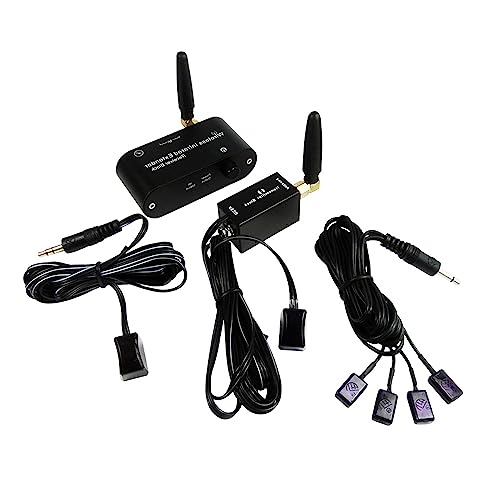
- 433 MHz wireless transmission
- Quad-eye support for four devices
- Includes hosts, cables, and adapters
Best For: Multi-room infrared A/V control
Best Expandable Frequency-Matched System
Four-Device Wireless IR Extender

- Eight selectable frequency bands
- Expandable with additional hosts
- Up to 200-meter stated wireless range
Best For: Large or expandable cross-room setups
Long-Range Choice

- Over 50 m indoor and over 200 m outdoor range
- 130° reception angle with external antenna
- Expandable multi-zone system with complete kit
Best For: Multi-room A/V systems and long-distance control
Easy-Setup Pick
Mini 180° Wireless IR Repeater

- Compact design needs no separate transmitter-receiver connection
- 180° wide-angle reception
- Over 50 m indoor and over 200 m outdoor transmission
Best For: Clutter-free multi-room household control
Simple Same-Floor Option

- Plug-and-play operation with no software
- Built-in transmitter and receiver
- Compact design for discreet same-floor placement
Best For: Straightforward same-floor infrared control
Best Overall Coverage – Multi-Device IR Repeater Kit
For shoppers comparing infrared repeaters for seniors, this ICESPRING kit is a practical choice when several A/V components are stored behind cabinet doors. It supports up to 10 devices, can expand to 12, and uses the existing IR remote controls for compatible equipment.
Best For: Homes with multiple hidden components, such as cable boxes, receivers, DVD players, and Blu-ray players.
Pros:
- Controls up to 10 devices and can expand to 12.
- Includes five 10-foot dual IR emitters for flexible component placement.
- Provides real-time transmission with receiver status lights and CFL-friendly operation.
Cons:
- Plasma displays may cause interference and require receiver placement away from the screen.
- Multiple receivers should be spaced at least 6 meters apart to avoid interference.
- The system requires wired emitter connections and setup.
Its generous device capacity and included accessories make it a strong all-around option, though careful placement may be needed in rooms with plasma displays or multiple receivers.
Best for Custom Installations – Niles IRP2+ IR Repeater
For infrared repeaters for seniors that are part of a professionally installed A/V system, the Niles IRP2+ emphasizes broad compatibility and installation flexibility. It works with virtually all A/V brands and remote controls except equipment using carrier frequencies above 64kHz.
Best For: Custom home-theater installations using Niles components, wired sensors, or keypads.
Pros:
- Compatible with virtually all A/V equipment and remote controls within its frequency limits.
- Accommodates two IR sensors or keypads.
- Provides two low-distortion, high-current IR flasher outputs, including one variable-power output.
Cons:
- Not compatible with brands using carrier frequencies higher than 64kHz.
- Screw connectors and wired sensors may be less convenient than a simple plug-and-play kit.
- The notes do not specify a wireless transmission range.
The IRP2+ is best viewed as an installation-oriented component rather than a basic standalone extender. Its dual sensor support and flasher outputs suit structured A/V setups, particularly those already using Niles products.
Best Wireless Range – 500-Foot IRBlast Repeater
This OrangeLight kit is a useful option for infrared repeaters for seniors when the equipment is far from the viewing area or located behind a cabinet. Its 433MHz wireless link is rated for up to 500 feet, while the receiver captures IR commands within a 45-degree angle.
Best For: Homes needing wireless control between rooms or across a long distance for standard IR-controlled equipment.
Pros:
- Provides a stated wireless range of up to 500 feet, with longer open-air range noted.
- Works with standard IR devices such as cable boxes, Blu-ray players, DVD players, and home audio receivers.
- Includes adjustable channel switches, adhesive mounting supplies, extension cables, and dual power adapters.
Cons:
- Works only with IR remotes, not RF remotes.
- Not compatible with Bluetooth, Wi-Fi smart TVs, or app-controlled streaming boxes.
- The receiver has a 45-degree capture angle.
Its wireless design can reduce line-of-sight and cabling concerns, but compatibility should be checked carefully before purchase, especially in homes centered on Bluetooth or Wi-Fi streaming devices.
Best for Multi-Zone Control – SPENFiLY Wireless IR Blaster
For infrared repeaters for seniors used across rooms or floors, the SPENFiLY WL-T1-E4 is designed for multi-zone control of up to four IR devices. It uses 433MHz communication, an external antenna, and a wide 180-degree reception angle.
Best For: Large homes or multi-floor spaces where compatible infrared appliances need control from different areas.
Pros:
- Supports control of four IR devices in this model.
- Offers multi-zone expansion with additional transmitters or receivers.
- Uses 433MHz transmission with a 180-degree signal reception angle.
Cons:
- The IR transmitter range is listed as less than 1 meter.
- Its extensive multi-zone features may be more than needed for a single-room setup.
- The supplied warranty is six months.
This model is appealing when coverage across rooms, floors, or separate areas matters most. Its short IR transmitter range means the transmitting unit still needs to be positioned close to the target appliance.
Best Long-Range Concealed Control – Hidden IR Repeater Kit
For seniors who want simpler entertainment control, this infrared repeater for seniors keeps compatible A/V equipment usable even when it is tucked behind cabinet doors or inside a closet. Its receiver and four emitter outputs are designed for broad home-theater compatibility, with a confirmation LED to show that a command was received.
Best For: Home theaters where several A/V components need to remain hidden but accessible by remote.
Pros:
- Controls equipment behind solid doors or walls without direct line of sight.
- Supports up to 32 A/V components, according to the product notes.
- Offers one IR receiver input and four IR emitter outputs.
- Supports a stated range of up to 100 feet and includes a confirmation LED.
Cons:
- Designed for infrared-controlled A/V equipment, not general wireless devices.
- The notes list a maximum of six supported devices in the specifications, while the feature description cites up to 32 components.
This is a practical choice when cabinet doors, walls, or bulky equipment make ordinary remote use inconvenient. The LED feedback and concealed-installation design may be especially helpful for users who prefer clear confirmation that a command was sent.
Best Wireless Multi-Room Option – WL-E4 Quad-Eye IR Extender
This wireless infrared repeater for seniors is built for through-wall and multi-room A/V control without running a signal cable between locations. The WL-E4 uses 433 MHz transmission, a wide 130-degree reception angle, and a quad-eye emitter setup for flexible control of compatible infrared devices.
Best For: Multi-room or multi-floor setups that need wireless control of several infrared appliances.
Pros:
- Supports true through-wall remote control for compatible infrared devices.
- Quad-eye IR emitter design helps support four infrared devices.
- Provides a stated indoor range over 50 meters and outdoor range over 200 meters.
- Includes the receiving host, transmitting host, cables, power adapters, and manual.
Cons:
- Only infrared-compatible devices are supported.
- Wireless setup may require pairing or expansion planning across multiple zones.
Choose this model when wireless reach and multi-room flexibility matter more than a simple cabinet-only installation. Its included accessories and wide reception angle can make it a convenient starting point for a more distributed A/V setup.
Best Expandable Frequency-Matched System – Four-Device Wireless IR Extender
This wireless infrared repeater for seniors is intended for cross-room control of amplifiers, A/V equipment, and air conditioners. It offers a stated wireless range of up to 200 meters, eight selectable frequency bands, and the ability to add compatible hosts for broader coverage.
Best For: Users who need expandable wireless control across rooms and want frequency-band flexibility.
Pros:
- Supports wall-penetrating, cross-room infrared control.
- Offers eight independent frequency bands for matching transmitter and receiver hosts.
- Can be expanded by adding compatible transmitter or receiver hosts.
- Provides a stated wireless range of up to 200 meters and infrared reception of at least 7 meters.
Cons:
- Transmitter and receiver must use the same frequency band or the signal will fail.
- Emitter cables must be placed directly on the controlled device’s receiver window.
- Outdoor sunlight, rain, and high temperatures should be avoided.
This model suits a more deliberate installation where distance and expansion are priorities. Its frequency controls add flexibility, but matching the bands and positioning the emitter correctly are important for reliable operation.
Long-Range Choice – Dual-Eye Wireless IR Repeater
SPENFiLY Remote Control Wireless Repeater-Dual Eye IR Emitter Remote Repeater System Kit WL-E2
Check Price On AmazonFor seniors who need infrared repeaters for seniors that can reach equipment in another room or on another floor, this SPENFiLY system emphasizes long-range wireless performance and flexible expansion. Its external antenna and included components make it suited to more involved home theater or multi-room setups.
Best For: Multi-room A/V systems, home theaters, and users who need extended wireless range.
Pros:
- Supports over 50 meters indoors and over 200 meters outdoors, according to the supplied specifications.
- External antenna provides a 130° signal reception angle and anti-interference capability.
- Supports expansion with additional transmitters or receivers for multi-zone control.
- Includes receiving and transmitting hosts, transmitter, receiver, USB cables, power adapters, and manual.
Cons:
- The more extensive kit may be more involved to install than a compact repeater.
- Its stated range and multi-zone features may be unnecessary for a single-room setup.
This is the strongest fit for shoppers prioritizing reach and expandability, though seniors may prefer assistance with setup if they only need basic, nearby control.
Easy-Setup Pick – Mini 180° Wireless IR Repeater
This compact SPENFiLY model is a practical option for seniors comparing infrared repeaters for seniors because its wire-free design avoids a separate transmitter-and-receiver installation. The 180° reception angle and real-time forwarding are designed to simplify control across rooms while keeping the setup discreet.
Best For: Users who want a compact, clutter-free repeater for multi-room or multi-device control.
Pros:
- Ultra-compact wireless design does not require connecting a separate transmitter and receiver.
- 180° wide-angle reception supports flexible placement.
- Supports over 50 meters indoors and over 200 meters outdoors, according to the supplied notes.
- Can be expanded with additional receiving or transmitting hosts.
Cons:
- It is compatible with infrared-equipped devices only.
- Although the design simplifies installation, users may still need help positioning and powering the units.
Choose this model when simple, low-clutter installation matters most. Its compact format and wide reception angle make it particularly appealing for everyday household use.
Simple Same-Floor Option – Hidden Wireless IR Extender
For seniors seeking infrared repeaters for seniors without software or complicated wiring, this compact SZBJ extender offers plug-and-play hardware operation. It relays signals in real time and is intended for infrared devices in same-floor living spaces, provided the directional receiver and transmitter are positioned correctly.
Best For: Same-floor setups where compact placement and straightforward hardware operation are priorities.
Pros:
- Plug-and-play hardware design requires no software installation.
- Built-in receiver and transmitter simplify installation.
- Real-time relay is described as having zero latency and strong anti-interference performance.
- Compact form allows discreet placement and avoids wiring between rooms.
Cons:
- The receiver is directional and must face the remote-control area.
- The transmitter should be placed a few inches from the controlled device for optimal performance.
- It is intended for infrared devices and same-floor use, with placement restrictions around direct sunlight, rain, and high temperatures.
This is a sensible budget-style choice for a nearby, same-floor installation, but careful positioning is more important here than with a wide-angle design.
How We Picked the Best Infrared Repeaters for Seniors
We focused on features that affect everyday usability rather than treating maximum range as the only measure of quality. The products in this roundup include wired and wireless systems, single- and multi-device designs, and models intended for concealed equipment. We considered receiver placement, emitter configuration, compatibility with common infrared remotes, installation complexity, and the clarity of each system’s control layout.
For seniors, dependable operation and a straightforward setup are especially important. A system that works reliably from a comfortable chair can be more useful than one with advanced features that are difficult to install or troubleshoot.
Quick Comparison
| Feature | What to look for | Why it matters |
|---|---|---|
| Connection type | Wireless or wired transmitter and receiver | Wireless designs reduce cable routing; wired kits can be predictable in fixed installations. |
| Device capacity | One emitter, dual-eye, quad-eye, or multi-device support | More emitters help control several components inside a cabinet. |
| Range | Room-scale or extended wireless range | Choose enough range for the home rather than paying for unnecessary distance. |
| Receiver angle | Wide-angle or centrally placed receiver | A forgiving receiving angle makes aiming the remote easier. |
Key Buying Factors for Infrared Repeaters for Seniors
Ease of Setup
Look for clearly labeled transmitter and receiver units, simple power requirements, and adhesive-backed emitters if the system will be mounted inside a cabinet. Wireless kits may be preferable when running a cable between rooms or around furniture would be difficult.
Number of Controlled Devices
Count the infrared components that need to receive commands. A television, cable box, soundbar, and streaming player may require multiple emitter heads. Single-device systems can be sufficient for a basic setup, while dual- or quad-eye models provide more flexibility.
Remote and Equipment Compatibility
Most repeaters are designed for standard infrared remotes, but they do not normally extend Bluetooth, radio-frequency, or Wi-Fi commands. Confirm that the remote and home entertainment devices use infrared before buying. Also check whether the emitters must be positioned directly over each device’s infrared sensor.
Placement and Visibility
A wide-angle receiver is useful when the user does not want to aim carefully. For concealed components, verify that the receiver can sit in an open location while the emitter heads reach the equipment inside the cabinet.
Who Should Buy Which Infrared Repeaters for Seniors?
Choose a basic infrared repeater kit for a single television or one concealed component. A dual-eye model suits a modest entertainment center with two devices, while a quad-eye or multi-device system is better for several components controlled from one chair. Select a wireless model when avoiding cable runs is the priority, especially in a finished room or a space where installation should remain uncomplicated.
If the user has difficulty aiming a remote, prioritize a centrally positioned receiver with a broad receiving angle. If reliability matters more than convenience during installation, a wired system may be the better choice. Before ordering, count the devices, measure the distance between the preferred receiver location and the equipment, and confirm that the system supports standard infrared signals.