A dependable wireless video receiver can simplify monitoring, livestreaming, and multi-camera production in a home studio. The right system delivers a stable picture without forcing you to run long video cables across the room.
This roundup compares 10 strong options across HDMI and SDI connectivity, 1080p and 4K support, transmission range, latency, multi-receiver capability, and streaming workflows.
Best 10 Wireless Video Receivers for Home Studios Picks for 2026
Best Multi-Receiver Pro Pick

- 4K30 HDMI and SDI support
- Up to four receivers with compatible transmitter
- UVC and RTMP streaming features
Best For: Multi-person monitoring and advanced home-studio workflows
Best Complete 4K Set

- Transmitter and receiver included
- UHD 4K30 transmission up to 985 feet
- HDMI and SDI connectivity
Best For: Studios wanting a matched wireless monitoring kit
Best for Live Streaming

- 1080p60 with under 0.06-second latency
- UVC output for computer streaming
- Up to four receivers or mobile devices
Best For: OBS, YouTube, and multi-device 1080p monitoring
Best Long-Range HDMI Value

- 4K30 and 1080p60 support
- Up to three receivers per transmitter
- HDMI loop-out and IR control
Best For: HDMI-only studios and multi-room display setups
Professional 4K Flexibility

- 4Kp30 HDMI transmission with HD/Full HD support
- HDMI and 3G-SDI inputs and outputs
- 450-foot stated range and up to four app monitors
Best For: Home studios combining HDMI and SDI equipment
All-in-One Monitoring Powerhouse

- Combines 7-inch monitor, transmitter, and receiver
- Supports 4K60 HDMI and up to four monitoring devices
- Adds LUTs, scopes, recording, and camera control
Best For: Creators needing advanced monitoring and wireless transmission
Long-Range Multi-Viewer Setup
Wireless HDMI 7-inch Monitor Kit
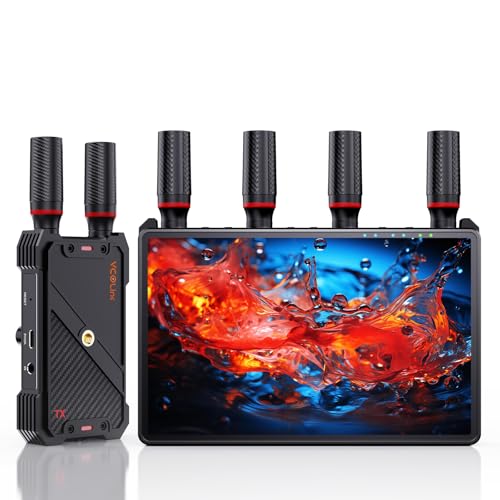
- Built-in 7-inch receiver monitor with HDMI output
- 1080p60 transmission with stated 1312-foot LOS range
- Supports one transmitter with up to five receivers
Best For: Multi-viewer Full HD studio and live-production setups
Premium 4K Production Pick

- 4K60 HDMI and 1080p HDMI/SDI support
- Tri-band wireless transmission
- Monitoring for up to four devices
Best For: 4K filmmakers and multi-monitor studio teams
Streaming-Friendly Choice
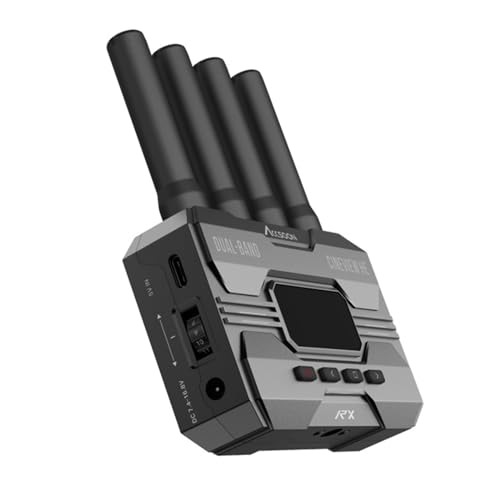
- 1080p60 wireless video
- USB-C UVC output for computer streaming
- Dual-band 2.4GHz and 5GHz connection
Best For: OBS, YouTube, and computer-based livestreaming
SDI/HDMI Monitoring Pick

- 1080p60 HDMI and SDI support
- Dual-band wireless transmission
- Compact body with OLED display
Best For: 1080p studios using mixed HDMI and SDI equipment
Best Multi-Receiver Pro Pick – Hollyland Pyro S RX
For home studios that need flexible monitoring and streaming, the Hollyland Pyro S RX is a feature-rich option among wireless video receivers for home studios. It supports HDMI and SDI output, 4K30 video over HDMI, dual-band hopping, and monitoring for up to four receivers when paired with a compatible transmitter.
Best For: Multi-person monitoring, live streaming, and studios using both HDMI and SDI equipment.
Pros:
- Supports 4K30 HDMI video and multiple SDI frame rates.
- Auto Dual-Band Hopping helps manage interference across 2.4GHz and 5GHz.
- Offers UVC plug-and-play streaming plus RTMP capability.
- Includes app monitoring tools such as waveform, vectorscope, and zebra patterns.
Cons:
- This listing is for the receiver only, so a compatible transmitter is required.
- Its broad professional feature set may be more than a simple home setup needs.
The Pyro S RX stands out when a studio prioritizes connectivity, monitoring tools, and expansion. Its HDMI/SDI support and streaming features make it a versatile choice for more advanced workflows.
Best Complete 4K Set – Atomos TX/RX Wireless System
The Atomos TX 4K/HD Wireless Video Transmitter & Receiver Set is a practical starting point for wireless video receivers for home studios because it includes both transmission and receiving hardware. It supports UHD 4K30 video, HDMI and SDI inputs, and transmission to smartphones as well as multiple receivers.
Best For: Home studios needing a matched transmitter-and-receiver kit for monitoring, gimbal work, or handheld production.
Pros:
- Complete set includes one transmitter and one receiver.
- Supports UHD 4K30 transmission over distances up to 985 feet.
- Provides HDMI and SDI connectivity, with HDMI loop-out on the transmitter.
- Can transmit to up to four receivers and Android or iOS smartphones.
Cons:
- Uses the 5GHz band rather than automatic dual-band hopping.
- The listed weight is about 950 grams for the system.
With its matched hardware and flexible outputs, the Atomos set is easier to deploy than a receiver-only purchase. It is especially appealing when a studio wants 4K monitoring without assembling a system from separate components.
Best for Live Streaming – Accsoon CineView HE
The Accsoon CineView HE combines dual-band wireless transmission with a receiver-side UVC output, making it a strong candidate among wireless video receivers for home studios focused on streaming. It supports 1080p60 video, up to four monitoring devices, and direct computer connection for platforms such as OBS and YouTube.
Best For: Live streaming, 1080p monitoring, and small production teams that need phone or computer viewing.
Pros:
- Dual-band 2.4GHz and 5GHz transmission is designed for stable, interference-resistant operation.
- Receiver UVC output can connect to a computer without a separate capture device.
- Supports up to 1,200 feet of range with latency under 0.06 seconds.
- One transmitter can serve up to four receivers or mobile devices.
Cons:
- Maximum listed video resolution is 1080p60 rather than 4K.
- Battery and charging cables are not included.
- The transmitter uses HDMI input and loop-out, so SDI workflows are not supported by the supplied notes.
The CineView HE is particularly convenient for creators who want to move a camera feed directly into a computer-based stream. Its lower resolution is a reasonable trade-off for UVC convenience, low latency, and broad device monitoring.
Best Long-Range HDMI Value – Graige 952 Wireless HDMI
The Graige 952 is a consumer-oriented option for wireless video receivers for home studios, with HDMI connectivity, 4K30 support, and a claimed 1,000-foot range. Its selectable Wi-Fi bands, HDMI loop-out, and multi-receiver support also suit studios that need to send one source to several displays.
Best For: HDMI-only home studios, presentations, home theaters, and multi-room display setups.
Pros:
- Supports 4K30 and 1080p60 transmission.
- One transmitter can connect to up to three receivers.
- Offers HDMI loop-out for simultaneous viewing on two displays.
- Includes IR control hardware and selectable Wi-Fi bands.
Cons:
- Supports progressive scan formats only and does not support 1080i or 720i.
- It is HDMI-focused and does not provide the HDMI/SDI flexibility of the professional systems above.
- The listed 1,000-foot range is a maximum claim that can depend on the environment.
For an HDMI-based studio, the Graige 952 offers useful distribution features at the system level, including loop-out and support for multiple receivers. It is less suitable for SDI production workflows or users who need advanced camera-monitoring tools.
Professional 4K Flexibility – Hollyland Mars 4K
For home studios that need professional connectivity, the Hollyland Mars 4K is a versatile choice among wireless video receivers for home studios. It supports 4K HDMI transmission plus HD and Full HD HDMI/SDI workflows, making it suitable for cameras, monitors, and production equipment.
Best For: Home studios using both HDMI and SDI equipment, especially when 4K capture and multiple monitoring options matter.
Pros:
- Supports HDMI video transmission up to 4Kp30.
- Includes HDMI and 3G-SDI connectivity with support for 23.98, 29.97, and 59.94 fps SDI output.
- Offers a stated 450-foot line-of-sight range, 66ms latency, and up to four app-monitoring options.
- Provides a color LCD, joystick controls, and multiple power options.
Cons:
- Its 4K support is limited to 24/25/30 fps.
- The stated range and latency apply to interference-free laboratory conditions.
- QC/PD charging is not supported.
The Mars 4K stands out when a studio needs one wireless system that bridges consumer HDMI and professional SDI gear. Its app monitoring and dual-interface design add flexibility, while the 66ms latency may be less suitable for workflows demanding extremely tight real-time response.
All-in-One Monitoring Powerhouse – Accsoon CineView M7H Pro
The Accsoon CineView M7H Pro combines a 7-inch camera monitor, transmitter, and receiver in one unit. For wireless video receivers for home studios, its 4K60 HDMI support, professional monitoring tools, recording features, and camera-control options make it a particularly capable studio hub.
Best For: Filmmakers and home studios that want wireless transmission alongside a bright, color-accurate field monitor and advanced camera controls.
Pros:
- Works as a monitor, transmitter, or receiver and supports up to four monitoring devices in TX mode.
- Offers 4K60 HDMI 2.0 input and output, plus a 7-inch 1000-nit touchscreen.
- Includes waveform, false color, zebras, focus peaking, histograms, and 1D/3D LUT support.
- Supports wired and wireless camera control for listed Sony, Canon, and Nikon models.
Cons:
- Wireless RX mode requires pairing with compatible CineView transmitters.
- Wireless camera control works in Monitor Mode only.
- Camera-control compatibility varies by model, and some Nikon models lack focus control.
This is the most feature-rich option of the three for a studio that values accurate on-camera monitoring as much as wireless video distribution. Its broad feature set is compelling, but buyers should verify camera and CineView-series compatibility before building a workflow around it.
Long-Range Multi-Viewer Setup – Wireless HDMI 7-inch Monitor Kit
This wireless HDMI transmitter-and-receiver kit focuses on straightforward Full HD distribution for studio and live-production setups. Among wireless video receivers for home studios, its built-in 7-inch display, HDMI loop out, and support for up to five receivers make it useful for shared monitoring without adding a separate screen to every station.
Best For: Home studios and small crews that need long-range 1080p monitoring across several viewers.
Pros:
- Includes a built-in 7-inch monitor with brightness, volume, headphone, and sleep controls.
- Supports 1080p at 60Hz with a stated 1312-foot line-of-sight range and less than 0.05-second latency.
- One transmitter can broadcast to up to five receivers for multi-viewer collaboration.
- Provides HDMI loop out, IR remote control, and NP-F battery, power-bank, or USB-C power options.
Cons:
- Its listed video capability is Full HD rather than 4K.
- The stated range is based on line-of-sight operation.
- A Type-C-to-HDMI cable is required for smartphone or tablet compatibility, and an HDMI cable is not included for external displays.
This kit is a practical choice when multiple people need to see the same camera feed and 4K is not required. The integrated screens reduce extra equipment, while loop out and flexible power make it convenient for a compact studio or portable production setup.
Premium 4K Production Pick – CineView Master 4K
For home studios that need high-resolution monitoring and flexible crew collaboration, the Accsoon CineView Master 4K is a versatile choice among wireless video receivers for home studios. It supports HDMI and SDI workflows, 4K video over HDMI, and monitoring on compatible receivers or mobile devices.
Best For: 4K filmmakers, livestreamers, and production teams that need multiple wireless monitoring destinations.
Pros:
- Supports HDMI video up to 4K60 and 1080p through HDMI or 3G-SDI.
- Tri-band 2.4GHz, 5GHz, and 6GHz connectivity is designed for stable transmission.
- Can send video to up to four receivers or compatible mobile devices.
- Accsoon SEE adds tools such as recording, live streaming, waveforms, and false color.
Cons:
- The listed 4K range and latency figures depend on open, interference-free conditions.
- Some mobile monitoring features require compatible iOS hardware.
- The system may offer more capability than a basic single-monitor home studio needs.
The Master 4K stands out when image resolution, connection flexibility, and multi-device monitoring matter more than simplicity. Its HDMI/SDI support and app-based tools make it a strong fit for more advanced studio setups.
Streaming-Friendly Choice – CineView HE Receiver
The Accsoon CineView HE Receiver is a practical option for wireless video receivers for home studios, especially when the receiving side needs to feed a computer for streaming. Its dual-band connection supports 1080p60 transmission, while USB-C UVC output can send received video directly to streaming software without a separate capture device.
Best For: Home livestreamers using OBS, YouTube, or other computer-based streaming platforms.
Pros:
- Dual-band 2.4GHz and 5GHz transmission is designed to improve stability and interference resistance.
- Supports 1080p60 video with claimed latency below 0.06 seconds.
- USB-C UVC output can connect the receiver directly to a computer for streaming.
- One transmitter can send video and audio to up to four receivers or mobile devices.
Cons:
- This listing is for the receiver only, so a compatible transmitter is required.
- It provides a 1200-foot claimed range under suitable conditions rather than guaranteed indoor performance.
- The receiver’s listed HDMI connectivity may be less flexible than a receiver with both HDMI and SDI.
Its UVC output is the main differentiator for a home studio streaming workflow. If your setup centers on a computer and streaming software, the CineView HE can reduce the need for an additional video capture device.
SDI/HDMI Monitoring Pick – CineView SE Receiver
For studios working with both camera and broadcast-style connections, the Accsoon CineView SE Receiver is a useful choice among wireless video receivers for home studios. It supports HDMI and SDI at up to 1080p60 and uses dual-band transmission to help maintain a responsive monitoring feed.
Best For: 1080p home studios that need both HDMI and SDI monitoring in a compact receiver.
Pros:
- Supports HDMI and SDI connections for 1080p video up to 60fps.
- Dual-band transmission combines 2.4GHz and 5GHz streams for improved stability.
- Claims 0.05-second latency and transmission up to 1200 feet under suitable conditions.
- Compact aluminum construction includes a 1.3-inch OLED display.
Cons:
- This listing is for the receiver only and requires a compatible transmitter.
- It is limited to 1080p rather than the 4K support offered by higher-end systems.
- The listing describes HDMI and SDI support but provides limited detail on the receiver’s exact port configuration.
The CineView SE is a balanced fit for creators who value connection flexibility and low-latency 1080p monitoring. Its HDMI/SDI compatibility makes it more adaptable than a basic HDMI-only receiver, while the compact design suits smaller studio spaces.
How We Picked the Best Wireless Video Receivers for Home Studios
We focused on the features that matter most in practical studio setups: supported resolution and frame rates, HDMI or SDI compatibility, claimed operating range, latency, wireless-band design, receiver capacity, and monitoring or streaming features. We also considered whether each system is better suited to a single-camera workstation, a multi-display setup, or a more advanced production environment.
Specifications such as range and latency are typically measured under favorable conditions. Walls, neighboring Wi-Fi networks, crowded 5 GHz channels, antennas, and battery power can affect real-world results, so treat manufacturer figures as performance targets rather than guarantees.
Quick Comparison
| Feature | What to look for | Best fit |
|---|---|---|
| Resolution | 1080p60 for efficient monitoring; 4K30 or 4K60 for high-resolution workflows | Creators matching the receiver to their camera and display |
| Video outputs | HDMI for consumer and mirrorless gear; SDI for longer cable runs and production equipment | Home studios that may expand into professional video hardware |
| Receiver count | One-to-many support for multiple monitors, directors’ displays, or client viewing | Multi-camera and collaborative setups |
| Streaming support | UVC output can let a computer recognize the receiver as a video source | Livestreaming, webinars, and video calls |
| Latency | Lower latency keeps monitoring and camera movement feeling more immediate | Presenters, camera operators, and live production |
Key Buying Factors for Wireless Video Receivers for Home Studios
Match the Inputs and Outputs
Start with your camera, switcher, monitor, and computer. HDMI is common on mirrorless cameras and consumer displays, while SDI is more secure and practical for professional cameras or longer wired connections. If your equipment uses both formats, a receiver with HDMI and SDI outputs offers more flexibility.
Choose Resolution and Frame-Rate Support Carefully
A 1080p60 receiver is often sufficient for monitoring and livestreaming, but 4K support makes sense for high-resolution cameras, large displays, and future upgrades. Check the exact supported frame rates, including formats such as 23.98, 29.97, and 59.94 fps, rather than relying only on a general “4K” label.
Consider Range, Interference, and Latency
Longer claimed range can help in larger rooms, but line-of-sight placement remains important. Dual-band or tri-band systems may handle congested environments better. For interactive monitoring, lower latency is especially valuable; for simple recording-room viewing, a slightly higher figure may be acceptable.
Plan for Power and Mounting
Verify whether the receiver uses batteries, USB power, or a wall adapter, and check compatibility with your preferred camera batteries or studio power system. Mounting threads, compact dimensions, loop-out connections, and a clear screen can also make daily operation easier.
Who Should Buy Which Wireless Video Receivers for Home Studios?
- For basic home monitoring: Choose a compact HDMI system with dependable 1080p support and straightforward setup.
- For mirrorless and 4K cameras: Select a 4K-capable HDMI transmitter-and-receiver pair with the frame rates your camera actually outputs.
- For livestreaming: Prioritize UVC output, stable connectivity, low latency, and compatibility with your computer or streaming software.
- For professional or expanding studios: Look for HDMI and SDI support, stronger wireless-band management, and multi-receiver operation.
- For multi-display workflows: Pick a system that supports several receivers so you can feed an operator monitor, client display, and recording station without adding extra transmitters.