Choosing a 3D scanner for jewelry comes down to detail, stability, and real-world workflow. The best models can capture fine prongs, engravings, and small curved surfaces without making setup a hassle.
In this roundup, we focus on scanners that balance precision, ease of use, and compatibility so you can find the right fit for ring design, repair, CAD work, or custom jewelry production.
Best 10 3d Scanner for Jewelry Picks for 2026
Professional Detail Scanner
Matter and Form Three 3D Scanner

- 0.033mm accuracy for fine detail
- Autofocus cameras help scan jewelry cleanly
- No tracking dots and broad OS support
Best For: High-precision jewelry and mixed-size scanning
Beginner-Friendly Mid-Format Pick

- 0.07mm accuracy for detailed scans
- Markerless AI tracking helps recover quickly
- JMStudio handles scanning, editing, and optimization
Best For: Beginners scanning small to medium objects
Ultra-Fine Jewelry Scanner

- Up to 0.02mm precision for tiny details
- Blue light tech helps with accuracy and tracking
- Compact, portable scanner for small objects
Best For: Tiny jewelry and other small detailed objects
Easy Handheld Value Pick
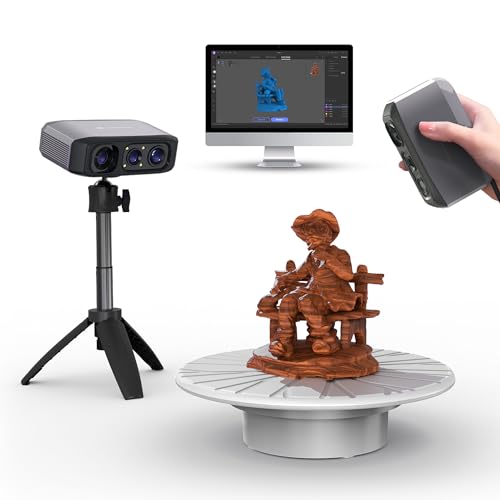
- 0.05mm precision in a handheld design
- AI visual tracking and anti-shake support
- Marker-free workflow keeps setup simple
Best For: Easy handheld scanning for jewelry and small objects
Metrology-Grade Pick
Creality CR-Scan Raptor for precision jewelry scans
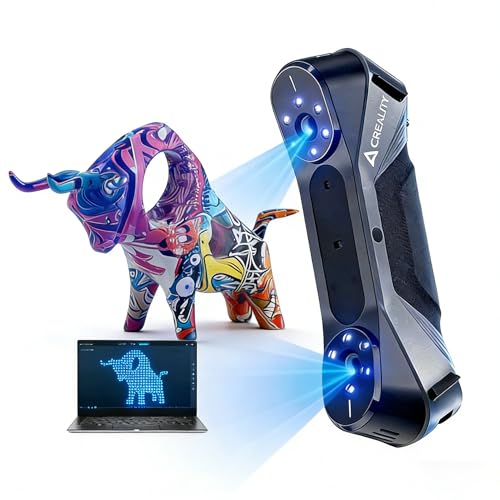
- 0.02mm maximum accuracy
- Blue 7-line laser and 24-bit color
- Handles many black and metal objects
Best For: Jewelers needing highly detailed scans and fine edge capture
Budget-Friendly Starter
3DMakerpro Fox for entry-level small-object scanning

- Up to 0.07mm accuracy
- Markerless tracking with anti-shake
- Scans objects from 40mm to 1200mm
Best For: Beginners scanning small objects who can handle a learning curve
Portable Full-Color Choice
Revopoint POP3 Plus for portable color scanning
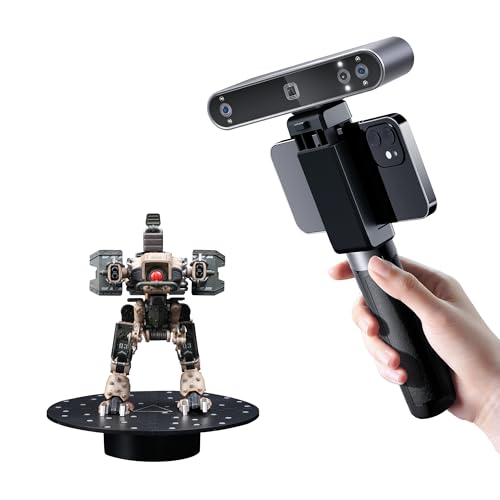
- Up to 20-micron accuracy
- Full-color scans with HD RGB camera
- Lightweight 190g body with Wi-Fi 6 or USB-C
Best For: Portable full-color scanning and scan-to-CAD workflows
Studio-Grade Detail
Creality Raptor Pro with Scan Bridge

- 0.02mm accuracy in laboratory conditions
- 22+7 blue laser lines with 60 FPS scanning
- Wireless scanning and full-color capture
Best For: Precision-focused scanning with advanced workflow flexibility
Portable Beginner Pick
Creality Ferret Pro Wireless Scanner

- WiFi6 wireless scanning with broad device support
- 24-bit full-color capture with anti-shake tech
- Not suitable for very small or highly detailed items
Best For: Beginners scanning larger objects, not jewelry
Precision Inspection Choice

- 0.01 mm single-frame precision
- Blue laser modes for shiny or dark surfaces
- Auto turntable and color-accurate scanning
Best For: High-precision detail work on reflective or complex objects
Professional Detail Scanner – Matter and Form Three 3D Scanner
If you want a 3d scanner for jewelry that can also handle larger objects, the Matter and Form Three is built around precision and flexibility. Its dual 13MP autofocus cameras, 0.033mm accuracy, and no-dot workflow make it a practical choice for users who need clean capture and reliable detail across a wide range of object sizes.
Best For: Users who need high-accuracy scans of jewelry, small parts, and larger objects without tracking dots.
Pros:
- 0.033mm accuracy for metrological-grade detail
- Dual 13MP autofocus cameras help keep tiny jewelry sharp
- No tracking dots needed, which simplifies setup and cleanup
- Compatible with Windows, Mac, Linux, iOS, Android, and Chromebooks
Cons:
- Heavier desktop-style setup than a lightweight handheld unit
- May be more scanner than needed for casual hobby use
Overall, this is the strongest pick here for buyers who value precision first and want a scanner that can move from jewelry to larger mechanical parts without changing tools. The built-in software and broad OS support also make it easier to slot into different workflows.
Beginner-Friendly Mid-Format Pick – 3DMakerpro Fox
The 3DMakerpro Fox is a solid 3d scanner for jewelry if you want a beginner-friendly path into medium-format scanning. With 0.07mm accuracy, 0.10mm resolution, and markerless AI visual tracking, it is designed to make scanning less intimidating while still delivering detail that can hold up for modeling and 3D printing.
Best For: Beginners and hobbyists who want an easier handheld scanner for small to medium objects.
Pros:
- 0.07mm accuracy and 0.10mm resolution for useful detail
- Markerless AI visual tracking helps relock after interruptions
- JMStudio combines scanning, editing, and optimization
- Entry-level design is approachable for new users
Cons:
- Not as fine-grained as the most precise scanners in this roundup
- Better suited to medium-format work than ultra-small inspection tasks
For buyers who want a more forgiving handheld scanner without a steep learning curve, the Fox makes sense. It focuses on convenience and workflow recovery, which can be especially helpful when learning how to capture reflective or intricate objects.
Ultra-Fine Jewelry Scanner – Revopoint MINI 2
The Revopoint MINI 2 is a strong 3d scanner for jewelry when tiny surface detail matters most. Its blue light system, up to 0.02mm single-frame precision, and compact capture range are aimed at small objects, while the RGB camera and flash LEDs help improve texture, color, and marker recognition.
Best For: Small jewelry pieces and other tiny objects where maximum detail is the priority.
Pros:
- Up to 0.02mm precision for very fine detail
- Blue light technology helps improve accuracy and reduce ambient light interference
- RGB camera and flash LEDs enhance texture and marker recognition
- Lightweight, portable design with USB or Wi‑Fi 6 connection options
Cons:
- Best suited to small objects rather than large items
- Blue light scanning may benefit from scanning spray on challenging materials
- Windows is the minimum system requirement for the main software setup
If your priority is capturing intricate jewelry details, this model stands out for sheer resolution. It is the most specialized option here for small-scale work, though it is less of a general-purpose scanner than the larger-format choices.
Easy Handheld Value Pick – 3DMakerpro Moose Lite Premium
The 3DMakerpro Moose Lite Premium is a practical 3d scanner for jewelry if you want a simple handheld option with beginner-friendly features. Its 0.05mm precision, AI visual tracking, anti-shake module, and marker-free workflow are all aimed at making scanning easier when you need solid results without extra setup.
Best For: Users who want a straightforward handheld scanner for jewelry and other small objects.
Pros:
- 0.05mm precision for detailed handheld scanning
- AI visual tracking helps detect issues and repair models automatically
- Anti-shake module and re-scanning support make it easier to recover from movement
- Marker-free scanning keeps the process simple
Cons:
- Less specialized for ultra-fine jewelry work than the top precision models
- Only the supplied notes are brief on exact scanning volume and software details
This is a sensible pick for buyers who want a lower-friction handheld experience and do not need the most advanced metrology-level specs. The focus here is ease of use, stability, and keeping the workflow moving.
Metrology-Grade Pick – Creality CR-Scan Raptor for precision jewelry scans
If you want a 3d scanner for jewelry that leans toward precision, the Creality CR-Scan Raptor is built for detailed capture and fine edge definition. Its 0.02mm maximum accuracy, blue 7-line laser system, and 24-bit color support make it a strong fit when small objects and surface detail matter.
Best For: Jewelers and makers who want high-precision scans with strong detail capture for small metal pieces and mixed-material objects.
Pros:
- Up to 0.02mm accuracy for metrological-level detail.
- Blue 7-line laser and high-resolution camera help restore sharper edges and richer morphology.
- Can scan many black and metal objects with low dependence on powder coating.
- Works with Windows and macOS, with built-in tutorials and automatic repair tools in the software.
Cons:
- Requires a fairly capable computer, including an 8-core / 16-thread CPU minimum.
- Best results may be overkill for casual users who only need basic scans.
Overall, this is the most precision-focused option in the group and a compelling choice if your jewelry workflow depends on fine detail and dependable geometry. It trades simplicity for higher-end scanning capability, which is often worth it for demanding pieces.
Budget-Friendly Starter – 3DMakerpro Fox for entry-level small-object scanning
The 3DMakerpro Fox is an approachable 3d scanner for jewelry if you are starting out and want a lower-cost path into small-object digitizing. It uses NIR light, offers up to 0.07mm accuracy, and skips marker dots, which helps simplify setup for desktop-sized pieces.
Best For: Beginners who want an entry-level scanner for small jewelry-related objects and other compact parts, with room to learn the workflow.
Pros:
- Markerless tracking makes setup easier and avoids target dots.
- Up to 0.07mm accuracy is solid for an entry-level scanner.
- NIR light is safe for human eyes and supports face/body scanning too.
- Designed for objects from 40mm to 1200mm, including miniatures and prototype parts.
Cons:
- Has a learning curve and benefits from basic CAD or 3D modeling experience.
- Needs a capable PC, and a dedicated GPU is strongly recommended.
- Not the best choice if you need the highest-end precision.
For buyers who want an affordable entry point, the Fox offers a practical mix of ease and capability. It is best viewed as a learnable tool for compact scans rather than a turnkey professional jewelry workstation.
Portable Full-Color Choice – Revopoint POP3 Plus for portable color scanning
The Revopoint POP3 Plus is a compact 3d scanner for jewelry buyers who want portability, full-color capture, and an easier scanning workflow. With up to 20-micron accuracy, 18 fps scanning, and a lightweight 190g body, it is well suited to small design jobs and detailed medium-object capture.
Best For: Users who want a portable full-color scanner for jewelry-related work, product design, and scan-to-CAD tasks.
Pros:
- Up to 20-micron accuracy for detailed models.
- Full-color scanning with HD RGB camera and Flash LED lighting.
- Lightweight 190g design with Wi-Fi 6 or USB-C connectivity.
- Revo Scan software includes tutorials, editing tools, and global marker tracking.
Cons:
- Software is only compatible with x86_64 architecture.
- Best for medium-sized objects rather than extremely large items.
This is a strong middle-ground option if you want portability without giving up useful detail and color capture. It is especially attractive for users who need a scanner that can move easily between desk work and different capture setups.
Studio-Grade Detail – Creality Raptor Pro with Scan Bridge
If you need a 3D scanner for jewelry that prioritizes fine detail, the Creality Raptor Pro is built around very high precision and fast capture. Its 0.02mm accuracy in laboratory conditions, blue laser lines, and marker-based alignment make it a strong pick for intricate objects where small features matter.
Best For: Detailed scanning of small-to-medium objects when precision and speed matter most.
Pros:
- Up to 0.02mm accuracy in laboratory conditions for intricate detail capture.
- 22+7 blue laser lines and up to 60 FPS scanning speed.
- Supports full-color scanning for realistic texture reproduction.
- Wireless scanning with the included Scan Bridge adds flexibility.
Cons:
- Best results depend on marker-based alignment and careful setup.
- The wide range is useful, but the 270mm x 170mm capture area may require repositioning for larger pieces.
For buyers focused on precision-first scanning, this model offers a strong mix of resolution, speed, and workflow convenience. It is best suited to users who want a more advanced setup for capturing fine geometry and color detail.
Portable Beginner Pick – Creality Ferret Pro Wireless Scanner
The Creality Ferret Pro is a practical 3D scanner for jewelry only if you are working with larger reference objects, because the product notes specifically say it is not suitable for very small or highly detailed items like jewelry. For general object scanning, it offers wireless convenience, beginner-friendly operation, and full-color output in a compact handheld package.
Best For: Beginners who want an easy, portable wireless scanner for larger objects.
Pros:
- Easy to use for entry-level users and DIY creators.
- WiFi6 wireless scanning with broad device support.
- 24-bit full-color scanning with anti-shake technology.
- Very lightweight at 105g and includes a travel-ready kit.
Cons:
- Not suitable for very small or highly detailed items like jewelry.
- Best results avoid reflective, transparent, or very dark surfaces.
As a general-purpose handheld scanner, the Ferret Pro is easy to carry and simple to get started with. Just keep its stated limits in mind if your main goal is jewelry scanning.
Precision Inspection Choice – Revopoint MetroX Pro
If your priority is a 3d scanner for jewelry or other fine-detail work, the Revopoint MetroX Pro stands out for its industrial-grade blue laser scanning and very tight precision specs. It is designed to capture shiny or dark surfaces, fine edges, and complex shapes, which can be useful when scanning reflective pieces and small design features.
Best For: High-precision scanning of detailed, shiny, or complex objects.
Pros:
- Single-frame precision up to 0.01 mm and accuracy up to 0.02 mm.
- Blue laser and structured-light modes handle shiny or dark surfaces well.
- Auto turntable and tracking modes help automate complex scans.
- HD RGB camera supports color-accurate scans in turntable mode.
Cons:
- Heavier and more industrial than a simple handheld option.
- Some software features such as Revo Design and Revo Measure are sold separately.
This is the most precision-oriented option in the roundup, especially if you want advanced scanning modes and strong results on difficult surfaces. It is a better fit for users who value measurement-grade detail over simplicity.
How We Picked the Best 3d Scanner for Jewelry
For jewelry work, tiny details matter more than raw scan volume. We prioritized scanners with strong fine-detail resolution, stable tracking, and the ability to handle reflective or small objects with fewer setup headaches. We also considered software support, portability, and how practical each scanner is for bench-top use.
Because a 3d Scanner for Jewelry is often used for rings, pendants, settings, and wax models, we weighted close-range performance more heavily than general-purpose scanning specs.
Quick Comparison
If you want the short version: choose a high-precision scanner for professional CAD and repair work, a compact handheld model for flexibility, and a color-capable scanner if presentation or visual archiving matters. Entry-level options are best for hobbyists or shops that are just starting to digitize jewelry workflows.
Key Buying Factors for a 3d Scanner for Jewelry
Accuracy and Resolution
Look for sub-millimeter accuracy, and ideally fine-detail capture around small features. Jewelry scan quality depends on whether the scanner can reproduce engraving, stone seats, filigree, and edge geometry without smoothing them away.
Surface Handling
Shiny metal can be difficult. Some scanners perform better with anti-glare spray, while others use blue laser or specialized optics to reduce problems on reflective surfaces. If you scan finished pieces often, this is a major factor.
Object Size and Working Distance
Most jewelry fits into the small-object category, so close-range focusing matters. Make sure the scanner is comfortable with rings and small components without forcing awkward movements or excessive post-processing.
Software and Export Options
Good software can make or break the experience. Check for clean mesh output, alignment tools, editing features, and export formats that work with your CAD or 3D printing workflow.
Color Capture and Portability
Color is useful for documentation and presentation, but it is less important than geometry for most production tasks. Portability matters if you scan at different benches, customer locations, or trade shows.
Who Should Buy Which 3d Scanner for Jewelry?
Professional jewelers and CAD designers should lean toward higher-accuracy models with strong close-range performance. Small shops and makers may prefer a simpler handheld scanner that is easier to learn and more versatile across jobs. If you mainly want to digitize pieces for cataloging, client previews, or light design work, a color scanner with reliable software can be the smartest value.
For the best results, match the scanner to your workflow rather than chasing the highest spec on paper. The right 3d Scanner for Jewelry is the one that consistently captures fine detail, fits your space, and integrates smoothly with your design process.