Choosing the right 4K video distribution amplifier depends on more than the number of outputs. Resolution, refresh rate, HDCP compatibility, signal distance, EDID control, and whether you need standard HDMI splitting or CAT6/7 extension all affect real-world performance.
This roundup compares 10 options spanning compact 1×2 splitters, 1×4 and 1×8 distribution systems, SDI hardware, HDMI 2.1 models, and long-distance extender designs. Use the guide below to match the amplifier’s capabilities to your displays, sources, and installation.
Best 10 4K Video Distribution Amplifiers Picks for 2026
Compact Pro Splitter
KD-DA1X2DC 4K HDMI Distribution Amp

- Two HDMI outputs for dual-display setups
- 18Gbps, HDR, and HDCP 2.2 support
- Optional 4K-to-1080p down-convert
Best For: Professional two-display installations
Long-Range 8-Display System
OREI 4K60 HDMI Over CAT Extender

- Distributes one source to eight displays
- 4K60 transmission up to 230 feet
- EDID, IR, RS-232, and loop-out features
Best For: Large installations with remote displays
Broadcast Signal Specialist
AVMATRIX SD1141 3G-SDI Splitter

- 1x4 distribution for 3G, HD, and SD-SDI
- Reclocked outputs for extended runs
- Transmission up to 400m for SD signals
Best For: Broadcast and production SDI systems
Flexible Mid-Range Extender
OREI UHD18-EX115-K 4K HDMI Splitter

- Distributes 4K60 HDMI to eight displays
- Supports HDR formats and HDCP 2.2
- Includes PoLAN receivers, IR, and loop out
Best For: Eight-display installations with moderate distances
Best 8K-Ready Pick
1x2 HDMI 2.1b Distribution Amplifier
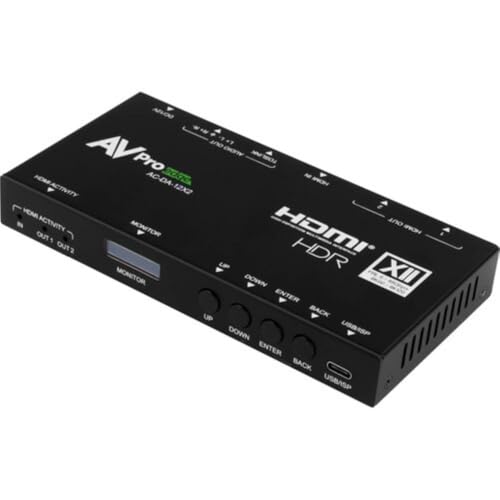
- 1x2 HDMI distribution
- Up to 8K60 and 48 Gb/s
- Extended EDID management
Best For: Two-display systems needing high-bandwidth HDMI
Best for Long-Run Installations
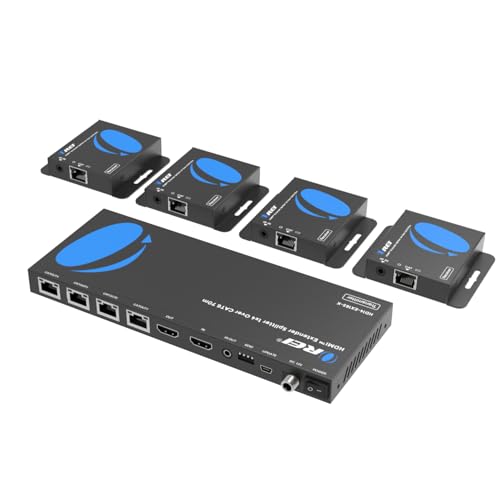
- Four remote displays over Cat6
- 4K@30Hz up to 165 feet
- Power over cable and IR passback
Best For: Multi-display installations with extended cable runs
Best for Eight Displays

- One HDMI source to eight displays
- 4K UHD and 1080p at 60Hz
- HDCP 2.2 and advanced audio support
Best For: Large multi-display HDMI installations
Best Long-Distance 4K Pick
OREI 1x4 HDMI over Ethernet Extender

- 4K@60Hz up to 200 feet over CAT6/7/8
- Four receivers plus HDMI loop-out
- EDID, HDCP 2.2, HDR, and bidirectional IR
Best For: Long-distance 4K distribution to four displays
Best Compact 1x2 Splitter
Monoprice Blackbird 4K HDMI Amplifier

- Splits one HDMI source to two displays
- Supports 4K@30Hz and 1080p@120Hz
- Includes 3D, deep color, and multichannel audio support
Best For: Simple two-display HDMI distribution
Best Eight-Display Value
OREI 1x8 HDMI over CAT6 Extender

- Distributes one source to eight displays
- Supports 1080p@60Hz and 4K@30Hz
- Includes receivers, loop-out, IR, and power-over-LAN
Best For: Large 1080p or moderate 4K display installations
Compact Pro Splitter – KD-DA1X2DC 4K HDMI Distribution Amp
For installations that need to send one HDMI source to two screens, the KD-DA1X2DC is a compact choice among 4k video distribution amplifiers. It supports 18Gbps bandwidth, HDR, HDCP 2.2, and an optional 4K-to-1080p down-convert function for mixed-display setups.
Best For: Digital signage, surveillance monitoring, and professional installations with two HDMI displays.
Pros:
- Supports 4K signals with 18Gbps bandwidth, HDR, and HDCP 2.2.
- Optional down-conversion can help accommodate 1080p displays.
- Includes power supply and two L-shaped mounting brackets.
Cons:
- Provides only two HDMI outputs.
- Designed for indoor use.
The KD-DA1X2DC is a straightforward two-output distribution amplifier for users who prioritize signal compatibility and a tidy installation over a high output count.
Long-Range 8-Display System – OREI 4K60 HDMI Over CAT Extender
The OREI UHD18-IPC230-K is built for distributing one HDMI source to as many as eight remote displays over individual CAT6, CAT7, or CAT8 cables. It supports 4K at 60Hz up to 230 feet, includes a local HDMI loop out, and provides EDID and IR features for more involved installations.
Best For: Large venues, meeting spaces, digital signage, and other setups requiring eight remote displays over long cable runs.
Pros:
- Feeds up to eight displays and includes eight receivers.
- Extends 4K at 60Hz up to 230 feet via CAT cabling.
- Includes EDID management, IR pass-through, RS-232, and local HDMI loop out.
Cons:
- Heavier and more involved than a basic HDMI splitter.
- Requires CAT cabling and separate receiver placement for remote displays.
- Warranty coverage is listed as one year.
With its long-distance capability and complete transmitter-and-receiver package, this OREI system is a strong fit when a conventional short HDMI connection is not practical.
Broadcast Signal Specialist – AVMATRIX SD1141 3G-SDI Splitter
The AVMATRIX SD1141 is a 1×4 SDI distribution amplifier for 3G-SDI, HD-SDI, and SD-SDI signals. Its auto-detect input, reclocked outputs, and long transmission distances make it a practical option for broadcast and production systems rather than consumer HDMI equipment.
Best For: Broadcast, video production, and long-distance SDI signal distribution.
Pros:
- Supports SD, HD, and 3G-SDI signals up to 1080p at 60Hz.
- Reclocks all outputs to help maintain signal transmission quality.
- Supports transmission distances up to 400m for SD, 200m for HD, and 120m for 3G-SDI.
Cons:
- Uses SDI connectors rather than HDMI.
- Not intended for direct consumer 4K distribution.
- Outputs 2 and 4 support DVB-ASI, while the unit has four total outputs.
The SD1141 is the specialized choice in this group: choose it when your system is SDI-based and reliable, extended-distance signal handling matters more than 4K HDMI compatibility.
Flexible Mid-Range Extender – OREI UHD18-EX115-K 4K HDMI Splitter
The OREI UHD18-EX115-K distributes one HDMI source to eight displays over CAT6, CAT6a, or CAT7 cabling, with 4K at 60Hz transmission up to 115 feet. It also combines HDR support, Power over LAN for receivers, IR control, EDID management, and a local HDMI loop out.
Best For: Meeting rooms, video conferences, exhibitions, bars, and other eight-screen installations with moderate cable distances.
Pros:
- Supports 4K at 60Hz, 4:4:4 color, 18Gbps bandwidth, and HDCP 2.2.
- Handles HDR formats including HDR10, HDR10+, Dolby Vision, and HLG.
- Includes eight receivers, Power over LAN, IR pass-back, and local loop out.
Cons:
- 4K transmission distance is limited to 115 feet.
- Requires compatible CAT cabling and receiver installation.
- Warranty coverage is listed as one year.
This OREI model offers a balanced feature set for eight-display HDMI distribution when the installation does not require the longer 230-foot range of the other OREI system.
Best 8K-Ready Pick – 1×2 HDMI 2.1b Distribution Amplifier
This compact 4K video distribution amplifier is a strong choice when you need to send one HDMI source to two displays while keeping room for higher-resolution equipment. It supports resolutions up to 8K60, offers 48 Gb/s bandwidth, and includes extended EDID management for more flexible display-handshake setup.
Best For: Home theaters, presentation systems, and installations feeding two HDMI displays.
Pros:
- Supports resolutions up to 8K60 with 48 Gb/s video bandwidth.
- Extended EDID management helps accommodate different display capabilities.
- Supports multichannel digital audio and includes mounting brackets.
Cons:
- Provides only two HDMI outputs.
- Requires a 12V DC power supply.
Choose this model if modern HDMI performance and a clean two-display installation matter more than a high output count. Its 1×2 design is straightforward, while the 8K60 support provides useful headroom for future upgrades.
Best for Long-Run Installations – OREI 1×4 HDMI Extender
For 4K video distribution amplifiers that also need to cover distance, this OREI system combines one HDMI input with four Cat6-connected receivers and a local HDMI loop output. It supports 4K at 30Hz over suitable cabling and uses power over cable to simplify receiver installation.
Best For: Meeting rooms, bars, exhibitions, and other multi-display setups using Cat6/6a/7 cable.
Pros:
- Distributes one source to four remote displays over Cat6 cable.
- Supports up to 4K@30Hz at distances of up to 165 feet, according to the supplied notes.
- Includes a local HDMI output, IR control accessories, and one-power-adapter operation.
Cons:
- Its listed highest resolution is 4K@30Hz, rather than 4K@60Hz.
- Requires separate Cat6-connected receivers for the remote displays.
This is a practical option when cable distance and four-screen coverage are more important than maximum refresh rate. Power over cable and plug-and-play operation can help reduce installation complexity, while IR passback adds remote-source control.
Best for Eight Displays – KanexPro 4K UHD 1×8
This 4K video distribution amplifier is designed for sending one HDMI source to as many as eight displays. The KanexPro unit supports 4K UHD and 1080p at 60Hz, while HDCP 2.2 compliance and support for Dolby and DTS formats make it suitable for centralized AV distribution.
Best For: Commercial displays, classrooms, digital signage, and home systems requiring eight HDMI outputs.
Pros:
- Distributes HDMI video and audio to up to eight displays.
- Supports 4K UHD and Full HD 1080p at 60Hz.
- Handles HDCP 2.2, Dolby Digital, DTS-HD, and Dolby TrueHD audio.
Cons:
- Uses HDMI connections rather than long-distance Cat6 extension.
- Designed for one source, with no source-switching function listed.
If your priority is maximum display count from a single HDMI source, this is the most capable option of the three. Its eight outputs and broad audio-format support suit installations where all screens are relatively close to the distribution unit.
Best Long-Distance 4K Pick – OREI 1×4 HDMI over Ethernet Extender
For demanding 4k video distribution amplifiers setups, this OREI kit combines a 1×4 splitter with Ethernet-based extension. It can deliver 4K at 60Hz up to 200 feet or 4K at 30Hz up to 230 feet over CAT6/7/8 cabling, while its HDMI loop-out supports local monitoring.
Best For: Meeting rooms, bars, exhibits, and installations distributing HDR 4K video to four displays over longer cable runs.
Pros:
- Supports 4K@60Hz, HDR formats, Dolby Vision, and 18Gbps bandwidth.
- Includes four receivers, four RJ45 outputs, and an HDMI loop-out.
- Offers EDID management, HDCP 2.2, bidirectional IR, and power-over-cable receivers.
- Includes mounting ears, cables, and a one-year warranty.
Cons:
- Requires CAT6/7/8 cabling for the extended connections.
- 4K@60Hz transmission is rated up to 200 feet, shorter than the 230-foot 4K@30Hz range.
This is the most capable option here for high-bandwidth, multi-display distribution over distance. Its EDID controls and loop-out add useful installation flexibility, though it is more equipment than a simple two-display splitter requires.
Best Compact 1×2 Splitter – Monoprice Blackbird 4K HDMI Amplifier
Monoprice Blackbird 4K 1x2 HDMI Amplifier Splitter - 48-bit Deep Color, 3D Video Support, Black
Check Price On AmazonThis Monoprice Blackbird is a straightforward choice among 4k video distribution amplifiers when you need to send one HDMI source to two displays. It supports up to 4K at 30Hz, along with 3D video, deep color, and a broad selection of digital audio formats.
Best For: Home or small commercial setups that need a compact HDMI splitter for two television or display connections.
Pros:
- Splits one HDMI input to two HDMI sink devices.
- Supports resolutions up to 4K@30Hz and 1080p@120Hz.
- Handles 48-bit Deep Color and multiple formats, including DTS-HD, Dolby TrueHD, and 7.1-channel LPCM.
- Supports 3D video formats up to a 297MHz TMDS clock.
Cons:
- Does not support 4K at 60Hz.
- Provides only two HDMI outputs and does not offer Ethernet-based extension.
- Its listed HDCP support is version 1.4.
The Blackbird keeps two-display distribution simple and compact. It is a sensible fit for 4K@30Hz systems, but buyers seeking 4K@60Hz, longer-distance CAT cable runs, or more outputs should consider a larger extender system.
Best Eight-Display Value – OREI 1×8 HDMI over CAT6 Extender
For larger installations, this OREI unit distributes one HDMI source to eight displays over CAT6/6a/7 cable. It supports up to 1080p at 60Hz and 4K at 30Hz over shorter runs, with a loop-out for a local display and IR pass-back for source control.
Best For: Meeting rooms, bars, conferences, and exhibits that need one HDMI source routed to eight displays.
Pros:
- Provides eight CAT6 outputs and includes eight receivers.
- Supports 1080p@60Hz, 2K@60Hz, and 4K@30Hz.
- Offers power-over-LAN, so receivers do not need separate adapters.
- Includes HDMI loop-out, IR remote control support, and a one-year warranty.
Cons:
- Its listed 4K range is up to 165 feet, while 1080p reaches up to 230 feet.
- It does not provide 4K@60Hz distribution.
- The eight-display design may be excessive for smaller systems.
This model is a practical choice when output count matters more than 4K refresh rate. It offers a complete eight-receiver package and convenient IR control, but 4K@60Hz users should choose a higher-bandwidth alternative.
How We Picked the Best 4K Video Distribution Amplifiers
We focused on the specifications that determine compatibility and installation flexibility: supported resolution and refresh rate, bandwidth, HDR and HDCP support, output count, signal distance, EDID management, down-conversion, loop-through connections, and control features such as IR or RS-232. We also separated conventional HDMI distribution amplifiers from extender-based systems that send signals over CAT6 or CAT7 cable.
A suitable unit should reliably replicate one source to multiple displays without forcing the source to renegotiate every time a screen is powered on. For professional environments, we gave added importance to signal-management features and support for longer cable runs.
Quick Comparison
- Small two-display systems: Compact 1×2 HDMI amplifiers are appropriate for a television and projector, confidence monitor, or duplicate presentation display.
- Multiple local displays: 1×4 and 1×8 HDMI models suit retail signage, classrooms, conference rooms, and home theater zones when displays are relatively close to the source.
- Long cable runs: HDMI extenders over CAT6 or CAT7 are more practical when displays are distributed across a room, building, or rack-to-screen installation.
- Broadcast and pro video: The SDI distribution amplifier is intended for compatible SDI workflows rather than ordinary HDMI equipment.
- Newer HDMI systems: HDMI 2.1b hardware is the better direction when your source and displays require higher bandwidth than older 18Gbps 4K equipment can provide.
Key Buying Factors for 4K Video Distribution Amplifiers
Resolution, Refresh Rate, and Bandwidth
Confirm whether you need 4K at 30Hz or 60Hz. For smooth computer desktops, gaming, and modern streaming devices, 4K at 60Hz is generally preferable. Check chroma support as well: 4:4:4 matters for fine text, while some video-focused systems may use reduced chroma formats.
HDCP, HDR, and Display Compatibility
HDCP 2.2 support is important for many 4K protected sources. HDR support can improve compatible content, but every device in the chain—including the source, amplifier, cable, and displays—must support the required standard. EDID management helps coordinate capabilities when connected displays differ.
Output Count and Cabling
Choose an output count that matches today’s installation while leaving room for expansion. Standard HDMI distribution is simplest for short runs. For distances around 100 feet or more, an extender-based design using suitable CAT6 or CAT7 cable may be more practical, though performance depends on cable quality, termination, interference, and the receiver hardware.
Down-Conversion and Control Features
Optional 4K-to-1080p down-conversion can keep an older display usable alongside newer 4K screens. Loop-out, IR, RS-232, and power-over-cable features can simplify rack layouts and remote-control access, but they are valuable only when your installation actually needs them.
Who Should Buy Which 4K Video Distribution Amplifiers?
Choose a compact 1×2 model for two nearby displays and a straightforward setup. Choose a 1×4 or 1×8 HDMI amplifier for several local screens, digital signage, training rooms, or multi-display entertainment systems. Choose a CAT6/7 extender splitter when screens are spread over longer distances or when running multiple HDMI cables would be impractical. Choose an SDI distribution amplifier only if your sources and destinations use SDI connections. Finally, choose HDMI 2.1b hardware when your equipment requires the additional bandwidth and features of the newer HDMI standard.