Choosing the right programmable DC power supply can make bench testing faster, safer, and far more accurate. Whether you need a compact single-channel unit or a higher-power multi-output model, the best option depends on your voltage, current, and control needs.
Below, we focus on practical performance factors that matter most to technicians, makers, and lab users in 2026.
Best 10 Programmable DC Power Supplies Picks for 2026
Bench-Ready Programmable DC Supply

- USB interface with Modbus programming support
- 0-30V, 0-10A output with 10 mV / 1 mA resolution
- OVP, OCP, OPP, OTP, and short-circuit protection
Best For: Bench testing with PC control and basic automated sequences
Compact Precision Pick
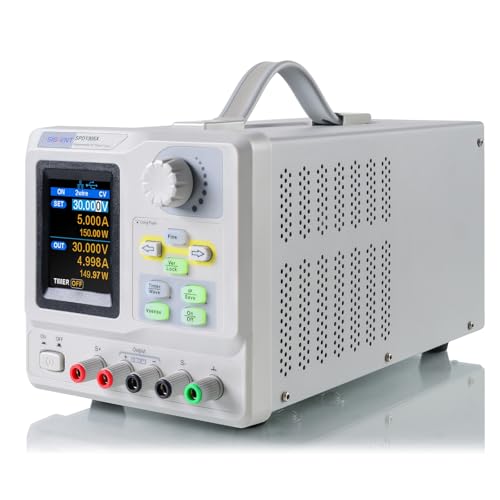
- 0-30V, 0-5A output with 150W rating
- 1 mV / 1 mA resolution and true-color TFT-LCD
- USB and LAN remote connectivity
Best For: Precise single-channel bench work with remote control
Feature-Rich Budget Control

- 0-30V, 0-10A output with memory presets
- Waveform editing with 10 adjustable points
- Color LCD plus rear PC USB and front charging USB
Best For: Flexible bench use with presets and waveform control
Multi-Channel Lab Leader
UNI-T UDP3305S-E 4-Channel Supply

- Four channels with CH1/CH2 up to 30V/5A
- List/delay automation supports long cycle testing
- USB, RS232, LAN, and Digital I/O connectivity
Best For: Advanced lab testing with multiple outputs and automation
Compact Desktop Pick
Jesverty SPS-3010V 32V/10A Bench Supply

- 0.01V / 0.001A encoder adjustment
- 20W USB-A and USB-C quick-charge ports
- Output switch plus OCP and cooling fan
Best For: Small benches, DIY electronics, and repair setups
Programmable Lab Classic

- USB and RS232 remote control with software
- 4 memory recall buttons for repeat setups
- 0.001V / 0.001A readout with safety protections
Best For: Lab users and hobbyists needing repeatable programmable control
High-Feature Bench Unit
Abestop 60V/10A Programmable Supply

- 0–60V / 0–10A with 10mV / 1mA resolution
- USB + SCPI control for automation
- List mode with 10 steps and 4 presets
Best For: Automation, burn-in testing, and higher-voltage bench work
Portable Programmable Bench Supply

- 0-30V, 0-5A output with 150W capacity
- PC programmable with 6 preset groups
- Low ripple and multiple protection features
Best For: Compact bench testing and light electronics work
Mid-Range Programmable Lab Supply

- 0-60V, 0-5A output with 300W rated power
- 4 memory presets and 10-point waveform editing
- PC software support plus front USB charging
Best For: Repeatable electronics testing and programmable bench use
High-Current Programmable Bench Supply
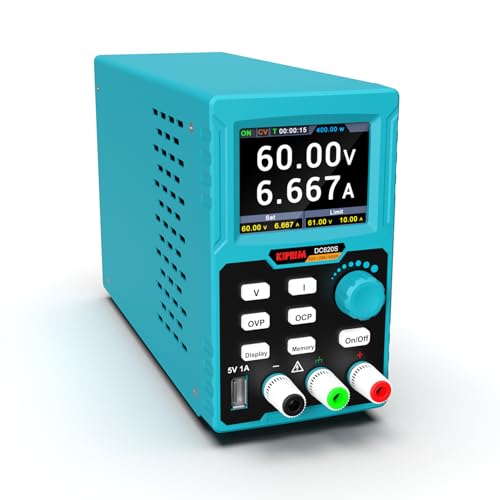
- 0-60V output with up to 20A rated current
- 400W capacity with 4 memory presets
- PC software support and waveform editing
Best For: Higher-current bench testing and lab equipment
Bench-Ready Programmable DC Supply – HANMATEK HM310T 30V 10A
If you need a programmable DC power supply for bench testing, the HANMATEK HM310T combines a 0-30V, 0-10A output range with PC software control and USB connectivity. Its 4-digit voltage, current, power, and time display makes it straightforward to monitor settings, while sequence output and quick storage help speed up repetitive work.
Best For: Electronics users who want a compact programmable bench supply with USB/PC control and built-in safety features.
Pros:
- Supports Modbus programming instructions through the rear USB interface
- 4-digit display shows voltage, current, power, and time with 10 mV / 1 mA resolution
- Built-in OVP, OCP, OPP, OTP, and short-circuit protection
- Includes six quick parameter storage groups and programmable sequence output
Cons:
- Single-channel design limits multi-output testing
- Front USB ports are for charging, not the main control interface
- Best suited to moderate-power work rather than larger lab setups
Overall, the HM310T is a practical programmable DC power supply for users who value control, protection, and simple PC integration in one unit.
Compact Precision Pick – Siglent SPD1305X 30V 5A
Siglent Technologies SPD1305X Programmable DC Power Supply 1 Channel,30 V / 5 A,150W
Check Price On AmazonThe Siglent SPD1305X is a programmable DC power supply aimed at users who want accurate output in a compact 1-channel benchtop format. With 0-30V and 0-5A output, a 2.8-inch true-color TFT-LCD, and fine 1 mV / 1 mA control, it fits precision electronics work where clear display and solid regulation matter.
Best For: Makers and lab users who want a compact, accurate single-channel bench supply with remote connectivity.
Pros:
- 0-30V, 0-5A output range with 150W capacity
- 1 mV / 1 mA resolution for precise setting and monitoring
- 2.8-inch true-color TFT-LCD makes readings easy to see
- USB and LAN connectivity support remote use
Cons:
- Single channel only
- Lower current output than 10A-class supplies
- Not intended for multi-rail or complex sequencing setups
If you want a clean, accurate programmable DC power supply for focused work, the SPD1305X stands out for its display quality and connectivity.
Feature-Rich Budget Control – Kiprim DC310S 30V 10A
For buyers comparing programmable DC power supplies, the Kiprim DC310S offers a strong feature set around a 0-30V, 0-10A regulated output. Its color LCD, waveform editing, memory presets, and dual USB ports make it a flexible pick for users who want more than a basic bench supply.
Best For: Users who want a 10A programmable DC power supply with waveform editing, presets, and front USB charging.
Pros:
- 0-30V, 0-10A output with 10 mV / 1 mA resolution
- 2.8-inch color LCD shows set and actual values, power, runtime, and channel status
- Stores four parameter sets and supports waveform editing with 10 adjustable points
- Dual USB ports include rear PC/firmware support and a front 5V charging port
Cons:
- Designed for a 110V AC input only
- Single output channel limits more advanced multi-rail use
- Front USB is mainly for charging, not main control
The DC310S is a practical choice if you want programmable features, a readable display, and flexible output control without moving up to a larger lab system.
Multi-Channel Lab Leader – UNI-T UDP3305S-E 4-Channel Supply
The UNI-T UDP3305S-E is a programmable DC power supply built for more advanced lab work, with four channels, remote interfaces, and list/delay functions for automated testing. Its 4.3-inch display, channel pairing on CH1 and CH2, and support for long cycle counts make it well suited to repetitive test and aging workflows.
Best For: Labs and test benches that need multiple outputs, remote control, and automated cycle testing.
Pros:
- Four channels, including CH1/CH2 at 0-30V/0-5A, plus 6V and 5V outputs
- 10 mV / 1 mA resolution with stated voltage and current accuracy
- List and delay functions support up to 2048 data sets and 99999 cycles
- USB, RS232, LAN, and Digital I/O connectivity for remote control
Cons:
- Heavier and larger than single-channel bench supplies
- Higher capacity and feature set may be more than casual users need
- Multi-channel complexity can be unnecessary for simple repairs
For users who need a programmable DC power supply with real lab-style flexibility, the UDP3305S-E offers the strongest automation and multi-output capability in this group.
Compact Desktop Pick – Jesverty SPS-3010V 32V/10A Bench Supply
If you want programmable DC power supplies for a small bench, the Jesverty SPS-3010V keeps setup simple with encoder coarse and fine adjustment, a 4-digit LED display, and a clean output switch. It’s a practical fit for electronics work where quick voltage/current changes and extra front-panel charging ports save time.
Best For: DIY builders, lab benches, and repair work that benefit from fast adjustment and compact size.
Pros:
- Encoder coarse and fine knobs offer 0.01V / 0.001A resolution for precise setup.
- USB-A and USB-C ports both support 20W quick charging for devices or development boards.
- Output ON/OFF button makes it easier to adjust settings without disconnecting the load.
- Selectable AC115V/230V input and built-in OCP add useful bench-friendly protection.
Cons:
- Supplied test leads are described as a giveaway, so higher-current work may need better leads.
- It is a 10A unit, so it’s not aimed at heavier-load applications.
This is a compact, feature-rich option if you want a bench supply that balances convenience with everyday precision. The integrated USB charging ports and small footprint make it especially handy on crowded workspaces.
Programmable Lab Classic – KORAD KA3005P 30V/5A
Among programmable DC power supplies, the KORAD KA3005P stands out for lab-style control, memory recall, and remote operation. Its linear design, 4-digit display, and coarse/fine adjustment controls make it a strong fit when you want stable, repeatable settings for testing and development.
Best For: Users who need a programmable bench supply with memory presets and PC control.
Pros:
- USB and RS232 ports support remote control, and software is included.
- Four memory recall buttons help save and reuse common settings quickly.
- 0.001V / 0.001A resolution with a 4-digit back-lit LED display improves readability.
- Safety features include thermal protection, overload and short-circuit protection, load on/off, and a lock button.
Cons:
- Only 30V and 5A output, so it is not built for higher-power projects.
- It is heavier and larger than compact switching supplies.
If your workflow depends on repeatable settings and remote control, this Korad model offers a very capable package. It feels especially suited to small labs and hobbyists who value precision over raw output power.
High-Feature Bench Unit – Abestop 60V/10A Programmable Supply
If you need programmable DC power supplies with more features for debugging and automation, the Abestop AT6301 brings a 60V/10A range, PC control, and list mode into one compact bench unit. The IPS color screen, 4-digit resolution, and multiple protections make it a strong match for testing workflows that need visibility and repeatability.
Best For: Automated test setups, burn-in work, and bench users who want higher voltage headroom.
Pros:
- 0–60V and 0–10A output with 10mV / 1mA resolution.
- USB and SCPI support enable PC control and integration into automated systems.
- List mode offers up to 10 editable steps, plus M1–M4 memory presets.
- Front USB power and a dedicated output on/off button add bench convenience.
Cons:
- It uses a switching-style bench design, so it may not be the simplest choice for users wanting a linear supply feel.
- The feature set may be more than basic hobby tasks require.
This model is the most automation-friendly pick in the group and is well suited to repeatable testing. Its higher voltage range and list mode make it especially useful when your bench work goes beyond basic voltage tuning.
Portable Programmable Bench Supply – FNIRSI DPS-150 0-30V 5A
If you want programmable DC power supplies with a compact footprint, the FNIRSI DPS-150 is built for small bench setups and field-use scenarios. It offers 0-30V and 0-5A output, PC programmable control, and a low-ripple design under 20mV, which makes it a practical pick for precision electronics work where stable adjustment matters.
Best For: Makers and technicians who need a compact, PC-programmable supply for light- to mid-power electronics testing.
Pros:
- 0-30V, 0-5A output with 150W capacity for general bench tasks
- PC programmable output with 6 preset parameter groups for quick changes
- <20mV ripple and CC/CV switching help protect sensitive gear
- Multiple connection options, including banana heads, U-shaped terminals, and fine copper wires
Cons:
- Lower power ceiling than higher-output bench supplies
- Best suited to lighter workloads rather than demanding high-current applications
- Interface and control features are focused on practical use, not advanced lab automation
Overall, the DPS-150 stands out if you want a portable programmable supply with solid protection features and straightforward preset control. It is a good fit for everyday electronics work where compact size and stable output are more important than maximum wattage.
Mid-Range Programmable Lab Supply – Kiprim DC605S 0-60V 5A
Among programmable DC power supplies, the Kiprim DC605S is a versatile mid-range option for users who want higher voltage without moving to a much larger unit. It provides 0-60V and 0-5A output, 10mV voltage resolution, 1mA current resolution, and PC software support for programmable waveform output and quick parameter recall.
Best For: Electronics hobbyists and repair users who want a programmable bench supply with waveform editing and solid everyday flexibility.
Pros:
- 0-60V and 0-5A output with 300W rated power
- 4 memory presets plus 10-point editable waveform output
- Dual USB ports, including rear PC/software control and front 5V charging
- Overvoltage, overcurrent, and overheat protection with intelligent fan cooling
Cons:
- Output current is limited to 5A, so it is not for heavy-load projects
- Needs 110V AC input only, which limits flexibility outside that voltage range
- Advanced programming features are useful, but more than casual users may need
The DC605S is a strong choice if you want a programmable bench supply that balances voltage range, precision, and control features. Its waveform editing and memory functions make it especially useful for repeatable test routines.
High-Current Programmable Bench Supply – Kiprim DC620S 0-60V 20A
If your workflow calls for programmable DC power supplies with more current headroom, the Kiprim DC620S is the strongest option in this group. It offers 0-60V output with up to 20A rated current, 400W rated power, PC software support, and the same editable waveform and memory features found on the smaller model.
Best For: Users who need a higher-current programmable supply for PC components, lab equipment, and power-hungry test setups.
Pros:
- 0-60V output with up to 20A rated current and 400W capacity
- 4 memory presets plus 10 editable waveform points for repeatable testing
- PC software support and dual USB ports for control and charging
- Built-in overvoltage, overcurrent, and overheat protection with fan cooling
Cons:
- Cannot reach 60V and 20A simultaneously because of the power limit
- 110V AC input only, so it is not universal for every setup
- Large capability is useful, but more than you need for basic low-power projects
The DC620S is the better fit when current capacity matters more than compactness. It keeps the same programmable convenience as the 5A model while adding much more headroom for demanding bench work.
How We Picked These Programmable DC Power Supplies
We prioritized output range, regulation quality, display clarity, protection features, programmability, and overall value. We also considered whether a unit makes sense for common uses like embedded debugging, charging tests, component validation, repair work, and small lab setups.
Because Programmable DC Power Supplies vary widely, we favored models that balance precision with everyday usability rather than chasing specs alone.
Quick Comparison: What Matters Most
Start with output range. A 30V/5A supply fits many electronics tasks, while 60V or higher current models are better for motors, larger prototypes, and broader lab coverage. Next, compare channel count, ripple, resolution, and interface options like PC software, USB control, or encoder-based adjustment.
If you want a simple bench tool, a single-channel model may be enough. If you test multiple boards at once, a multi-channel unit can save time and reduce clutter.
Key Buying Factors for Programmable DC Power Supplies
Voltage and Current Range
Choose headroom above your typical project requirements. Running a supply near its limits can reduce flexibility and make future projects harder to support.
Resolution and Regulation
Finer voltage and current adjustment helps when you are working with sensitive circuits. Good regulation and low ripple are especially important for analog devices, RF work, and delicate prototypes.
Protection Features
Look for overvoltage, overcurrent, overload, short-circuit, and thermal protection. These features protect both the power supply and the device under test.
Controls and Connectivity
Some users prefer a straightforward front panel with coarse/fine adjustment, while others need software control, USB connectivity, or preset automation for repeated test workflows. Programmable DC Power Supplies with PC support are useful when logging, scripting, or batch testing matters.
Display and Usability
A clear four-digit display, readable IPS screen, and intuitive knob layout can save time in daily use. If you work in a busy bench environment, visibility and fast adjustment are worth paying for.
Who Should Buy Which Programmable DC Power Supplies?
If you are a hobbyist or general electronics user, a 0-30V, 0-5A or 0-10A supply is usually the best starting point. Makers and repair techs who need more flexibility may prefer 60V models or multi-channel units for simultaneous testing.
Choose a compact supply for occasional bench tasks, a linear model for cleaner output, and a higher-power programmable unit if you expect to test demanding loads or power-hungry projects. The best choice is the one that matches your real workload, not just the highest numbers on the spec sheet.