If you edit 4K or larger footage, a fast RAID setup can make a real difference in playback, caching, and project transfers. The right enclosure helps keep large media libraries organized while reducing bottlenecks.
This roundup focuses on RAID enclosures suited for video editing, from compact USB options to higher-speed Thunderbolt and multi-bay workflow systems.
Best 10 Raid Enclosure for Video Editing Picks for 2026
Speed-Focused 2-Bay RAID
TERRAMASTER D2-320 USB RAID Enclosure

- USB 3.2 Gen 2 delivers up to 10Gbps
- Hardware RAID 0/1/JBOD/SINGLE supported
- Tool-free trays with push-lock drive retention
Best For: Editors who want fast direct-attached RAID for active projects
High-Performance Thunderbolt Array
OWC ThunderBay 4 with SoftRAID

- Thunderbolt 3 with up to 1527MB/s sustained speed
- Four bays support RAID 0/1/4/5/10 and JBOD
- SoftRAID Premium included for array management
Best For: Power users building a fast four-drive editing array
Shared Editing NAS
Synology DS1525+ Video Editing Server

- Built for shared 4K/8K editing over the network
- Up to 1,181 MB/s and 10GbE ready
- Scales from 100TB to 300TB with expansion
Best For: Teams needing collaborative network storage for post-production
Expandable 4-Bay Budget RAID
MAIWO 4 Bay HDD RAID Enclosure

- Multiple RAID modes including 0, 3, 5, 1/10, and JBOD
- Up to 96TB capacity with four 24TB drives
- Dual cooling fans help keep drives cooler
Best For: Editors who want a high-capacity 4-bay DAS for archives and backups
High-Speed 5-Bay Workhorse
ORICO 5-Bay 20Gbps RAID Enclosure
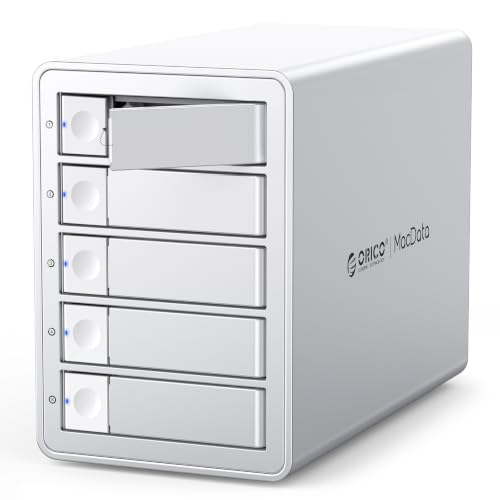
- 5-bay RAID enclosure with up to 104TB capacity
- USB 3.2 Gen 2x2, with USB4 needed for full 20Gbps
- RAID 0/1/5/10, JBOD, and Normal modes
Best For: High-volume video editors who want fast desktop RAID storage
Flexible Backup Hub
UGREEN 5-Bay USB-C DAS Enclosure

- 8 modes including RAID 0/1/3/5/10, JBOD, Large, Clone
- Up to 160TB total across 5 drives
- Smart cooling with S.M.A.R.T. fan control and sleep mode
Best For: Editors who want flexible RAID setups and large-capacity backup storage
High-Capacity RAID Bay
Yottamaster 5-Bay USB 3.0 RAID Enclosure
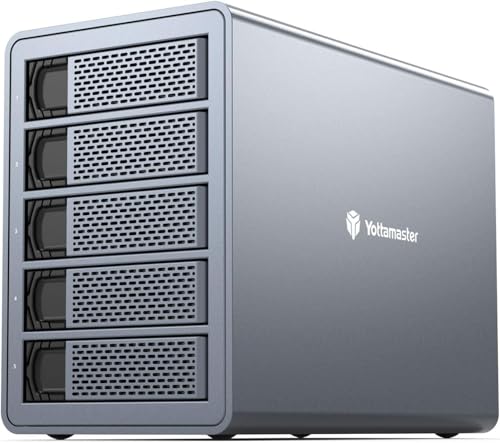
- Up to 120TB with five drive bays
- RAID 0/1/5/10, JBOD, CLONE, Normal
- Aluminum build with 80mm fan
Best For: Editors needing large-capacity DAS for media, backups, and archives
Budget-Friendly RAID Option
CENMATE 4-Bay Aluminum RAID Enclosure

- Up to 80TB across four SATA drives
- RAID 0/1/3/5/10, CLONE, LARGE, NORMAL
- USB A/C 3.0 and eSATA included
Best For: Small editing setups that need flexible RAID and multiple cable options
USB-C RAID Upgrade
Yottamaster 5-Bay USB-C RAID Enclosure

- Up to 110TB with five drive bays
- USB-C connection with 5Gbps transfer speed
- RAID 0/1/3/5/10, JBOD, CLONE support
Best For: Video editors wanting a USB-C five-bay DAS with flexible RAID modes
Speed-Focused 2-Bay RAID – TERRAMASTER D2-320 USB RAID Enclosure
If you need a raid enclosure for video editing that prioritizes speed and simplicity, the TERRAMASTER D2-320 is a compact 2-bay DAS with USB 3.2 Gen 2 and hardware RAID support. It’s a practical fit for editors who want fast local storage for active projects, with RAID 0 for performance and RAID 1 for mirrored protection.
Best For: Solo editors or small teams that want a fast, no-frills two-drive RAID enclosure for active footage and project storage.
Pros:
- USB 3.2 Gen 2 connection supports up to 10Gbps transfer speeds
- Hardware RAID options include RAID 0, RAID 1, JBOD, and SINGLE
- Up to 521MB/s in RAID 0 with HDDs; up to 1075MB/s with SSDs
- Tool-free trays and push-lock design make drive swaps easier
Cons:
- Only two drive bays, so expansion is limited
- It’s a DAS, not a NAS, so it’s meant for direct-attached use
Overall, this is a straightforward choice if you want fast direct-attached storage for editing without overcomplicating your setup. The mirrored RAID 1 mode also adds a useful layer of data protection for important project files.
High-Performance Thunderbolt Array – OWC ThunderBay 4 with SoftRAID
For a raid enclosure for video editing that needs serious throughput, the OWC ThunderBay 4 is built around Thunderbolt 3 and four-drive storage. With sustained performance up to 1527MB/s and SoftRAID Premium included, it’s aimed at users assembling a high-speed desktop array for demanding media work.
Best For: Editors who want a four-bay Thunderbolt RAID enclosure with flexible RAID modes and included management software.
Pros:
- Thunderbolt 3 connectivity for fast direct-attached performance
- Up to 1527MB/s sustained speed
- Supports RAID 0/1/4/5/1+0 (10) and JBOD
- Includes SoftRAID Premium with a 3-year subscription
Cons:
- Bulkier and heavier than smaller two-bay options
- Requires Thunderbolt-equipped Mac or PC for best use
This enclosure stands out when workflow speed and RAID flexibility matter more than compact size. It’s a strong fit for editors building a high-capacity scratch or project array on a Thunderbolt workstation.
Shared Editing NAS – Synology DS1525+ Video Editing Server
If you’re shopping for a raid enclosure for video editing but need shared network access instead of direct-attached storage, the Synology DS1525+ is built as a video editing and production server. It supports multi-user workflows, reaches up to 1,181 MB/s, and is 10GbE ready for teams working on 4K and 8K projects.
Best For: Production teams that need shared network storage for collaborative editing, media management, and growing archives.
Pros:
- Designed for editing 4K and 8K footage directly over the network
- Up to 1,181 MB/s and support for multiple editors simultaneously
- 10GbE ready for faster post-production workflows
- Can start at 100TB and expand to 300TB with DX525 units
Cons:
- It’s a NAS, not a direct-attached DAS enclosure
- Diskless unit means drives are purchased separately
This is the right pick when editing is collaborative and storage needs to scale with a growing media library. It’s less about a simple local enclosure and more about building a shared production hub.
Expandable 4-Bay Budget RAID – MAIWO 4 Bay HDD RAID Enclosure
This raid enclosure for video editing is a practical four-bay DAS for users who want more capacity and RAID options without stepping up to a network storage system. The MAIWO 4 Bay HDD RAID Enclosure supports multiple RAID modes, includes cooling fans, and is designed for large 3.5-inch SATA libraries.
Best For: Editors and power users who need a roomy 4-bay enclosure for backups, archives, and larger media libraries.
Pros:
- Supports RAID Normal, 0, 3, 5, 1/10, Clone, and Large (JBOD)
- Up to 96TB capacity with four 24TB drives
- Two built-in cooling fans help manage drive temperature
- USB A-C and C-C cables are included
Cons:
- USB 3.1 speed is limited to up to 5Gbps
- Designed for 3.5-inch SATA drives, so it is less flexible than mixed-format enclosures
If your editing workflow needs capacity and RAID versatility more than extreme transfer speeds, this enclosure covers the basics well. It’s especially useful for storing raw footage, backups, and long-term media archives.
High-Speed 5-Bay Workhorse – ORICO 5-Bay 20Gbps RAID Enclosure
If you need a raid enclosure for video editing that can handle large transfers and big project libraries, this ORICO 5-bay model is built around speed and capacity. The JMS591 upgrade, USB 3.2 Gen 2×2 support, and RAID flexibility make it a practical fit for editors who want a desktop storage box for active footage, archives, and backups.
Best For: Editors who want a high-capacity RAID enclosure for large media projects and fast USB 4/USB-C workflows.
Pros:
- Supports RAID 0, 1, 5, 10, JBOD, and Normal modes for different workflow and protection needs.
- Up to 20Gbps over USB 3.2 Gen 2×2, with USB4 able to reach the full bandwidth.
- Holds up to 5 drives and supports up to 104TB total capacity.
- Includes aluminum construction, a low-noise fan, hot-swapping, and a 150W power supply.
Cons:
- Thunderbolt connections are limited to about 10Gbps, so they won’t use the full 20Gbps speed.
- Changing RAID modes erases drive contents, so setup needs care and backups.
For editors with a lot of footage to move and store, this enclosure is strongest when connected to a USB4 port and configured once as the right RAID mode for the job. It is less about portability and more about dependable, high-volume desktop storage.
Flexible Backup Hub – UGREEN 5-Bay USB-C DAS Enclosure
This raid enclosure for video editing focuses on flexibility more than raw interface speed. The UGREEN 5-bay DAS supports a wide range of RAID and non-RAID modes, making it a useful choice for editors who want to reuse drives, organize backups, or build a protected media library on a single desktop unit.
Best For: Editors who value RAID flexibility, drive reuse, and safer multi-drive storage over maximum transfer speed.
Pros:
- Offers 8 storage modes, including RAID 0, 1, 3, 5, 10, JBOD, Large, and Clone.
- Supports up to 5 SATA HDDs/SSDs and up to 160TB total capacity.
- Includes smart cooling, S.M.A.R.T.-based fan control, and sleep behavior in PM mode.
- Works with Windows, macOS, and Linux, and uses a USB-C connection.
Cons:
- 5Gbps USB 3.2 Gen 1 speeds are much slower than higher-end editing enclosures.
- Changing RAID modes requires reformatting, so backups are essential.
If your editing setup prioritizes dependable storage organization and expansion rather than top-end throughput, this enclosure makes sense. It is especially appealing for users who want clear drive status, simple RAID options, and a large total pool for media libraries.
Portable All-Flash Option – ORICO 4-Bay 2.5-Inch RAID Enclosure
For a raid enclosure for video editing that leans toward portability, this ORICO all-flash model is designed around 2.5-inch SSDs and smaller drive footprints. It combines RAID support with extra USB and card-reader expansion, which makes it practical for editors and photographers working on the move.
Best For: Mobile editors and shooters who want compact SSD-based RAID storage with extra card and USB expansion.
Pros:
- Supports seven RAID modes, including RAID 0, 1, 3, 5, 10, JBOD, and CLEAR.
- Uses a USB 3.2 Gen 2 interface and can reach up to 10Gbps with a PSSD.
- Includes two 10Gbps USB ports plus SD and TF 3.0 card slots for workflow expansion.
- Compact all-flash design is over 50% smaller than traditional 3.5-inch enclosures and has no mechanical parts.
Cons:
- Only supports 2.5-inch drives, so it is not for 3.5-inch HDD users.
- Total capacity is capped at 40TB, which is lower than larger desktop enclosures.
This enclosure makes the most sense when mobility matters as much as storage structure. Its smaller, shock-resistant design and built-in card/USB expansion fit field workflows better than bulky bay units.
High-Capacity RAID Bay – Yottamaster 5-Bay USB 3.0 RAID Enclosure
If you need a RAID enclosure for video editing that can handle large media libraries, this Yottamaster 5-bay unit is built for exactly that kind of workflow. It supports up to 120TB, runs over USB 3.0, and offers RAID 0/1/5/10, JBOD, CLONE, and Normal modes for flexible project storage and backup.
Best For: Editors who want high-capacity, hardware RAID storage for on-location or studio workflows.
Pros:
- Supports up to 120TB across five SATA drives.
- Hardware RAID modes include RAID 0/1/5/10, JBOD, CLONE, and Normal.
- Aluminum body and built-in 80mm fan help with heat management.
- Works with both 2.5-inch and 3.5-inch HDDs/SSDs.
Cons:
- USB 3.0 maxes out at 5Gbps, which may not satisfy everyone seeking the fastest transfers.
- Sleep mode defaults to 10 minutes, though it can be adjusted or canceled.
This is a practical choice if you want a large, flexible DAS setup for editing, backups, and archive storage. It prioritizes capacity, cooling, and RAID versatility over more advanced connectivity options.
Budget-Friendly RAID Option – CENMATE 4-Bay Aluminum RAID Enclosure
This raid enclosure for video editing is a compact 4-bay option for users who want RAID flexibility without jumping to a five-drive system. It supports 2.5-inch and 3.5-inch SATA HDDs/SSDs, includes USB A/C 3.0 and eSATA connections, and offers multiple RAID modes for storage, backup, and duplication workflows.
Best For: Individuals or small teams who want a 4-bay DAS with multiple connection options.
Pros:
- Supports up to 80TB total capacity with four drives.
- Offers RAID 0/1/3/5/10, CLONE, LARGE, and NORMAL modes.
- Includes USB A/C 3.0 plus eSATA cables for connectivity flexibility.
- Aluminum construction and cooling fan support drive stability.
Cons:
- Hot-swapping is not supported.
- eSATA RAID access depends on the computer’s eSATA port supporting RAID functionality.
- Fan noise is noted at around 40-50 dB, which may be noticeable in quiet spaces.
If you want a straightforward multi-bay enclosure with broad RAID support, this CENMATE model covers the basics well. It’s best suited to users who value practical storage expansion and can work within its eSATA and swap limitations.
USB-C RAID Upgrade – Yottamaster 5-Bay USB-C RAID Enclosure
For a raid enclosure for video editing with a newer USB-C connection, this Yottamaster 5-bay model balances capacity, cooling, and RAID flexibility. It supports up to 110TB, works with 2.5-inch and 3.5-inch SATA HDDs/SSDs, and offers RAID 0/1/3/5/10, JBOD, and CLONE modes for different project and backup needs.
Best For: Editors who want a USB-C DAS with five bays and adjustable RAID configurations.
Pros:
- USB-C connection with up to 5Gbps transfer speeds.
- Supports up to 110TB total storage across five drives.
- RAID 0/1/3/5/10, JBOD, and CLONE modes support flexible workflows.
- Aluminum shell and 80mm intelligent fan help keep drives cool.
Cons:
- Total drive power consumption should not exceed 78W.
- New drives may need formatting and partitioning before use.
This is a strong fit if you want a modern USB-C enclosure with plenty of drive bays and built-in RAID choices. It’s especially appealing for editors who want one box for active projects, backups, and long-term storage.
How We Picked the Best Raid Enclosure for Video Editing
For a Raid Enclosure for Video Editing, the most important factors are sustained transfer speed, RAID flexibility, drive capacity, cooling, and connection type. We prioritized models that can handle large media files, support common SATA drives or SSDs, and offer practical expansion for growing projects.
We also favored enclosures with clearer workflow advantages, such as faster interfaces for timeline work, easier drive replacement, and better support for multi-user or shared production environments.
Quick Comparison
In simple terms, USB 3.2 enclosures are often a good value for solo editors and archive storage, while Thunderbolt models are better for demanding real-time editing. NAS systems are the best fit when the goal is shared access, centralized storage, and collaborative production rather than direct-attached speed.
Key Buying Factors for a Raid Enclosure for Video Editing
Interface Speed
Your connection matters as much as the drives themselves. Thunderbolt and faster USB standards are better for editing high-bitrate footage and moving large projects quickly. Slower links may still work for backups or lighter workloads.
RAID Mode and Data Protection
Choose the RAID level based on your priorities. RAID 0 increases speed but offers no redundancy. RAID 1, 5, and 6 improve protection, while JBOD or individual-disk modes can be useful for flexibility. Match the mode to your risk tolerance and workflow.
Drive Type and Capacity
HDDs usually offer the best cost per terabyte, which is useful for media libraries and backups. SSD-based systems are faster and quieter, making them attractive for active projects, but they cost more per terabyte.
Cooling and Build Quality
Long editing sessions generate heat, especially with multiple drives. Look for metal housings, active cooling, and sensible airflow to help maintain performance and drive longevity.
Compatibility and Workflow
Make sure the enclosure works with your editing computer, operating system, and preferred drives. If you collaborate often, a NAS may be more practical than a direct-attached enclosure. If you work solo and want low latency, a DAS is usually the better choice.
Who Should Buy Which Raid Enclosure for Video Editing?
Solo editors on a budget should look at USB-based multi-bay enclosures that balance capacity and value. Editors working with 4K/6K footage or heavy timelines should lean toward faster Thunderbolt or high-bandwidth USB options. Teams, studios, and creators who need shared access should consider a NAS-style solution.
If your priority is raw editing performance, choose the fastest connection your system supports. If your priority is storing large media libraries reliably, focus on capacity, cooling, and the RAID level that best matches your backup strategy.