Choosing the right reader can make asset tracking faster, more accurate, and easier to scale. The best USB RFID readers for asset management depend on your tags, software, and workflow.
Below, we break down the top options for offices, warehouses, labs, and IT teams so you can match the right device to your system without overspending.
Best 10 USB RFID Readers for Asset Management Picks for 2026
UHF Long-Range Desktop Capture

- USB keyboard emulation for direct tag entry
- Up to 50 cm read range for UHF assets
- SDK and read-write mode for custom setups
Best For: Desktop asset tracking and simple UHF inventory capture
Driverless NFC Badge Reader
Cryptnox USB-C Smart Card Reader

- Reads FIDO2, MIFARE, and ISO 14443 cards
- Driverless setup on Windows and macOS
- USB-C native with USB-A adapter included
Best For: NFC badges and smart-card authentication on modern systems
Windows UHF Writer With SDK

- UHF 860–960 MHz read/write support
- Virtual keyboard and serial port modes
- Free SDK plus user guides included
Best For: Windows inventory teams needing configurable UHF read/write support
Dual-Frequency Plug-and-Play Badge Reader

- Reads 125 kHz and 13.56 MHz cards
- HID USB mode with no driver request
- Wide OS support including Windows, Linux, and mobile
Best For: Mixed-format badge and proximity card workflows
Portable UHF Mobile Reader
A7 Portable UHF RFID Reader Writer
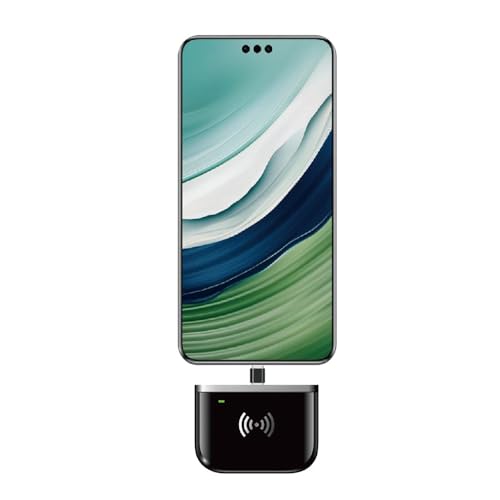
- 902-928 MHz UHF reader-writer
- USB-C and Bluetooth 5.0 connectivity
- Works with Windows, Android, and iOS
Best For: Mobile asset tracking with close-range UHF scanning
Dual-Frequency USB Badge Reader
125KHz/13.56MHz USB RFID Scanner

- Reads both 125KHz and 13.56MHz cards
- Plug-and-play USB with keyboard emulation
- Compatible with Linux, Android, Windows, Mac, and iOS
Best For: Mixed-card environments needing a simple USB reader
13.56MHz HID Card Reader
13.56MHz USB RFID Keyboard Emulator

- Reads ISO14443A 13.56MHz cards
- HID USB with no driver requested
- Works with Raspberry Pi, Linux, Android, Windows, and macOS
Best For: Simple 13.56MHz card reading in existing software
Most Flexible Dual-Frequency Pick
Durable 125KHz/13.56MHz USB Card Reader

- Reads both 125KHz and 13.56MHz tags
- Supports EM4100, ISO Prox, MFS50/S70, and 14443A/B
- USB HID-style, plug-and-play operation
Best For: Mixed badge environments that need broad card compatibility
Easiest Setup Option
Plug-and-Play Dual-Band USB RFID Card Reader

- Plug-and-play USB operation
- Reads 125KHz and 13.56MHz cards
- Includes status lights and buzzer feedback
Best For: Simple asset-tracking setups that prioritize easy installation
Broadest Protocol Support
Metal Case Dual-Frequency USB RFID Scanner
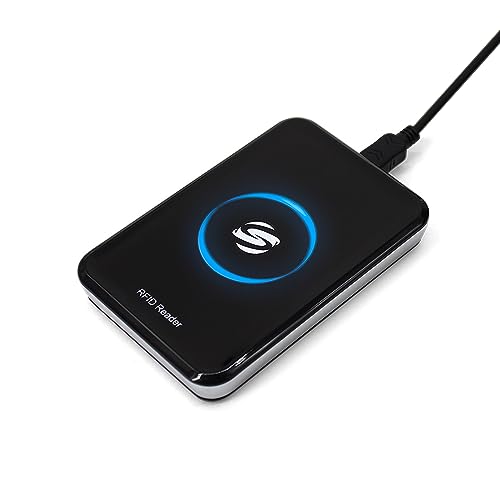
- Reads 125KHz and 13.56MHz cards
- Supports EM4100, ISO Prox, MFS50/S70, and 14443A/B
- 40 output formats with configurable card numbers
Best For: Windows-focused workflows needing wide card compatibility
UHF Long-Range Desktop Capture – Fongwah UHF RFID Reader
If you need USB RFID readers for asset management that can capture UHF tags directly into spreadsheets or text fields, this Fongwah model is built for simple desktop workflows. It works as a keyboard emulator out of the box on Windows and Linux, while also offering a read-write mode and SDK support for custom integration.
Best For: Desktop asset tracking, inventory entry, and teams that want plug-and-play tag capture with optional developer integration.
Pros:
- USB HID keyboard emulation lets tag data appear in Excel, Notepad, or other text fields without driver setup.
- Reads UHF ISO18000-6C / EPC C1 Gen 2 tags with up to 50 cm reading distance.
- Adjustable 0 to 20 dBm output power helps tune range and reduce interference.
- Includes SDK support and a mode switch for either simple use or custom software integration.
Cons:
- Focused on UHF tags, so it is not a dual-frequency reader for 125 kHz or NFC badges.
- Long-range performance may need careful power tuning in dense electronic environments.
This is a strong choice when you want a USB reader that can streamline asset logging without forcing a complicated software rollout. The combination of keyboard emulation and SDK support makes it flexible for both office users and developers.
Driverless NFC Badge Reader – Cryptnox USB-C Smart Card Reader
For USB RFID readers for asset management that also need badge or smart-card authentication, this USB-C reader is a practical contactless option. It is CCID and PC/SC compliant, reads common ISO 14443 cards, and works driverlessly on Windows and macOS with Linux support via standard libraries.
Best For: NFC badges, FIDO2 cards, and contactless access workflows on modern laptops and desktops.
Pros:
- Reads FIDO2 cards, MIFARE badges, NFC payment cards, and other ISO 14443 Type A/B smart cards.
- Driverless plug-and-play operation on Windows and macOS simplifies deployment.
- Native USB-C plus included USB-C to USB-A adapter improves compatibility.
- Android USB OTG support makes it useful for mobile authentication workflows.
Cons:
- Limited to contactless smart cards, not UHF asset tags.
- USB-A use is via adapter and runs at USB 2.0 speed.
This reader fits organizations that want a clean, standards-based NFC solution rather than a long-range inventory scanner. It is especially useful when asset control, badge access, or identity verification overlap in the same workflow.
Windows UHF Writer With SDK – Yanzeo SR3308 RFID Reader
Yanzeo SR3308 860-960Mhz UHF RFID Reader Writer USB RFID Reader Free SDK User Guides
Check Price On AmazonIf you want USB RFID readers for asset management with both read and write support, the Yanzeo SR3308 is built around UHF EPC Gen2 workflows. It connects by USB, supports virtual keyboard or serial port modes on Windows, and includes a free SDK for custom development.
Best For: Windows-based inventory, warehouse, and retail teams that need UHF read/write functionality.
Pros:
- Supports 860 to 960 MHz UHF tags, including ISO18000-6C / EPC Gen2 and ISO18000-6B.
- Virtual keyboard and serial port modes provide flexible integration options.
- Free SDK and user guides help with custom setup and development.
- Low power draw and USB or +5V operation support stable desktop use.
Cons:
- Driver installation is required before use.
- Officially described as Windows-compatible, so it is less cross-platform than driverless alternatives.
This model makes sense when your asset tracking process needs writing as well as reading, not just scan-and-record behavior. It offers useful flexibility, but the setup is better suited to users comfortable installing drivers and working with a Windows environment.
Dual-Frequency Plug-and-Play Badge Reader – Ajfwm ID IC Card Reader
When your USB RFID readers for asset management need to handle both low-frequency ID cards and 13.56 MHz NFC-style cards, this Ajfwm unit offers broad dual-frequency compatibility. It acts as a HID USB device with no driver request and can simulate keyboard input on Windows, Linux, Mac, Android, and iOS.
Best For: Mixed card environments where 125 kHz and 13.56 MHz badge reading need to work from one USB device.
Pros:
- Reads both 125 kHz and 13.56 MHz cards, including EM4100, ISO Prox, and ISO14443-A/B formats.
- HID keyboard-style operation means no driver is required.
- Supports many output formats for EM4100 UID and 1326-family card data.
- Works across Windows, Linux, Android, Mac, and iOS according to the product notes.
Cons:
- More focused on proximity and access-card workflows than long-range asset tag scanning.
- Card-reader-only design means it does not handle UHF inventory tags.
This is a versatile pick if your asset or access process uses several card standards and you want the simplest possible connection. The tradeoff is range and specialization: it is more of a universal badge reader than a dedicated inventory scanner.
Portable UHF Mobile Reader – A7 Portable UHF RFID Reader Writer
If you need USB RFID readers for asset management that can also move around the office or warehouse, this portable UHF model is built for that kind of flexible work. It supports 902-928 MHz operation, USB Type-C and Bluetooth 5.0, and works across Windows, Android, and iOS with included app and demo software.
Best For: Mobile asset tracking teams that want a portable UHF reader with both USB-C and Bluetooth connectivity.
Pros:
- Supports ISO18000-6C/6B and EPC C1G2 protocols for UHF tags
- USB Type-C and Bluetooth 5.0 give you wired or wireless use options
- Portable design makes it easier to carry between scan points
- Works with Windows, Android, and iOS
Cons:
- Read range is listed up to 30 cm, so it is not a long-range fixed reader
- Write distance is shorter at up to 10 cm
- UHF-focused unit will not suit low-frequency or 13.56 MHz use cases
For teams that want a compact UHF reader-writer for hands-on inventory checks, this model offers a practical mix of portability and cross-platform support. It is a better fit for close-range asset management workflows than for doorway or dock-level scanning.
Dual-Frequency USB Badge Reader – 125KHz/13.56MHz USB RFID Scanner
For USB RFID readers for asset management in mixed-card environments, this dual-frequency scanner is useful when you need one device that can read both 125KHz and 13.56MHz cards. It is a USB Type-A plug-and-play reader that simulates keyboard input, so it can drop card data into many existing workflows without driver setup.
Best For: Environments that need a simple USB reader for both low-frequency and 13.56MHz cards.
Pros:
- Reads both 125KHz and 13.56MHz card families
- USB device works without driver requests
- Keyboard-emulation output helps with simple data entry
- Supports Linux, Android, Windows, Mac, and iOS
Cons:
- Card reader only, so it does not write or encode tags
- Best suited to proximity card workflows rather than UHF asset tags
- Setup flexibility depends on using its supported output formats
This is a practical choice if your asset or access process involves mixed proximity card types and you want a straightforward USB reader. Its strength is compatibility and ease of use, not advanced tag programming.
13.56MHz HID Card Reader – 13.56MHz USB RFID Keyboard Emulator
If you want USB RFID readers for asset management that focus on 13.56MHz cards, this compact reader is designed for simple plug-in use. It sends card data to the cursor location as HID USB input, making it a straightforward option for systems that can accept keyboard-style entry.
Best For: Simple 13.56MHz card reading in existing software without driver installation.
Pros:
- Supports ISO14443A protocol cards
- HID USB mode means no driver is requested
- Emulates keyboard output for easy integration
- Compatible with Raspberry Pi, Linux, Android, Windows, and macOS
Cons:
- 13.56MHz only, so it will not handle 125KHz cards
- Reader-focused device, not a full-featured writer for broad tag workflows
- Listed as supporting common formats, but it is still limited to ISO14443A cards
This reader makes sense when you need a no-fuss 13.56MHz USB device that works like a keyboard input tool. It is best for lightweight card capture rather than broader multi-frequency asset tracking.
Most Flexible Dual-Frequency Pick – Durable 125KHz/13.56MHz USB Card Reader
If you’re comparing USB RFID readers for asset management, this dual-frequency model is built for simple keyboard-style input with broad card support. It reads both 125KHz and 13.56MHz cards, including EM4100 ID cards, ISO Prox family cards, MFS50/S70, and other 14443A/B protocol tags, making it a practical pick when you need one reader for mixed badge types.
Best For: Multi-card environments that need a plug-and-play USB reader for both 125KHz and 13.56MHz tags.
Pros:
- Reads 125KHz and 13.56MHz cards in one device.
- Supports EM4100, ISO Prox family cards, MFS50/S70, and 14443A/B protocol tags.
- USB HID-style operation with no driver request.
- Offers 40 output formats and configurable card number output.
Cons:
- Described as card reader only, so it does not handle writing or encoding.
- Requires using the supplied format/output options to match your workflow.
This is a strong fit if your asset-management setup needs broad compatibility and straightforward USB use rather than advanced software integration. The metal case and configurable output formats add flexibility for teams tracking varied card types.
Easiest Setup Option – Plug-and-Play Dual-Band USB RFID Card Reader
For buyers looking at USB RFID readers for asset management, this dual-band card reader keeps setup simple with plug-and-play USB operation and keyboard-style input. It supports 125KHz and 13.56MHz cards, including EM4100, ISO Prox family cards, and other 14443A/B protocol tags, so it can cover common badge and ID card workflows without extra hardware complexity.
Best For: Teams that want an easy USB reader for Windows-based asset tracking and mixed-card use.
Pros:
- Plug in and play USB operation with no driver request noted.
- Reads both 125KHz and 13.56MHz proximity cards.
- Supports EM4100, ISO Prox, and 14443A/B protocol cards.
- Includes status lights and a built-in buzzer for swipe feedback.
Cons:
- Listed as card reader only, so it is not an encoder.
- Specification details vary across the listing, so setup expectations should be checked carefully.
This model is a practical choice if you want a straightforward reader for day-to-day scanning and asset entry. Its status indicators and broad OS support make it easy to fit into a simple inventory or badge-reading workflow.
Broadest Protocol Support – Metal Case Dual-Frequency USB RFID Scanner
When you need USB RFID readers for asset management, this metal-case dual-frequency scanner offers broad tag support and USB keyboard emulation for straightforward data entry. It reads 125KHz and 13.56MHz cards, including EM4100, ISO Prox family cards, MFS50/S70, and 14443A/B protocol labels, which makes it suitable for mixed card environments.
Best For: Users who need a broad-compatibility USB reader and can work around the Mac limitation.
Pros:
- Supports 125KHz and 13.56MHz dual-frequency reading.
- Handles EM4100, ISO Prox, MFS50/S70, and other 14443A/B tags.
- USB HID device behavior with no driver request.
- Offers 40 output formats and configurable card-number display.
Cons:
- Not compatible with Mac unless used with a USB converter.
- Windows may require a VCRedist 2008 SP1 patch if it does not work immediately.
- H10301 and 8310 cards are noted as unsupported.
This reader stands out for broad tag support and configurable output, but it also has the clearest setup caveats of the three. If your environment is Windows-focused and your card types match the supported list, it can be a useful fit for asset management workflows.
How We Picked the Best USB RFID Readers for Asset Management
We focused on devices that fit real-world asset workflows: reliable tag reading, clear frequency support, simple USB connectivity, and practical software integration. We also considered whether a reader is better suited to fixed desktop use, long-range scanning, or mobile inventory tasks.
Quick Comparison
For basic check-in/check-out and badge-style inventories, simple desktop readers are usually enough. For faster audits, mixed tag environments, or shelves and racks with harder-to-reach labels, long-range UHF or dual-frequency models are more flexible. If you need portability, look for USB-C, Bluetooth, or cross-platform support so the reader can move between stations or devices.
Key Buying Factors for USB RFID Readers for Asset Management
Frequency and Tag Type
Make sure the reader matches the tags already attached to your assets. Common choices include 125KHz low-frequency ID tags, 13.56MHz HF/NFC cards, and UHF ISO18000-6C / EPC Gen 2 tags. If your inventory includes multiple tag families, a dual-frequency reader can reduce compatibility problems.
Range and Reading Style
Short-range desktop readers work well for single-item scans at a desk or gate. UHF readers are better when you need quicker batch reads or a longer scan distance. Keyboard-emulation models are easy to deploy, while SDK-based devices are better if you want custom software or automated workflows.
Platform and Software Compatibility
Check support for Windows, macOS, Linux, Android, or iOS if you plan to use the reader across multiple systems. For asset management software, SDKs, driverless operation, and standard USB input modes can save a lot of setup time.
Form Factor and Durability
Desktop units are ideal for fixed workstations, while portable readers help with audits and field checks. Metal housings may be useful in busier environments, but the best choice is the one that matches how often the device will be moved and how rough the environment is.
Who Should Buy Which USB RFID Readers for Asset Management?
If you need straightforward asset check-ins, choose a simple USB desktop reader with the correct frequency for your tags. If you manage larger inventories or want faster counts, choose a UHF reader with better range and SDK support. If your team uses mixed badge and asset credentials, a dual-frequency model is usually the safest option. For mobile or multi-device setups, prioritize portable connectivity and broad OS support.
In short, the best USB RFID Readers for Asset Management are the ones that match your tag standard, software stack, and daily scanning volume—not just the longest range or lowest price.