Reliable wireless video transmission can make a major difference when you stream from cameras, gimbals, studios, or event venues. The right system sends a clean, low-latency feed to a receiver, monitor, switcher, or computer without forcing you to run long cables.
We selected 10 video transmitters for live streaming across different budgets and workflows, including HDMI and SDI models, UVC-capable systems, multi-device monitoring options, and long-range professional kits.
Best 10 Video Transmitters for Live Streaming Picks for 2026
Best Dual-Band Streaming Stability

- Dual-band 2.4/5GHz transmission
- 1080p60 with under 0.06s latency
- UVC output and four-device monitoring
Best For: Production crews and live events needing stable, flexible monitoring
Best Long-Range SDR System

- Up to 3 km transmission distance
- 1080p60 video at up to 20 Mbps
- SDI, HDMI, USB-C, and Broadcast mode
Best For: Large or complex productions requiring extended wireless range
Best Direct RTSP Streaming

- RTSP output for OBS, vMix, or VLC
- SDI/HDMI support with 0.08s latency
- Three power options for location work
Best For: Event and indie production teams using network-based streaming
Best Compact Mobile Monitoring

- 1080p60 transmission to four mobile devices
- 500-foot range with 0.06s latency
- Clamp and gimbal mounting options
Best For: Solo shooters and small crews using phone-based monitoring
Best Multi-Camera Workflow

- Two transmitters and one receiver
- HDMI, SDI, NDI, UVC, and RTMP support
- 3,000ft range with 33ms latency
Best For: Multi-camera live events and professional production crews
Best 4K Long-Range Option

- End-to-end 4K60 transmission
- 25ms latency and claimed 2.5km range
- Tri-band 2.4GHz, 5GHz, and 6GHz wireless
Best For: Professional 4K filming and extended-distance monitoring
Best On-Set Monitoring Kit
Wireless HDMI Transmitter with 7-inch Monitor
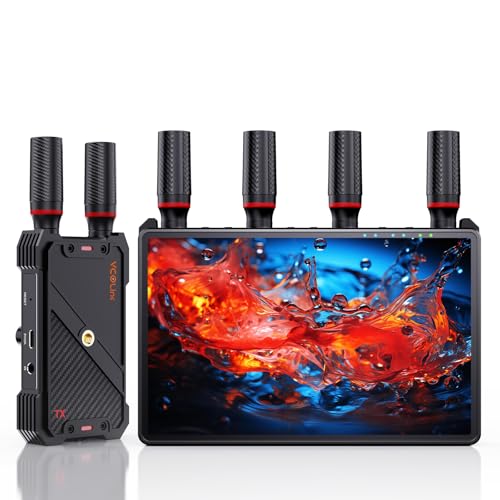
- Built-in 7-inch receiver display
- One transmitter can feed up to five receivers
- 1080p60, 1,312ft range, and HDMI loop-out
Best For: Collaborative film sets and live production monitoring
Best Low-Latency Value

- 1080p60 HDMI transmission
- Up to 600-foot range
- Fanless design with loop-out
Best For: Portable live streaming and wireless monitoring
Best for Osmo Pocket 3 Streaming

- Built-in Osmo Pocket 3 Type-C connector
- UVC output for direct PC streaming
- 20 channels and up to five receivers
Best For: Pocket 3 creators and multi-screen broadcasts
Best 4K Production System

- 4K30 HDMI transmission
- 1,300-foot range with 60ms latency
- UVC streaming and up to four receivers
Best For: Professional crews and multi-viewer live production
Best Dual-Band Streaming Stability – Accsoon CineView HE
For creators who need dependable video transmitters for live streaming, the Accsoon CineView HE combines dual-band 2.4GHz and 5GHz transmission with 1080p60 video, low latency, and a receiver with UVC output. Its HDMI loop-out and multi-device monitoring also make it practical for shoots involving both a streaming computer and an on-set crew.
Best For: Live productions and video crews that need stable long-distance transmission, computer-based streaming without a separate capture device, and monitoring on up to four devices.
Pros:
- Dual-band transmission is designed to reduce interference and signal dropouts.
- Supports 1080p60 transmission with latency under 0.06 seconds and a stated range of up to 1,200 feet.
- Receiver UVC output can connect to a computer for streaming through platforms such as OBS and YouTube.
- One transmitter can send to up to four receivers or mobile devices, with HDMI loop-out for a zero-latency monitoring path.
Cons:
- Battery and charging cables are not included.
- UVC computer streaming requires a user-provided USB-C cable.
- The system is more feature-rich than necessary for simple, short-range monitoring.
The CineView HE is a strong all-around option when stability, crew monitoring, and direct computer streaming matter more than minimal setup. Its flexible power options and dual-band design suit demanding event and production environments.
Best Long-Range SDR System – DJI SDR Transmission Combo
The DJI SDR Transmission Combo is built for demanding video transmitters for live streaming and monitoring setups where distance, interference resistance, and image quality are priorities. It supports 1080p60 video at up to 20 Mbps, offers SDI, HDMI, and USB-C monitoring, and can reach up to 3 kilometers in suitable conditions.
Best For: Large productions, complex locations, and teams that need long-range wireless monitoring, strong signal penetration, or multiple receivers in Broadcast mode.
Pros:
- SDR transmission automatically hops across 2.4GHz, 5.8GHz, and DFS bands to help avoid interference.
- Offers a stated transmission distance of up to 3 kilometers with enhanced penetration.
- Supports 1080p60 video, up to 20 Mbps bitrate, and minimal latency of 35 milliseconds.
- Provides SDI, HDMI, USB-C, and direct Wi-Fi monitoring options, plus unlimited receivers in Broadcast mode.
Cons:
- The advanced SDR feature set may be excessive for basic short-range streaming.
- Actual range and performance depend on the shooting environment.
- Its strongest feature set is geared toward professional production workflows rather than casual use.
DJI’s system stands out when a production needs maximum reach and flexible monitoring connections. Ronin compatibility and remote-control features add value for crews already using compatible DJI stabilization equipment.
Best Direct RTSP Streaming – Hollyland Mars 400S Pro
The Hollyland Mars 400S Pro is a practical choice among video transmitters for live streaming when you want SDI and HDMI support plus a direct network-based workflow. Its receiver can feed RTSP video to OBS, vMix, or VLC through a Type-C-to-RJ45 connection, while low latency and multiple power options support mobile production.
Best For: Broadcasters, event videographers, and indie filmmakers who want direct RTSP streaming and flexible power in a compact transmitter-receiver system.
Pros:
- Supports RTSP live streaming without requiring additional video capture equipment.
- Provides SDI and HDMI connectivity, up to 12 Mbps data rate, and 0.08-second latency.
- Offers up to 400 feet of transmitter-to-receiver line-of-sight range.
- Supports L-series batteries, 6–16V DC, and 5–12V USB-C power.
Cons:
- Its stated range is shorter than the long-distance systems in this roundup.
- RTSP streaming requires a Type-C-to-RJ45 connector and standard RJ45 cable.
- The monitoring configuration limits vary depending on the combination of receivers and mobile apps used.
The Mars 400S Pro is especially appealing if your streaming workflow is built around Ethernet networking and software such as OBS or vMix. Its three-way power support also makes it adaptable for events, weddings, and location shoots.
Best Compact Mobile Monitoring – Accsoon CineView Nano
The Accsoon CineView Nano is a compact option for video transmitters for live streaming when a small camera setup and phone-based monitoring are more important than a dedicated receiver. It sends 1080p60 video to up to four iOS or Android devices, and the Accsoon SEE app supports monitoring, recording, streaming, and sharing.
Best For: Solo creators, gimbal operators, and small crews that want lightweight phone monitoring with a simple mobile workflow.
Pros:
- Sends 1080p60 video to up to four iOS or Android devices at once.
- Offers a stated 500-foot range and latency of 0.06 seconds.
- Accsoon SEE supports monitoring, recording, streaming, and sharing.
- Detachable phone clamp can be replaced with the included plate for DJI RS2/RS3 gimbals.
Cons:
- Its mobile-device-focused design does not provide the listed SDI, HDMI receiver, or UVC features of larger systems.
- The 500-foot range is more limited than long-range professional transmitters.
- Phone and app compatibility are central to the workflow.
The CineView Nano makes the most sense when portability and quick phone access are the priorities. Its detachable clamp and gimbal plate are useful for balancing a compact camera rig while keeping multiple viewers connected.
Best Multi-Camera Workflow – Hollyland Cosmo C2
For production teams comparing video transmitters for live streaming, the Hollyland Cosmo C2 stands out as a two-transmitter, one-receiver system with HDMI and SDI connectivity. It supports 1080p60 transmission, up to 3,000 feet of line-of-sight range, 33ms latency, and built-in NDI, UVC, and RTMP streaming options.
Best For: Multi-camera productions, live events, and crews that need flexible HDMI/SDI connections and direct streaming workflows.
Pros:
- Includes two transmitters and one receiver for synchronized multi-camera use.
- Supports HDMI, SDI, NDI, UVC, and RTMP workflows.
- Offers 3,000 feet of line-of-sight range with 33ms latency.
- Uses seamless frequency hopping and supports DC, NP-F, and V-Mount power options.
Cons:
- Limited to 1080p60 rather than 4K transmission.
- The seven-pound kit may be less convenient for lightweight setups.
- Its broad feature set may be more than a simple single-camera stream requires.
The Cosmo C2 is a strong choice when a live-streaming setup needs multiple camera feeds, professional SDI support, and several paths to a computer or streaming platform. Its larger kit and 1080p ceiling make it less suited to compact 4K workflows.
Best 4K Long-Range Option – Accsoon CineView Master 4K
The Accsoon CineView Master 4K is aimed at demanding video transmitters for live streaming and production monitoring. It provides end-to-end 4K60 video, 25ms latency, and a claimed 2.5km transmission distance, while its tri-band 2.4GHz, 5GHz, and 6GHz system is designed to manage connections dynamically.
Best For: Professional 4K productions, long-distance camera monitoring, and crews prioritizing low latency.
Pros:
- Transmits end-to-end 4K video at up to 60 frames per second.
- Provides a claimed 2.5km range under suitable conditions.
- Uses 2.4GHz, 5GHz, and 6GHz tri-band transmission.
- Offers 25ms latency for responsive monitoring and camera operation.
Cons:
- This listing is for one transmitter rather than a complete transmitter-and-receiver kit.
- It relies on HDMI connectivity, without the SDI connections offered by some professional systems.
- Its advanced 4K capabilities may be unnecessary for basic 1080p streaming.
Choose the CineView Master 4K when resolution, range, and responsive monitoring matter most. Before buying, confirm that the rest of the transmission system and your camera workflow are compatible, since the supplied listing identifies this product as a transmitter unit.
Best On-Set Monitoring Kit – Wireless HDMI Transmitter with 7-inch Monitor
This wireless HDMI system is a practical pick among video transmitters for live streaming when built-in monitoring and team viewing are priorities. The receiver includes a 7-inch display, supports 1080p60 transmission up to 1,312 feet with less than 0.05 seconds of latency, and can send one transmitter feed to as many as five receivers.
Best For: Film sets, studios, and live crews that need private monitoring plus shared HDMI displays.
Pros:
- Built-in 7-inch receiver monitor reduces the need for an extra screen.
- Supports one-to-five receiver distribution for on-set collaboration.
- Includes HDMI loop-out, IR remote control, and a 3.5mm headphone connection.
- Offers NP-F battery, power bank, and USB-C power options.
Cons:
- Supports 1080p rather than 4K video.
- An HDMI cable for external display output is not included.
- Smartphone or tablet use requires a Type-C-to-HDMI cable.
This system makes sense for productions where the receiver’s integrated screen and expandable multi-viewer setup can simplify monitoring. It is less appropriate if your workflow requires SDI, 4K output, or a very compact receiver without an integrated display.
Best Low-Latency Value – Shimbol TP Mini
If you need practical video transmitters for live streaming, the Shimbol TP Mini offers a straightforward HDMI setup with up to 1080p60 video, simultaneous audio and video transmission, and latency as low as 0.07 seconds. Its 600-foot claimed range suits many event, sports, and production setups.
Best For: Live broadcasters, camera operators, and small production teams that want a compact wireless HDMI link with low latency and simple operation.
Pros:
- Supports up to 1080p60 transmission with audio and video together.
- Up to 600 feet of range and intelligent frequency hopping help support stable connections.
- HDMI loop-out, fanless operation, and USB-C power-bank support add flexibility.
- NP-F550 battery operation is rated for up to eight hours, though batteries are not included.
Cons:
- Limited to 1080p rather than 4K transmission.
- NP-F batteries must be purchased separately.
- Real-world range can vary with obstacles and interference.
The TP Mini is a sensible choice when low latency and portability matter more than 4K resolution. Its loop-out and multiple power options make it easy to integrate into a mobile streaming or monitoring kit.
Best for Osmo Pocket 3 Streaming – Vrriis WL087PRO
Among video transmitters for live streaming, the Vrriis WL087PRO stands out for its built-in Type-C connection for the DJI Osmo Pocket 3 and UVC output for direct computer streaming. It can send 1080p video at up to 60Hz and supports OBS-style workflows without a separate capture device.
Best For: Osmo Pocket 3 users, PC-based streamers, and teams needing multi-screen monitoring with flexible wireless connections.
Pros:
- Built specifically for the DJI Osmo Pocket 3 with a built-in Type-C transmitter connector.
- UVC output can connect directly to a computer for live streaming at up to 1080p60.
- Offers 20 adjustable channels, an LCD status display, and claimed latency as low as 0.05 seconds.
- Supports one transmitter to up to five receivers and includes HDMI loop-out.
Cons:
- Its 1,640-foot range claim applies to open, unobstructed conditions.
- Walls, glass, and especially metal obstacles can reduce signal coverage.
- NP-F batteries are not included.
This is the most specialized option in the group. Its UVC output and Pocket 3 compatibility simplify computer streaming, while the channel selection and multi-receiver support suit collaborative broadcasts.
Best 4K Production System – Hollyland Pyro H
For demanding video transmitters for live streaming, the Hollyland Pyro H combines HDMI transmission up to 4K30 with dual-band 2.4GHz and 5GHz operation. Smart channel scanning, UVC streaming, and support for up to four receivers make it well suited to professional monitoring and broadcast teams.
Best For: Film crews, live production teams, ENG/EFP operators, and streamers who need 4K input support and multiple monitoring points.
Pros:
- Supports HDMI video formats up to 3840×2160 at 24, 25, or 30fps.
- Claims up to 1,300 feet of range with 60ms latency in suitable conditions.
- Dual-band wireless operation and smart channel scanning help manage frequency selection.
- Can transmit to up to four receivers and supports UVC live streaming to a computer.
Cons:
- 4K transmission is limited to 30fps; 1080p60 is the higher-frame-rate option noted.
- The listed kit includes one transmitter and one receiver, with additional receivers needed for larger setups.
- Its professional feature set may be more than necessary for basic single-camera streaming.
The Pyro H is the strongest fit for production environments where resolution, crew monitoring, and computer streaming all matter. Its dual-band design and receiver expansion provide more room to grow than a basic wireless HDMI kit.
How We Picked the Best Video Transmitters for Live Streaming
We compared these systems by looking at the features that matter during real productions: supported inputs and outputs, maximum resolution and frame rate, stated transmission range, latency, wireless-band design, receiver flexibility, and connection options for streaming hardware. We also considered whether each kit is better suited to a solo creator, mobile camera operator, studio, or larger event setup.
Published range and latency figures are typically measured under favorable conditions. Walls, competing wireless networks, antenna position, power limits, and local regulations can reduce performance, so treat specifications as useful comparisons rather than guarantees.
Quick Comparison
| Best For | What to Prioritize | Recommended Type |
|---|---|---|
| Solo streamers | Simple setup and computer connectivity | HDMI-to-UVC transmitter kits |
| Camera operators | Low latency and dependable range | Dual-band wireless systems |
| Multi-camera crews | Multiple receivers or monitoring devices | Systems supporting several receivers |
| Professional venues | SDI, interference resistance, and robust links | SDI/HDMI production transmitters |
| High-resolution workflows | 4K support and adequate bandwidth | 4K-capable wireless systems |
Key Buying Factors for Video Transmitters for Live Streaming
Inputs, Outputs, and Streaming Compatibility
Confirm that the transmitter matches your camera’s connector. HDMI is common on mirrorless cameras and compact production gear, while SDI is preferred for longer cable runs and professional cameras. If you want to stream directly to a computer, look for UVC output or plan to use a capture device.
Resolution, Frame Rate, and Latency
1080p at 60 frames per second is usually sufficient for live streaming and helps keep bandwidth demands reasonable. 4K support is useful for monitoring, recording, or future upgrades, but it does not automatically improve a 1080p stream. Low latency is especially important for camera operators, presenters, musicians, and anyone monitoring live action remotely.
Range, Stability, and Interference
Long range matters only when the link remains stable. Dual-band or tri-band systems can provide more flexibility in crowded environments, while frequency hopping may help maintain a connection. Keep the transmitter and receiver in clear line of sight whenever possible.
Power and Physical Setup
Check battery compatibility, USB power options, mounting hardware, antenna design, and total kit size. A compact transmitter is convenient for gimbals and mobile cameras, while a larger professional unit may offer stronger connectors and more reliable power options.
Who Should Buy Which Video Transmitters for Live Streaming?
Choose a compact HDMI or UVC model if you stream from a single camera and want the simplest path to a laptop or mobile production setup. Pick a dual-band system with multi-receiver support if several people need to monitor the same feed. For broadcast, worship, sports, or event work, prioritize SDI/HDMI flexibility, stable long-range performance, and low latency over the smallest possible size. If you use a camera capable of 4K capture, a 4K-ready transmitter can provide more flexibility, but confirm that every part of your workflow supports the desired resolution.