Hearvo’s USB 3.0 HDMI KVM switch is for buyers who want one monitor, one keyboard, and one mouse to serve two computers without making the desk more complicated.
If your setup needs a simple way to switch between a work machine and a personal machine, this is aimed squarely at that problem.
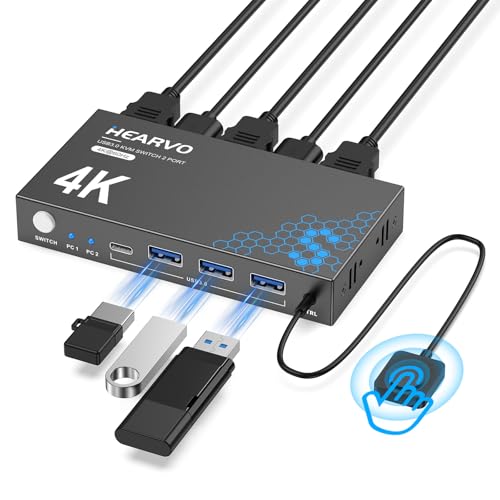
Hearvo USB 3.0 HDMI KVM Switch Review Summary
The Hearvo USB 3.0 HDMI KVM Switch is a focused utility product rather than a lifestyle accessory.
It is the kind of device you buy when your desk has already become the bottleneck: too many computers, too many cables, and not enough patience for constant unplugging.
Best for: a dual-computer desk where both systems need to share a single monitor and USB peripherals.
Less compelling for: buyers who only need occasional input switching or who do not care about keeping a tidy, permanent setup.
Review Scorecard
| Category | Score | Why it matters |
|---|---|---|
| Core function | 9/10 | It combines HDMI switching and USB peripheral sharing in one box for two computers and one monitor. |
| Display support | 8/10 | The listing supports 4K@60Hz plus 4K@30Hz, 2K, 3D, and 1080P. |
| Peripheral sharing | 9/10 | Four USB 3.0 ports, including one USB-C port, broaden compatibility for common desk devices. |
| Switching convenience | 8/10 | You can switch with the button on the unit or the wired remote. |
| Setup simplicity | 9/10 | Plug-and-play design and no driver requirement make it approachable. |
| Desk practicality | 8/10 | Adaptive EDID and the remote switch are clearly aimed at reducing hassle and clutter. |
For the right buyer, this is a practical, high-utility purchase.
It is especially attractive if you already know you want a permanent two-computer workstation and do not want a desktop full of duplicate peripherals.
Key Features and Specifications of Hearvo USB 3.0 HDMI KVM Switch
The main appeal is straightforward: two computers, one monitor, shared keyboard and mouse, and additional USB device support.
The listing describes it as a complete USB switch and HDMI switch in one unit, which is the right framing for buyers comparing it to a stack of separate adapters.
Here are the most useful facts from the product data:
| Feature | Details |
|---|---|
| Supported setup | 2 computers, 1 monitor |
| Video support | Up to 4K@60Hz |
| Additional display support | 4K@30Hz, 2K, 3D, 1080P |
| USB ports | 4 total: 3 USB-A and 1 USB-C |
| USB speed | Up to 5Gbps |
| Switching methods | On-unit button and wired remote switch |
| Compatibility | Windows 7/8/10/11/Vista/XP, Linux, Mac, and more |
| Display handling | Adaptive EDID |
| Power/driver needs | No power supply or driver software required |
| Included items | KVM unit, two USB 3.0 cables, wired remote, manual, anti-slip pads, protection plan card |
The combination of 4K@60Hz support, USB 3.0 sharing, and dual switching methods is the real value here.
Many KVMs solve the monitor problem but become annoying as soon as you need to move peripherals or reach behind the desk.
Hearvo’s wired remote addresses that directly.
The four USB ports matter because they let the device handle more than a keyboard and mouse.
The listing specifically calls out printers, flash drives, scanners, headsets, and webcams, so this is positioned as a real workstation hub rather than a minimal switch.
Pros and Cons of Hearvo USB 3.0 HDMI KVM Switch
Pros
- Combines video and USB switching for a cleaner two-computer desk.
- 4K@60Hz support gives it a modern baseline for productivity displays.
- Four USB 3.0 ports, including USB-C, improve peripheral flexibility.
- Wired remote switch is useful when the unit is hidden under a desk or off to the side.
- Plug-and-play design keeps setup friction low.
- Adaptive EDID should help avoid display handoff issues that frustrate some KVM setups.
Cons
- It is built for a specific two-computer / one-monitor use case, so it is not a general-purpose hub.
- The listing does not provide detailed data about advanced display edge cases, so buyers with unusual monitor chains should verify compatibility.
- Users who only switch occasionally may not need a dedicated KVM at all.
The pros are not flashy, but they are practical.
This is a product where the strongest argument is not novelty; it is removing repeated friction from daily work.
Who Should Buy Hearvo USB 3.0 HDMI KVM Switch?
Buy this if you have two computers that regularly share the same desk and monitor.
It makes sense for a home office, a mixed work/personal setup, or any workstation where the keyboard and mouse should follow the active machine without manual cable swaps.
It also fits buyers who want to share more than just basic input devices.
If a printer, webcam, flash drive, or scanner needs to move between systems, the four USB ports make the unit more useful than a bare-minimum switch.
You should probably skip it if your workflow is mostly laptop-only and you rarely connect both machines to the same display.
It is also less appealing if you need a complex multi-monitor or multi-computer setup, because this model is clearly optimized around one monitor and two computers.
If your priority is pure convenience, the wired remote is a meaningful advantage.
If your priority is flexibility across many endpoints, you may want a broader dock or a more advanced KVM instead.
How the Hearvo USB 3.0 HDMI KVM Switch Fits a Shared Desk
Switching Without Reaching Behind the Monitor
The inclusion of both a button on the unit and a wired remote switch is a practical detail, not a cosmetic one.
On a clean desk, the switch itself may be tucked out of sight, and the remote lets you keep the actual control point within easy reach.
Why Adaptive EDID Matters
Adaptive EDID is one of those terms that only matters when it fails.
Here, the listing says it is intended to keep image transmission stable and smooth by optimizing display settings automatically.
For a shared-display workstation, that is exactly the kind of feature that reduces annoying handoff issues.
USB 3.0 Sharing for Real Peripherals
The USB side is not just for a keyboard and mouse.
The listing specifically names printers, scanners, flash drives, headsets, and webcams, which tells you the device is meant to act like a genuine desk hub.
That broadens the value substantially for people who keep a fixed workstation.
Where the Design Is Sensible
The device is designed around clutter reduction.
The remote, the included cables, the anti-slip pads, and the plug-and-play approach all point to the same goal: make a dual-computer desk feel like one coherent workstation instead of two separate piles of hardware.
Alternatives to Hearvo USB 3.0 HDMI KVM Switch
If you want similar products on Amazon, these are the most obvious comparison points:
UGREEN is worth checking if you want a more established accessory brand in the same category.
TESmart is a common comparison point when buyers want a KVM with a strong focus on desk workflows and switching convenience.
AIMOS is another straightforward alternative if you are comparing feature sets more than brand history.
The main question across all of them is the same: do you want a clean two-computer desktop with one monitor, or do you need something more flexible?
If the first answer is yes, this Hearvo model belongs in the comparison set.
Is Hearvo USB 3.0 HDMI KVM Switch Worth It?
Yes, if your goal is a simple and orderly two-computer desk. The Hearvo USB 3.0 HDMI KVM Switch has the right feature mix for that job: 4K@60Hz support, four USB ports, plug-and-play setup, and a wired remote that makes daily switching easier.
It is not the most universal solution, but it does not need to be.
This is a focused tool, and the product data supports that focus well.
If you want one monitor and shared peripherals to serve two computers cleanly, it is worth serious consideration.