If you need to turn an SFP+ port into an RJ45 copper link without redesigning a rack, the 10Gtek 10G SFP+ to RJ45 Transceiver is built for that job.
It is a practical option for short 10GBASE-T runs where compatibility and cable reuse matter more than elegance.
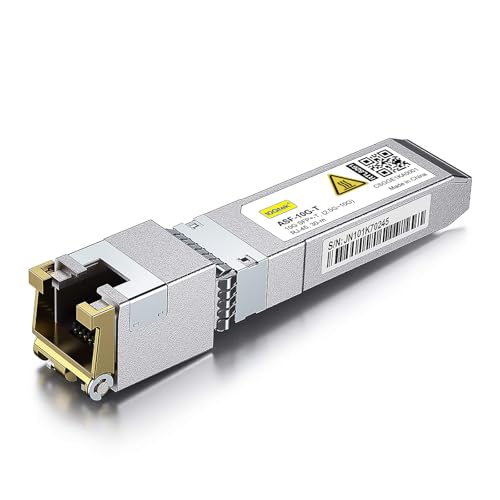
10Gtek 10G SFP+ RJ45 Transceiver Review Summary
The 10Gtek 10G SFP+ to RJ45 Transceiver makes sense for buyers who already have SFP+ switching gear but need to connect to 10GBASE-T endpoints over copper.
Its value is straightforward: it gives you an SFP+ form factor on one side, an RJ-45 interface on the other, and support for CAT6A or CAT7 cabling up to 30 meters according to the listing.
That combination suits rack-to-rack or intra-rack links where replacing hardware is harder than adding a transceiver.
Best fit: network admins, homelab builders, and IT buyers who want a short copper 10G bridge with broad compatibility claims and no software setup.
Review Scorecard
| Category | Score | Why it scores here |
|---|---|---|
| Compatibility flexibility | 8/10 | The listing names Cisco, Meraki, Ubiquiti, UniFi, MikroTik, Supermicro, TP-Link, D-Link, and Netgear. |
| Short-run practicality | 9/10 | 30-meter support is a useful ceiling for many rack and closet deployments. |
| Simplicity | 9/10 | Plug-and-play behavior is explicitly stated, with no software or technician setup needed. |
| Thermal caution | 6/10 | The module can get hot and may stop working when overheating, so it needs realistic airflow expectations. |
| Power efficiency | 7/10 | The Realtek RTL8261 chip is listed with maximum power consumption of 3W. |
| Deployment fit | 8/10 | It is aimed squarely at enterprise LAN and copper networking use cases. |
Key Features and Specifications of 10Gtek 10G SFP+ RJ45 Transceiver
The core appeal here is not novelty.
It is the simple conversion from SFP+ to RJ-45 for 10G copper networking, with enough breadth in the compatibility list to cover many common switching brands.
The listing positions it as a 10GBASE-T module that can use CAT6A or CAT7 cable and reach up to 30 meters.
That makes it especially relevant when the link distance is short, the port type mismatch is the main problem, and you want to keep the rest of the network intact.
The module uses a Realtek RTL8261 chip and is listed at up to 3W maximum power consumption.
That matters because copper transceivers in this class often trade convenience for heat.
The listing is direct about that tradeoff: the module can get hot and will stop working automatically if it overheats.
Buyers should read that as a thermal constraint, not a minor footnote.
| Spec | What the listing says |
|---|---|
| Brand | 10Gtek |
| Product type | 10G SFP+ to RJ45 transceiver |
| Protocol | 10GBASE-T |
| Interface | SFP+ to RJ-45 |
| Cable support | CAT6A / CAT7 |
| Reach | Up to 30 meters |
| Chip | Realtek RTL8261 |
| Max power consumption | 3W |
| Compatibility | Cisco, Meraki, Ubiquiti, UniFi, MikroTik, Supermicro, TP-Link, D-Link, Netgear, and others with 10G SFP+ ports |
| Setup | Plug and play |
The compatibility note is useful but still generic.
The phrase “compatible with many brands” does not guarantee universal support across every switch, firmware version, or port profile.
The safest reading is that the module is intended for common 10G SFP+ ports and should be checked against your exact hardware list before buying in quantity.
Pros and Cons of 10Gtek 10G SFP+ RJ45 Transceiver
Pros
- Converts SFP+ to RJ-45 without extra adapters or software setup.
- Supports short 10G copper links up to 30 meters, which is enough for many rack and office runs.
- Works with CAT6A and CAT7, so it can reuse cabling many buyers already have.
- Broad brand compatibility claims make it attractive for mixed environments.
- The 3W ceiling gives you at least some expectation of power behavior before installation.
Cons
- Heat is the main caution, and the module may shut down if overheated.
- It is not the best fit for long or thermally constrained deployments.
- Compatibility is broad in the listing but still needs validation against the exact switch or endpoint.
- It solves a specific port mismatch; it is not a general-purpose networking upgrade.
The strongest upside is convenience.
The strongest downside is also convenience: these modules are easy to deploy, but heat and compatibility are the two variables that can turn a simple purchase into a troubleshooting exercise.
That is normal for this category, but it should be part of the buying decision.
Who Should Buy 10Gtek 10G RJ45 Transceiver?
Buy this if you need a short, copper-based 10G link between an SFP+ switch port and a 10GBASE-T endpoint.
It is a sensible choice for closets, racks, and homelab builds where the cable path is short and the goal is to avoid replacing switches, NICs, or patch infrastructure.
It also makes sense if you want a plug-and-play module and value the convenience of reusing CAT6A or CAT7 cabling.
It is less compelling if your environment already runs hot, has limited airflow, or has a history of transceiver thermal issues.
The listing is unusually clear that overheating can stop the module from working, so this is not the kind of accessory you buy casually for a dense, poorly ventilated chassis.
It is also not ideal if you need long copper reach or if your deployment depends on guaranteed cross-vendor behavior without testing.
If you are trying to decide whether this is a sensible purchase, the key question is simple: do you need a short-range SFP+ to RJ45 bridge more than you need absolute thermal headroom?
If yes, this is a plausible fit.
If no, a different networking approach is safer.
Thermal and Compatibility Considerations for 10Gtek 10G RJ45 Transceiver
Heat Is the Main Tradeoff
The listing makes heat management central to this product.
A 3W copper transceiver can be perfectly usable, but only when the host port and surrounding chassis can tolerate the thermal load.
That is the first thing to check, especially if the module will sit next to other warm networking hardware.
Short Runs Are the Sweet Spot
The up-to-30-meter claim places this module in a very specific lane.
It is meant for short copper runs, not sprawling plant or warehouse layouts.
For buyers, that is a feature rather than a limitation if the job is a clean rack-to-rack or switch-to-endpoint connection.
Brand Lists Help, But Do Not Replace Validation
The compatibility list is broad and reassuring, but it should still be treated as a starting point.
Real deployments depend on the specific switch model, port behavior, firmware, and thermal environment.
The product is best understood as broadly aimed at common enterprise and prosumer networking gear, not as a universal guarantee.
Plug-and-Play Still Needs Planning
“Plug and play” is useful because it reduces setup friction, but it does not eliminate system design.
Cable quality, port density, airflow, and the physical layout of the rack all affect whether the module feels effortless or annoying after installation.
Alternatives to 10Gtek 10G RJ45 Transceiver
If you need a similar module but want to compare ecosystems, the most obvious alternatives are other 10G SFP+ to RJ45 transceivers from established networking brands and the broader product lines they sell on Amazon.
These searches are a practical way to compare compatibility, thermal notes, and form-factor options without committing to one listing too early.
- Cisco 10G SFP+ to RJ45 transceiver
- MikroTik 10G SFP+ RJ45 module
- Ubiquiti 10G SFP+ to RJ45
- FS 10G SFP+ to RJ45 transceiver
The right alternative usually comes down to host compatibility and thermal tolerance, not branding alone.
If your switch vendor has a known-good module line, that is often the safest place to start.
If not, a widely reviewed third-party option can still be reasonable, provided you verify the exact port support.
Is 10Gtek 10G RJ45 Transceiver Worth It?
Yes, if your use case is a short copper 10G link and you want a simple SFP+ to RJ45 bridge with clear manufacturer-listed compatibility claims.
It is not the most flexible networking product in the world, and it is not the best answer for hot, crowded chassis, but it is a sensible tool for the narrow job it is designed to do.
Buy it if you need a compact 10GBASE-T adapter for short runs, you can manage heat, and you want plug-and-play convenience.
Skip it if your environment is thermally tight or you need longer, more forgiving copper connectivity.