Fanless firewall appliances are a smart pick when you want always-on network security without noise, dust buildup, or high power draw. They’re especially useful for homes, labs, and small offices that need reliable routing and VPN performance.
In this roundup, we focus on practical features that matter most: Ethernet port count, 2.5GbE support, CPU class, memory/storage options, and compatibility with popular firewall software.
Best 10 Fanless Firewall Appliances Picks for 2026
Compact 6-LAN Fanless Firewall Box

- 6 x Intel i226-V 2.5GbE LAN ports
- Fanless aluminum body with 6W N150 CPU
- Barebone build with DDR5 and dual M.2 NVMe support
Best For: DIY firewall builds that need lots of wired ports and quiet operation
Quiet 4-Port Gateway Box
J3710 Fanless Firewall Appliance

- 4 x Intel i226 2.5GbE LAN ports
- Ships with 8GB DDR3 and 240GB mSATA SSD
- Fanless aluminum case with VESA mount
Best For: Small pfSense or OPNsense setups that want a ready-to-use box
Preloaded 2.5GbE Router Box

- 4 x Intel I226 2.5GbE NICs
- 8GB DDR5 RAM and 128GB SSD included
- Fanless build with AES-NI and dual 4K output
Best For: Buyers who want a ready-made firewall router with modern specs
Ultra-Compact 4-Port Router
J3710 Fanless Firewall Appliance

- 4 x Intel I226 LAN ports
- 8GB DDR3 and 128GB mSATA SSD included
- Fanless 6W design with VESA mount
Best For: Small home or lab firewall setups on a budget
High-LAN Fanless Pick
J6413 4-Port 2.5GbE Firewall Mini PC

- 4 x i226V 2.5GbE LAN ports
- Fanless aluminum enclosure
- 2 x NVMe plus 2 x SATA expansion
Best For: Quiet home labs and small offices needing flexible storage
Ultra-Low-Power Fanless Option

- 4 Intel I226 LAN ports
- 6.5W fanless aluminum cooling
- Tested with pfSense and OPNsense
Best For: Basic always-on routing on a tight budget
Most Connected Barebone
N150 6-Port Firewall Micro Appliance

- 6 Intel I226-V 2.5GbE LAN ports
- Intel N150 with AES-NI
- DDR5, NVMe, and SATA expansion
Best For: Custom firewall builds that need six wired ports
Budget Fanless 2.5GbE Gateway
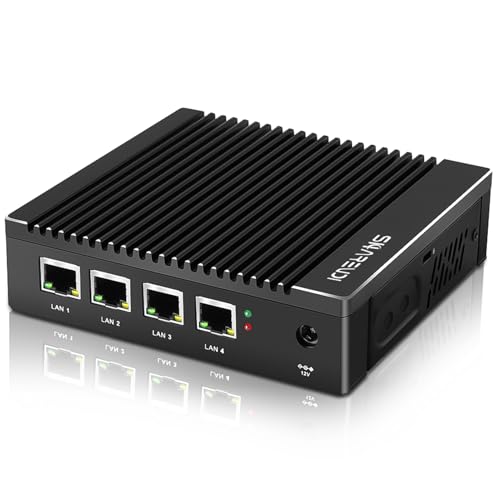
- Intel J4105 quad-core with AES-NI support
- 4x Intel 2.5GbE I226-V LAN ports
- Includes 8GB DDR4 and 240GB mSATA SSD
Best For: A ready-to-use fanless firewall box with memory and storage included
Barebone Silent 2.5GbE Appliance

- Pentium Silver J5005 quad-core processor
- 4x Intel i226-V 2.5GbE LAN ports
- Barebone design with no RAM or SSD included
Best For: A silent base for users who want to add their own memory and storage
Ultra-Minimal Fanless Test Box
- Intel J4105 with AES-NI support
- 4x Intel 2.5GbE I226-V LAN ports
- Ships without RAM, SSD, or OS
Best For: Advanced users building a fully custom fanless firewall setup
Compact 6-LAN Fanless Firewall Box – N150 6-Port DDR5 Barebone
This fanless firewall appliance is built for users who want a quiet, low-power network box with plenty of wired connectivity. With a 6W Intel N150 processor, six 2.5GbE i226-V LAN ports, and support for OPNsense, PVE, and ESXi, it fits well as a compact firewall, soft router, or small virtualization node.
Best For: DIY users who want a barebone, high-port-count firewall appliance for OPNsense or Proxmox.
Pros:
- Six Intel i226-V 2.5GbE ports give it strong network flexibility.
- Fanless aluminum-alloy design keeps operation silent.
- DDR5 support and dual M.2 NVMe slots offer useful upgrade headroom.
- Triple-display output and multiple USB ports add day-to-day usability.
Cons:
- Barebone configuration includes no RAM or SSD.
- Requires assembly and component selection from the buyer.
- Designed more for routing and firewall work than general desktop use.
Overall, this is a strong choice if you want a fanless firewall appliance with modern 2.5GbE networking and room to customize storage and memory. The tradeoff is that you must supply the core components yourself.
Quiet 4-Port Gateway Box – J3710 Fanless Firewall Appliance
This fanless firewall appliance targets buyers who want a simple, low-power gateway box with proven open-source firewall support. It pairs an Intel J3710 CPU with four 2.5GbE Intel i226 LAN ports, 8GB of DDR3 memory, and a 240GB mSATA SSD, making it ready for pfSense, OPNsense, or Linux-based routing tasks.
Best For: Users who want a compact, preconfigured firewall box for pfSense or OPNsense.
Pros:
- Includes 8GB RAM and 240GB mSATA SSD out of the box.
- Four Intel 2.5GbE LAN ports suit small network gateway setups.
- Fanless aluminum design is quiet and rated for 24/7 use.
- VESA mount helps save desk space behind a monitor.
Cons:
- DDR3 platform is older than newer N100/N150-based options.
- Memory tops out at 8GB.
- Does not support HDD storage.
This is a practical pick if you want a ready-to-run firewall appliance instead of a barebone system. It offers the essentials for small office or home gateway use, though its older hardware limits future expandability.
Preloaded 2.5GbE Router Box – N100/N150 Fanless Firewall PC
This fanless firewall appliance is aimed at buyers who want modern networking features with less setup work. It uses an Intel N100-class processor, four Intel I226 2.5GbE NICs, 8GB of DDR5 memory, and a 128GB M.2 SSD, while supporting pfSense, OPNsense, OpenWrt, and virtualization use cases.
Best For: Users who want a preconfigured firewall router with DDR5 memory and 2.5GbE networking.
Pros:
- Four Intel I226 2.5GbE NICs support fast wired networking.
- Includes 8GB DDR5 RAM and 128GB SSD.
- Fanless design with AES-NI and watchdog-style features suits security-focused builds.
- Supports dual 4K@60Hz output via HDMI 2.1 and DisplayPort 1.4.
Cons:
- Listing says N100, while the title notes N150 shipping language.
- Only one M.2 PCIe 3.0 SSD slot is provided.
- Still compact hardware, so it is best suited to routing and light server tasks.
For buyers who want a modern fanless firewall appliance with more current memory and storage already installed, this model is appealing. Its main drawback is the mixed N100/N150 naming, so it is worth checking the exact shipped configuration before buying.
Ultra-Compact 4-Port Router – J3710 Fanless Firewall Appliance
This fanless firewall appliance is built for straightforward gateway and routing tasks in a very compact chassis. It combines an Intel J3710 processor, four Intel I226 LAN ports, 8GB of DDR3 memory, and a 128GB mSATA SSD, with support for pfSense, OPNsense, and other open-source operating systems.
Best For: Budget-conscious users who need a small, silent firewall box for home or lab networking.
Pros:
- Four Intel I226 LAN ports provide flexible multi-WAN or segmentation options.
- Fanless aluminum design supports silent 24/7 operation.
- Includes 8GB RAM and 128GB mSATA SSD.
- VESA mount makes it easy to tuck behind a monitor.
Cons:
- Older J3710 and DDR3 platform is less modern than N-series alternatives.
- Storage is limited to mSATA SSDs, not HDDs.
- Only one HD video output is listed in the details.
This model keeps the formula simple: low power, silent cooling, and four 2.5GbE ports in a tiny footprint. It is a solid firewall appliance for basic routing needs, but buyers wanting newer silicon or more upgrade flexibility should look higher up the stack.
High-LAN Fanless Pick – J6413 4-Port 2.5GbE Firewall Mini PC
If you’re shopping for fanless firewall appliances with a strong balance of ports, storage flexibility, and quiet operation, this J6413 mini PC is built for lab and small-business routing setups. Its 4 x Intel i226V 2.5GbE LAN ports, fanless aluminum chassis, and support for OPNsense or Proxmox make it a practical choice when you want a compact box that can stay on around the clock.
Best For: Home labs, small offices, and users who want a quiet firewall appliance with room for storage expansion.
Pros:
- 4-core Intel Celeron J6413 with low power use and AES-NI support.
- 4 x i226V 2.5GbE LAN ports for multi-LAN routing and virtualization use.
- Expandable with 2 x DDR4 SO-DIMM slots, 2 x NVMe slots, and 2 x SATA 3.0 bays.
- Fanless aluminum design keeps operation silent and compact.
Cons:
- Ships with 8GB RAM and 128GB SSD, which may be modest for heavier builds.
- Hardware is geared more toward networking than general desktop use.
This model stands out if you want a firewall appliance that combines quiet cooling with unusually flexible storage and display options. The tradeoff is that it’s best appreciated as a network box rather than a general-purpose mini PC.
Ultra-Low-Power Fanless Option – J3710 4-Port Silent Gateway
Among fanless firewall appliances, this J3710-based mini PC is a straightforward pick for basic routing, gateway, and lab use. It pairs 4 Intel I226 LAN ports with a 6.5W fanless aluminum design, and it has been tested with pfSense, OPNsense, Ubuntu, and other open-source operating systems, making it a simple entry point for always-on network projects.
Best For: Budget-conscious users who want a silent, low-power firewall router for basic network tasks.
Pros:
- Intel J3710 processor with 4 cores, 4 threads, and AES-NI support.
- 4 Intel i226 LAN ports for firewall and gateway setups.
- Very low 6.5W power draw and fanless cooling for 24/7 use.
- Includes VESA mount for cleaner behind-monitor installation.
Cons:
- Max RAM support is limited to 8GB DDR3.
- 64GB mSATA storage is modest and it does not support HDDs.
This is the most basic option in the group, but that simplicity can be an advantage if your priority is silence, low power, and reliable firewall duties. It’s best viewed as a compact network appliance rather than a performance-heavy platform.
Most Connected Barebone – N150 6-Port Firewall Micro Appliance
If port count matters most, this barebone unit is one of the more capable fanless firewall appliances in the lineup. It uses an Intel N150 processor, adds 6 Intel I226-V 2.5GbE LAN ports, and supports DDR5 memory plus NVMe and SATA storage, so it fits well in firewall, VPN, and router builds that need more connectivity than a typical mini PC.
Best For: Network builders who want a barebone firewall appliance with six 2.5GbE ports and modern memory support.
Pros:
- Intel N150 quad-core processor with AES-NI support.
- 6 Intel I226-V 2.5GbE LAN ports for dense networking setups.
- DDR5 SO-DIMM support up to 32GB.
- Includes dual HDMI 2.1, USB-C, and storage options for NVMe and SATA.
Cons:
- It is a barebone system with no pre-installed operating system.
- Performance is tuned for networking, not general-purpose computing.
For users building a custom firewall or VPN appliance, the six-port layout is the standout feature here. It offers strong connectivity in a fanless box, but you’ll want to supply your own OS and memory configuration plan.
Budget Fanless 2.5GbE Gateway – J4105 with 8GB/240GB
This fanless firewall appliance is built for small network gateways, VPN use, and pfSense or OPNsense testing when you want quiet 24/7 operation. The Intel J4105 processor, four Intel 2.5GbE I226-V ports, and included 8GB RAM plus 240GB mSATA SSD make it a practical all-in-one starting point.
Best For: Buyers who want a ready-to-use fanless firewall box with memory and storage already installed.
Pros:
- Intel J4105 quad-core CPU with AES-NI support for firewall and gateway tasks
- 4x Intel 2.5GbE I226-V LAN ports for multi-interface networking
- 8GB DDR4 RAM and 240GB mSATA SSD included
- Fanless aluminum alloy design supports silent 24/7 use
Cons:
- mSATA storage only; HDD is not supported
- Memory tops out at 16GB, which may limit heavier workloads
- Designed as a compact firewall box rather than a general-purpose desktop
If you want a compact fanless firewall appliance that arrives with core components in place, this model keeps setup straightforward while offering solid 2.5GbE networking. It is most compelling for home labs and small deployments that value silence, low power use, and a simple footprint.
Barebone Silent 2.5GbE Appliance – J5005 Expandable Chassis
For buyers comparing fanless firewall appliances, this barebone mini PC stands out if you want flexibility in how you build it. It uses a Pentium Silver J5005 processor, four Intel i226-V 2.5GbE ports, and passive cooling, while leaving RAM and storage for you to add.
Best For: Users who want a silent barebone firewall appliance they can populate with their own memory and drives.
Pros:
- Fanless, maintenance-free design with passive cooling
- 4x Intel i226-V 2.5GbE LAN ports for network routing and VPN setups
- Pentium Silver J5005 quad-core CPU with UHD graphics
- Expandable with 2.5-inch SATA HDD/SSD and DDR4 memory
Cons:
- Ships with no RAM and no SSD, so it needs additional parts before use
- Maximum memory support is 8GB
- Less plug-and-play than preconfigured firewall mini PCs
This is a good fit if you prefer to choose your own components and want a silent base for a network appliance. The four 2.5GbE ports and flexible storage options make it useful for firewall, VPN, and lab builds, but it is not the easiest option if you want an immediate out-of-box setup.
Ultra-Minimal Fanless Test Box – J4105 No RAM/No SSD
This fanless firewall appliance is aimed at builders who already have spare parts and want a compact platform for testing pfSense, OPNsense, Linux, or Ubuntu. It uses the same Intel J4105, four Intel 2.5GbE I226-V ports, and low-10W fanless chassis approach, but ships with no RAM, no SSD, and no operating system.
Best For: Advanced users who want a no-frills fanless firewall test platform and plan to supply every core component themselves.
Pros:
- Intel J4105 quad-core CPU with AES-NI support
- 4x Intel 2.5GbE I226-V LAN ports for multi-network routing
- Fanless aluminum alloy case designed for silent 24/7 operation
- VESA mount included for space-saving installation
Cons:
- Includes no RAM, no SSD, and no preinstalled system
- Not suited to buyers who want a ready-to-run appliance
- Limited to the components you add later, so total cost depends on your build
If you need a quiet hardware platform for experiments rather than a turnkey router, this model is the most stripped-down option here. It makes sense for lab users and DIY builders who want complete control over the final setup.
How We Picked These Fanless Firewall Appliances
We focused on hardware that makes sense for real-world firewall and routing use: stable Intel network chips, enough ports for WAN/LAN/VLAN setups, and CPUs suited to light-to-moderate security workloads. We also prioritized models that can run common platforms such as OPNsense and pfSense, plus devices with flexible RAM and SSD configurations for easier deployment.
Quick Comparison
For simple home internet, lower-power J4105, J5005, and J3710 systems can be enough. For faster broadband, VPN use, or multiple VLANs, N150 and J6413-based models are the stronger choices because they generally offer better headroom and newer platform support. If you need more wired segmentation, 6-port designs give you more layout flexibility than 4-port units.
Key Buying Factors for Fanless Firewall Appliances
CPU and Throughput
Start with your internet speed and intended workload. Basic routing, ad blocking, and modest VPN use can run on older Celeron chips, but heavier encrypted traffic and multiple users benefit from newer processors like the N150 or J6413.
Network Ports and NIC Quality
Most buyers should look for Intel i226/i226-V ports because they are widely supported and better suited to firewall use than generic adapters. Count the ports you actually need for WAN, LAN, and any DMZ or dedicated VLAN connections.
Memory and Storage
Appliances sold barebone can be a good value if you already have RAM and SSDs, but prebuilt options are easier if you want a quick setup. For firewall software, 8GB RAM and a modest SSD are usually a practical baseline for many households and small offices.
Connectivity and Expansion
Consider whether you need 2.5GbE now or later. Multi-gig ports can future-proof a setup for faster internet plans, NAS access, or a multi-device LAN. USB-C and additional display outputs matter less for firewall duty, but can simplify first-time configuration.
Who Should Buy Which Fanless Firewall Appliances?
If you want the simplest, lowest-cost option for a basic network, older quad-core models can still do the job. If you’re building a quiet but capable router for fiber internet, VPN, or a busy home lab, newer N150-based Fanless Firewall Appliances are the best balance of efficiency and performance. Small businesses and advanced users should lean toward models with 4 to 6 Intel 2.5GbE ports and enough upgrade room to match future network changes.