Digitizing a large photo collection is easier when your scanner matches the size, condition, and variety of the originals. The right model can reduce manual handling while preserving enough detail for reprints, sharing, and long-term storage.
These 10 picks include high-speed photo feeders, compact flatbed scanners, and dedicated options for older prints and film. Use the guide below to narrow the list by workflow, image quality, and budget.
Best 10 Photo Scanners for Archiving Picks for 2026
Best High-Volume Pick

- Scans up to one photo per second at 300 dpi
- Batch-scans up to 36 photos with duplex capture
- Offers wireless sharing, enhancement, and OCR
Best For: Large family photo collections and mixed photo-document archiving
Best Simple USB Scanner

- Scans 4 x 6 photos in about two seconds
- Supports common print sizes up to 8 x 10
- Includes auto crop, deskew, and enhancement tools
Best For: Straightforward Mac or PC scanning of standard printed photos
Best Legacy FastFoto Model
- Scans photos at up to one per second
- Automatic feeder holds up to 30 photos
- Supports scans up to 600 dpi and panoramic photos
Best For: Fast USB batch scanning on a Windows computer
Best Standalone Film-and-Photo Option
DigitPro M129A Film & Photo Scanner

- Scans prints, slides, and 35mm, 135, and 110 negatives
- Works without a computer or installed software
- Includes a 5-inch screen and 8GB SD card
Best For: Simple mixed-media digitizing at home
Best Flatbed for Photo Detail

- 4800 dpi optical resolution
- Restores faded colors with Easy Photo Fix
- Removable lid handles books and albums
Best For: Detailed scans of individual photos and albums
Best Slim Budget-Friendly Flatbed

- 4800 x 4800 dpi photo resolution
- Color restoration and dust removal
- Slim USB Type-C flatbed design
Best For: Small home archives and space-conscious setups
Simple SD-Card Archiver

- 600 dpi scanning for photos up to 8.5 x 11 inches
- Saves directly to SD cards without a PC
- Includes five-in-one memory card reader
Best For: Basic, computer-free photo digitizing
Organized Memory Digitizer

- 300/600 dpi scanning for varied photo sizes
- Includes cleaning tools and protective carrier sheet
- Picture Studio adds restoration and organization tools
Best For: Mixed-size photo collections needing cleanup and organization
High-Detail Flatbed Choice

- 4800 dpi optical resolution for detailed enlargements
- Scans photos, artwork, books, and documents
- Includes Easy Photo Fix and ScanSmart features
Best For: Detailed flatbed scanning across photos and documents
Best High-Volume Pick – Epson FastFoto FF-680W
For anyone comparing photo scanners for archiving, the Epson FastFoto FF-680W stands out for high-volume batches, wireless connectivity, and flexible resolution options. It can scan photos at up to one per second at 300 dpi, batch up to 36 photos, and capture handwritten notes on the back in the same pass.
Best For: Families archiving thousands of photos while also scanning documents and sharing files wirelessly.
Pros:
- Fast batch scanning with duplex capture for photos and notes.
- Supports 300 dpi sharing, 600 dpi TIFF archiving, and 1200 dpi enlargements.
- Includes enhancement tools, OCR, wireless connectivity, and cloud backup options.
- Handles varied media, including Polaroids, panoramas, postcards, and photos up to 8 x 10 inches.
Cons:
- At 8.2 pounds, it is less portable than compact single-photo scanners.
- Its broader document-scanning features may be more than occasional photo users need.
The FF-680W is the most capable choice here for a serious archiving project. Its feeder, duplex scanning, restoration tools, and wireless workflow make it well suited to organizing a large family collection.
Best Simple USB Scanner – Plustek ePhoto Z300
The Plustek ePhoto Z300 is a straightforward option for photo scanners for archiving when you want a compact, computer-connected workflow. It scans a 4 x 6 photo in about two seconds at 300 dpi, supports common print sizes, and includes automatic cropping, deskewing, and image enhancement.
Best For: Mac and PC users digitizing a steady stream of standard-size prints without needing wireless or film scanning.
Pros:
- Scans 4 x 6 photos in about two seconds at 300 dpi.
- Supports 3 x 5, 4 x 6, 5 x 7, and 8 x 10 photos plus letter and A4 documents.
- Offers 300 dpi and 600 dpi settings with automatic crop and deskew.
- Works with Windows 7 through 11 and Mac OS X 10.12 through 15.x.
Cons:
- Photos are inserted one at a time rather than batch-fed.
- USB is the listed connection, so it lacks the FF-680W’s wireless convenience.
- It does not scan slides or negatives.
The Z300 keeps the process uncomplicated and efficient for ordinary prints. Its one-at-a-time feed is less suitable for massive batches, but its quick scans and automatic corrections make it a practical desktop archiving tool.
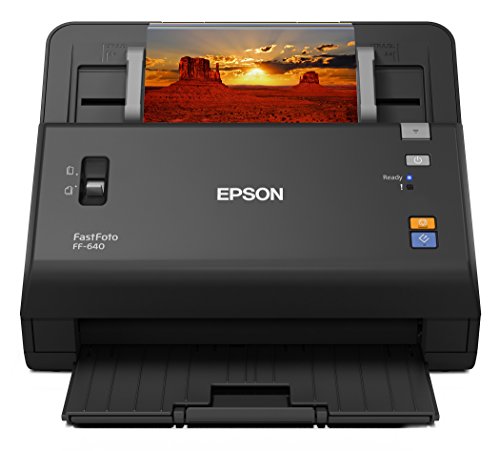
Best Legacy FastFoto Model – Epson FastFoto FF-640
The Epson FastFoto FF-640 is designed for shoppers seeking photo scanners for archiving with fast automatic feeding. It scans at up to one photo per second, supports resolutions up to 600 dpi, and uses a feeder that accommodates up to 30 photos at a time.
Best For: Windows users who want rapid batch scanning of prints from wallet-size images through panoramic photos.
Pros:
- Scans thousands of photos at a stated speed of up to one photo per second.
- Automatic feeder holds up to 30 photos at a time.
- Supports scans up to 600 dpi and a range of photo formats, including panoramic photos.
- Includes a carrier sheet and cleaning cloth for handling and maintenance.
Cons:
- Uses USB rather than wireless connectivity.
- The supplied minimum system requirement is Windows 7, with no Mac support listed in the notes.
- Its feature set is focused on photos rather than the broader document workflow of the FF-680W.
The FF-640 remains a focused high-speed option for print-heavy projects. Its automatic feeder and fast scan rate can shorten a large digitization task, provided a USB-connected Windows setup fits your workflow.
Best Standalone Film-and-Photo Option – DigitPro M129A Film & Photo Scanner
The DigitPro M129A is a useful alternative among photo scanners for archiving if your collection includes both printed photos and film. It converts 35mm, 135, and 110 negatives, slides, and several print sizes to JPEGs, then saves them directly to the included SD card without requiring a computer.
Best For: Beginners or family members who want a standalone device for mixed photo, slide, and negative collections.
Pros:
- Scans printed photos, 35mm slides, and 135 and 110 film negatives.
- Works offline with one-touch controls and no software or drivers required.
- Includes a large 5-inch viewing screen for previewing and editing.
- Comes with an 8GB SD card, holders, trays, cleaning brush, and a three-year warranty.
Cons:
- Its listed connection options are USB and HDMI rather than wireless networking.
- The notes specify 1080P output and JPEG storage, without the higher-resolution TIFF archiving workflow offered by the FF-680W.
- It is less suited to rapid automatic batch-feeding of large print collections.
The M129A is the most versatile choice for mixed-media archives, especially when convenience matters more than a computer-based workflow. Its standalone operation and included accessories make it approachable for slides, negatives, and everyday prints.
Best for Easy Setup – Canon imageFORMULA RS40
For archiving large batches, the Canon imageFORMULA RS40 is a practical choice among photo scanners for archiving. Its 60-sheet automatic feeder scans both sides of photos and documents at up to 40 items per minute, while bundled software adds photo-enhancement tools.
Best For: Families or offices digitizing substantial collections of mixed-size photos and documents.
Pros:
- Automatic feeder holds up to 60 sheets and scans both sides simultaneously.
- Handles photos, Polaroids, receipts, cards, IDs, and documents.
- Includes color and photo-enhancement features such as red-eye correction and face smoothing.
- Works with Windows and Mac and supports JPG, TIF, BMP, PNG, PDF, and PPTX output.
Cons:
- Uses a USB connection rather than wireless scanning.
- Its 6.6-pound, feeder-style design takes more space than a slim flatbed.
- The listed 1200 dpi resolution is interpolated.
The RS40 stands out when speed and batch handling matter more than compactness. It is especially useful for mixed archives that include both photographs and paperwork.
Best Flatbed for Photo Detail – Epson Perfection V19 II
The Epson Perfection V19 II is a strong fit for photo scanners for archiving when image detail and careful handling are priorities. Its 4800 dpi optical resolution, flatbed design, and Easy Photo Fix technology support detailed scans and faded-photo restoration.
Best For: Users archiving individual photographs, artwork, books, and album pages with high-resolution output.
Pros:
- 4800 dpi optical resolution supports detailed scans and enlargements.
- Removable high-rise lid accommodates books and photo albums.
- Easy Photo Fix restores color to faded photographs with one click.
- Compact, 3.1-pound body is USB powered and includes a vertical storage position.
Cons:
- Its one-item sheet capacity is less suited to high-volume batches.
- Scanning individual items is slower for large collections than using an automatic feeder.
- The supplied system requirements list Windows 7 but do not specify Mac compatibility.
Choose the V19 II for a compact flatbed workflow where resolution, album access, and restoration features are more important than batch speed.
Best Slim Budget-Friendly Flatbed – Canon CanoScan LiDE 400
Canon CanoScan LiDE 400 Slim Scanner, 7.7" x 14.5" x 0.4", Document & Photo Scanner, Black
Check Price On AmazonThe Canon CanoScan LiDE 400 offers a straightforward option for photo scanners for archiving in tight spaces. It combines 4800 x 4800 dpi resolution with color restoration and dust removal, plus one-cable USB Type-C data and power.
Best For: Home users who want a slim scanner for individual photos, letters, and searchable PDFs.
Pros:
- 4800 x 4800 dpi resolution captures detailed photos and images.
- Color restoration and dust removal help improve archived photos.
- EZ buttons and auto scan mode simplify everyday scanning.
- Built-in PDF buttons support editable and searchable multi-page PDFs.
Cons:
- Its one-item capacity requires manual placement for each scan.
- It is less suitable for large batch archives than an automatic document feeder.
- The supplied minimum system requirements list Windows 7 but do not specify Mac compatibility.
The LiDE 400 is a sensible space-saving pick for smaller collections. Its high resolution and enhancement features make it more versatile than a basic document-only scanner, though manual loading limits throughput.
Simple SD-Card Archiver – No-PC Photo Scanner
For straightforward photo scanners for archiving, the Pandigital PANSCN06 offers a simple, computer-free workflow. It scans photos up to 8.5 x 11 inches at 600 dpi and saves them directly to an SD card, making it convenient for basic digitizing projects.
Best For: Users who want a simple, standalone scanner for transferring printed photos to an SD card.
Pros:
- Scans photos up to 8.5 x 11 inches at 600 dpi.
- Works without a PC for direct SD-card saving.
- Includes a five-in-one card reader for SD, MS, MSPRO, MMC, and XD cards.
Cons:
- Listed minimum system requirements specify Windows 7.
- Uses a CIS optical sensor and 24 bpp color depth rather than offering advanced restoration tools.
The PANSCN06 is best suited to uncomplicated home archiving where direct-to-card operation matters more than extensive editing or organization software.
Organized Memory Digitizer – AMBIR Photo Scanner Bundle
For photo scanners for archiving that combine digitizing with cleanup and organization, the AMBIR bundle is a practical choice. It supports several photo sizes, scans at 300 or 600 dpi, and includes a cleaning kit, protective carrier sheet, and Picture Studio software for editing and organizing images.
Best For: Families archiving mixed-size prints who want built-in tools for cleaning, restoring, tagging, and arranging their digital collection.
Pros:
- Supports 300 or 600 dpi scanning for archival-quality image files.
- Handles sizes from 1 x 1-inch photos through panoramic images up to 12 inches.
- Includes a blower, microfiber cloth, anti-static brush, and protective carrier sheet.
- Picture Studio supports albums, tags, notes, restoration, and image adjustments.
Cons:
- Requires a USB connection and compatible Mac or PC.
- Its 600 dpi setting may require more storage space than 300 dpi scans.
With flexible sizing and collection-management software, this AMBIR package is a strong fit for a larger archiving project involving varied and delicate prints.
High-Detail Flatbed Choice – Epson Perfection V39 II
The Epson Perfection V39 II is a versatile option among photo scanners for archiving, especially when detailed scans and flatbed flexibility are priorities. Its 4800 dpi optical resolution is designed for clear enlargements, while the scanner also handles artwork, books, and documents.
Best For: Users who want a high-resolution flatbed for photos, artwork, documents, and occasional oversized originals.
Pros:
- Provides 4800 dpi optical resolution for detailed scans and enlargements.
- Supports photos, artwork, illustrations, books, and documents.
- Easy Photo Fix can restore color to faded photos with one click.
- Includes ScanSmart features, one-touch buttons, and a removable high-rise lid.
Cons:
- Flatbed scanning handles one standard sheet at a time.
- USB-powered and listed with a 3.1-pound weight, so it is less focused on high-volume portability.
- The supplied details list 300 dpi under resolution despite the advertised 4800 dpi optical resolution.
The V39 II is a well-rounded flatbed for archival work that benefits from high optical detail, photo restoration, and the ability to scan more than loose photographs.
How We Picked the Best Photo Scanners for Archiving
We focused on scanners suited to real home-archiving projects, where speed, consistent results, and flexible media support matter. The selection includes automatic-feeder models for processing large batches, flatbeds for delicate or irregular originals, and compact scanners for occasional use. We also considered optical resolution, automatic cropping and deskewing, connection compatibility, supported photo sizes, and the ability to scan documents alongside pictures.
For archiving, advertised scan speed is only part of the equation. Software workflow, feeder capacity, image handling, and how much correction is required after scanning can have an equally significant effect on total project time.
Quick Comparison
- Best for large collections: Epson FastFoto and Canon imageFORMULA feeder models.
- Best for simple 4-by-6 scanning: Plustek ePhoto Z300 and similar automatic-crop photo scanners.
- Best for fragile, oversized, or mixed originals: Epson Perfection and Canon CanoScan flatbeds.
- Best for slides and negatives: A dedicated photo, slide, and negative scanner with appropriate film support.
- Best for occasional portable-style use: Compact personal photo scanners such as the Pandigital and AMBIR options.
Key Buying Factors for Photo Scanners for Archiving
Scanning Speed and Feeder Design
If you have hundreds or thousands of prints, choose an automatic photo feeder and look for batch-oriented software. Duplex document scanning is useful when the same device will handle paperwork, but confirm how it treats different photo sizes and delicate prints.
Resolution and Image Quality
Optical resolution is more meaningful than interpolated resolution. Around 300 to 600 dpi is typically sufficient for everyday photo preservation and reprints, while higher-resolution flatbeds provide additional flexibility for cropping, enlargements, and detailed originals. Color depth, dust reduction, and accurate automatic exposure also affect the final file.
Original Formats and Condition
Flatbeds are safer for curled, brittle, mounted, or unusually sized photographs. If you need to digitize slides or negatives, choose a scanner designed for film rather than assuming a standard photo scanner can handle them. Check the minimum and maximum supported print sizes before buying.
Software, File Formats, and Storage
Useful software should support automatic cropping, deskewing, rotation, batch naming, and common formats such as JPEG, TIFF, or PDF. Plan storage before scanning: high-resolution TIFF files consume substantially more space than compressed JPEGs, but can serve as better archival masters.
Who Should Buy Which Photo Scanners for Archiving?
Choose a high-speed feeder scanner if your priority is completing a large family archive quickly. Select a flatbed if image quality, fragile originals, creative control, or mixed media matter more than throughput. A compact automatic photo scanner works well for smaller collections and straightforward 4-by-6 prints. Buyers who need one device for photos, receipts, and paperwork should favor a document-capable model with a reliable feeder.
Whichever model you choose, preserve the original files in at least two locations, use clear folder and filename conventions, and keep the physical photographs after digitization whenever possible.