The best vertical mouse for office work can help keep your hand and wrist in a more neutral position during long days at a desk. The right choice depends on comfort, hand size, connectivity, precision, and how much switching you do between devices.
We compared 10 ergonomic vertical mice across wired and wireless designs, including options for different budgets, workspaces, and productivity needs.
Best 10 Vertical Mouse for Office Picks for 2026
Best Overall
Logitech Lift Vertical Ergonomic Wireless Mouse

- 57-degree upright design with thumb support
- Bluetooth and Logi Bolt wireless connectivity
- Quiet clicks and up to two years of battery life
Best For: Small-to-medium right-handed office users
Best Customizable Wired Pick

- Handshake grip supports a natural hand position
- Six customizable buttons and four pointer speeds
- Sculpted for medium-to-large right hands
Best For: Right-handed users seeking wired customization
Best Precision Upgrade
Logitech MX Vertical Wireless Mouse

- 57-degree angle with thumb rest
- 4000 DPI sensor and cursor-speed switch
- Textured surface for a secure grip
Best For: Right-handed users needing precise office navigation
Best Budget Wired Option
Anker USB Wired Vertical Mouse
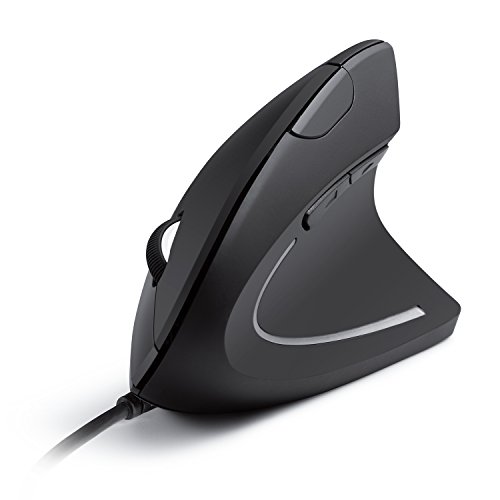
- Ergonomic handshake-style design
- 1000/1600 DPI optical tracking
- Next/previous buttons and 4.9-foot USB cable
Best For: Everyday wired office use on a budget
Best Multi-Device Pick
TECKNET 3-Device Vertical Mouse

- Bluetooth and 2.4GHz USB-A connectivity
- Six DPI settings up to 4800
- Quiet primary clicks for shared spaces
Best For: Office users who switch between multiple devices
Best Rechargeable Option
Lekvey Rechargeable Vertical Mouse

- Over 150 hours per charge
- Plug-and-play 2.4GHz receiver
- Handshake grip for a neutral wrist position
Best For: Users seeking a rechargeable mouse for daily office work
Best Simple Wireless Pick

- Neutral vertical handshake-style design
- Three DPI settings up to 1600
- Dedicated USB receiver with browser buttons
Best For: Right-handed users who prefer simple 2.4GHz wireless
Compact Wrist Relief
ProtoArc EM11 NL Vertical Mouse

- For small to medium hands under 7.5 inches
- Connects with up to three devices
- Rechargeable with quiet primary clicks
Best For: Compact office setups and users seeking wrist-friendly ergonomics
Multitasker’s Control Hub

- Adds a built-in volume control knob
- Connects to three devices
- Quiet clicks and USB-C recharging
Best For: Hybrid workers and media-focused multitaskers
Ambient-Light Ergonomics

- Seven-color ambient lighting
- Connects to three devices
- Four adjustable DPI levels
Best For: Small- to medium-handed users wanting flexible office connectivity
Best Overall – Logitech Lift Vertical Ergonomic Wireless Mouse
The Logitech Lift is a strong vertical mouse for office work if you want wireless convenience, quiet clicking, and an upright design suited to small-to-medium right hands. Its 57-degree shape, thumb rest, and customizable controls make it practical for long workdays.
Best For: Small-to-medium right-handed users who want a comfortable, quiet wireless office mouse.
Pros:
- 57-degree vertical design encourages a more natural forearm posture.
- Bluetooth and Logi Bolt connectivity support computers and tablets.
- Whisper-quiet clicks, SmartWheel scrolling, and six buttons suit productive office workflows.
- Up to two years of battery life reduces charging and battery-related interruptions.
Cons:
- Designed specifically for right-handed users.
- May not be the best fit for medium-to-large hands.
The Lift combines ergonomic positioning with low-maintenance wireless use, making it an especially balanced choice for everyday office setups.
Best Customizable Wired Pick – Evoluent Vertical Mouse VM4R
The Evoluent VM4R is a vertical mouse for office users who prefer a wired connection and extensive control customization. Its handshake grip, finger support, six programmable buttons, and four pointer-speed settings are designed for medium-to-large right hands.
Best For: Medium-to-large right-handed users who want a highly customizable wired ergonomic mouse.
Pros:
- Upright handshake grip helps reduce wrist strain and forearm twisting.
- Six customizable buttons can streamline frequent office tasks.
- Four pointer speeds with indicator lights provide control over cursor movement.
- Finger support helps keep the pinkie from rubbing against the desk.
Cons:
- The wired design offers less desk flexibility than a wireless model.
- Its shape is intended for medium-to-large hands and right-handed use.
- Advanced customization requires optional Windows software.
With its larger sculpted shape and extensive button programming, the Evoluent is a specialized option for office professionals who prioritize control and a stable wired connection.
Best Precision Upgrade – Logitech MX Vertical Wireless Mouse
The Logitech MX Vertical is a vertical mouse for office work that emphasizes precision and reduced hand movement. Its 57-degree angle, textured grip, 4000 DPI sensor, and dedicated cursor-speed switch make it well suited to detailed computer tasks.
Best For: Right-handed office users who want precise tracking and an adjustable cursor speed.
Pros:
- 57-degree vertical angle and thumb rest support a more natural wrist posture.
- 4000 DPI sensor is designed to reduce hand movement during navigation.
- Cursor-speed switch makes it easy to change pointer behavior.
- Textured rubber surface provides a secure grip across varied hand shapes.
Cons:
- Right-handed design does not suit left-handed users.
- Listed battery life is up to four months, shorter than the Logitech Lift’s stated life.
- The mouse has four buttons, fewer than some customizable alternatives.
The MX Vertical is a good fit when tracking precision and cursor control matter more than maximum button count or long battery intervals.
Best Budget Wired Option – Anker USB Wired Vertical Mouse
The Anker USB Wired Vertical Mouse is a straightforward vertical mouse for office users who want an affordable corded setup. Its handshake-style shape, optical tracking, next/previous buttons, and 4.9-foot cable cover common productivity and web-navigation needs.
Best For: Users seeking a lightweight wired vertical mouse for everyday computer work.
Pros:
- Handshake position is designed to reduce wrist and arm strain.
- 1000/1600 DPI settings provide basic tracking flexibility.
- Next and previous buttons make web navigation more convenient.
- Lightweight 5.3-ounce design includes a 4.9-foot USB cable and an 18-month warranty.
Cons:
- Wired USB connection limits portability and desk placement.
- Operating-system support listed in the notes is limited to Linux and Windows 10.
- It offers fewer controls and lower sensitivity than some premium alternatives.
The Anker keeps the feature set simple, but its ergonomic shape and low-maintenance wired connection make it a practical entry point for office users.
Best Multi-Device Pick – TECKNET 3-Device Vertical Mouse
The TECKNET is a practical vertical mouse for office users who move between computers or prefer flexible connection options. It supports Bluetooth connections for up to two devices plus 2.4GHz USB-A connectivity, while six DPI settings and quiet primary clicks suit varied workspaces.
Best For: Office users who need multi-device switching, adjustable sensitivity, and quieter clicking.
Pros:
- Connects through Bluetooth 5.0/3.0 or a 2.4GHz USB-A receiver.
- Offers six DPI levels from 800 to 4800 for adjustable tracking.
- Near-silent left and right clicks can be useful in quiet offices.
- Automatically enters sleep mode after roughly 10–30 minutes of inactivity.
Cons:
- Designed for right-handed use only.
- Requires two AAA batteries, which are not included.
- Side buttons are not compatible with macOS.
Choose this model if connectivity flexibility is a priority. Its vertical shape and broad DPI range make it adaptable for everyday office work, though Mac users should account for the side-button limitation.
Best Rechargeable Option – Lekvey Rechargeable Vertical Mouse
The Lekvey is a straightforward vertical mouse for office work, with a rechargeable battery and plug-and-play 2.4GHz wireless connection. Its handshake-style grip is designed to support a neutral wrist position, and the three DPI settings cover common everyday cursor-control needs.
Best For: Users who want a rechargeable office mouse with a simple USB receiver setup.
Pros:
- Built-in rechargeable battery provides over 150 hours of continuous use per charge.
- Plug-and-play 2.4GHz receiver requires no Bluetooth pairing or drivers.
- Includes page-back and page-forward buttons for browsing.
- Backed by a 36-month manufacturer’s warranty.
Cons:
- Only three DPI levels are available, from 800 to 1600.
- Recommended for medium or large hands.
- Forward and back buttons are not compatible with Mac OS.
The Lekvey is a sensible choice when avoiding disposable batteries matters. Its larger shape and limited DPI range may not suit every user, but the rechargeable design and uncomplicated receiver setup fit routine office use well.
Best Simple Wireless Pick – Anker 2.4G Vertical Mouse
The Anker 2.4G is a simple vertical mouse for office users who prefer a dedicated USB receiver over Bluetooth. Its neutral handshake-style design, three DPI settings, and browser navigation buttons cover the basics for everyday computer work.
Best For: Right-handed users who want a basic wireless office mouse with familiar controls.
Pros:
- Ergonomic vertical structure encourages a neutral wrist and arm position.
- Three DPI settings provide 800, 1200, and 1600 tracking sensitivity.
- Next and previous buttons make webpage navigation easier.
- Power-saving mode activates after eight minutes of inactivity.
Cons:
- Uses 2.4GHz USB wireless rather than Bluetooth.
- Requires two AAA batteries, which are not included.
- Click sounds are not silent.
This Anker model suits buyers who want a no-frills vertical mouse for office tasks. It offers the essential ergonomic and navigation features, but users in quiet environments may prefer a model with quieter clicks.
Compact Wrist Relief – ProtoArc EM11 NL Vertical Mouse
The ProtoArc EM11 NL is a practical vertical mouse for office use if you have small to medium hands and want a rechargeable design with flexible device connectivity. Its handshake-style grip is intended to keep the wrist and forearm in a more natural position, while quiet left- and right-clicks help limit distractions.
Best For: Office users with hand lengths under 7.5 inches who switch among up to three compatible devices.
Pros:
- Vertical ergonomic shape is designed to reduce wrist and forearm strain.
- Connects to up to three devices through Bluetooth and the included 2.4G USB-A receiver.
- Rechargeable 500mAh battery and quiet primary clicks suit shared workspaces.
- Adjustable 1000/1600/2400 DPI settings and side navigation buttons support everyday productivity.
Cons:
- Designed specifically for small to medium hands; measuring before purchase is recommended.
- Requires a learning period of roughly one to two weeks for users new to vertical mice.
- Side buttons are not compatible with Mac OS, and the middle wheel and side buttons are not silent.
The EM11 NL offers a focused office setup for users who value a compact ergonomic shape, rechargeable power, and multi-device support. Check the hand-size guidance and Mac button limitations before choosing it.
Multitasker’s Control Hub – seenda MOU-302 Vertical Mouse
The seenda MOU-302 stands out as a vertical mouse for office work when you want ergonomic support plus quick media controls. Along with a natural handshake grip, it provides a volume knob, quiet clicks, three-device connectivity, and USB-C recharging for busy desks and hybrid workflows.
Best For: Hybrid workers, remote professionals, and multitaskers who control music or call audio while moving between multiple devices.
Pros:
- Vertical design encourages a neutral wrist and forearm position during extended use.
- Volume control supports pause, play, and volume adjustments without changing windows.
- Switches among three devices using 2.4G USB, Bluetooth 1, and Bluetooth 2.
- Quiet clicks, adjustable 1000/1600/2400 DPI, and a claimed up to two-month battery life fit office routines.
Cons:
- The added volume control may be unnecessary if you prefer a simpler mouse layout.
- Its listed wireless range is 5 meters, which may be limiting for some larger setups.
- As a right-handed vertical mouse, it is not designed for left-handed use.
The MOU-302 is a feature-rich choice for an office or home office where media control and device switching matter. Its extra controls are most useful for users who regularly handle calls, music, or several computers and tablets.
Ambient-Light Ergonomics – Uineer A9 Vertical Mouse
The Uineer A9 is a vertical mouse for office users who want a compact ergonomic design with visual customization. It combines a natural handshake grip with seven-color ambient lighting, three-device wireless connectivity, four DPI settings, and automatic power-saving features.
Best For: Small- to medium-handed users who want a multi-device office mouse with adjustable sensitivity and ambient lighting.
Pros:
- Vertical shape is designed to keep the wrist straight and forearm relaxed.
- Supports simultaneous connections to three devices through dual Bluetooth and 2.4G wireless.
- Offers four DPI levels—800, 1200, 1600, and 2400—for different work tasks.
- Includes seven-color ambient lighting, auto-sleep power saving, and a low-battery reminder.
Cons:
- Intended for small to medium hands, so measuring before ordering is advisable.
- Side buttons do not function with macOS.
- Its lighting may not suit users seeking a strictly understated office appearance.
The A9 is a versatile option if you want ergonomic positioning without giving up device switching or adjustable tracking. Consider the hand-size guidance and macOS side-button limitation, and decide whether the ambient lighting fits your workspace.
How We Picked the Best Vertical Mouse for Office Work
We focused on features that matter during everyday office use rather than gaming performance alone. Our comparison considers ergonomic shape, hand support, sensor resolution, button placement, connection type, battery or charging design, device compatibility, and ease of setup.
Because comfort is highly personal, we included several right-handed vertical designs in different sizes and price ranges. We also considered whether each mouse is practical for common work such as browsing, document editing, spreadsheets, video calls, and switching between computers.
Quick Comparison
Wired models are usually the simplest and most dependable choice for a fixed workstation. Wireless USB mice offer a cleaner desk and typically work with computers that lack Bluetooth, while Bluetooth models avoid occupying a USB port. Multi-device mice are useful if you regularly move between a desktop, laptop, tablet, or work computer.
Rechargeable options reduce disposable battery use but require periodic charging. Battery-powered models can be convenient for longer stretches away from a charger. DPI ratings provide a rough indication of cursor sensitivity, but tracking consistency and comfortable control are more important for office tasks than a high maximum number.
Key Buying Factors for a Vertical Mouse for Office
Ergonomic Fit and Hand Size
A vertical mouse should let your hand rest naturally without forcing your wrist, thumb, or fingers to stretch. Check the manufacturer’s recommended hand size and look for a shape that supports your palm. Most models in this roundup are designed primarily for right-handed use.
Connection and Compatibility
Choose wired USB if you want plug-and-play reliability. A 2.4GHz receiver is flexible for computers without Bluetooth, while Bluetooth is convenient for laptops and tablets. If your office setup includes multiple devices, a three-device model can reduce the need to carry separate mice.
Controls, Tracking, and Sensitivity
Essential controls include left and right click, a scroll wheel, and a thumb-accessible back button. Extra buttons can improve productivity, but they should not make the grip crowded. Adjustable DPI is helpful when moving between large displays and detailed documents.
Power and Desk Setup
Consider whether you prefer replaceable batteries or USB charging. Also check receiver storage, wireless range, surface compatibility, and whether the mouse can be used comfortably beside your keyboard without excessive arm movement.
Who Should Buy Which Vertical Mouse for Office?
Choose the Logitech Lift if you want a compact, polished wireless option for typical office work. The Logitech MX Vertical is a stronger fit for users who want a premium design and multi-computer productivity features. Evoluent is worth considering when hand-specific fit and established vertical ergonomics are priorities.
Pick a wired Anker or Evoluent model for a fixed desk and minimal maintenance. The TECKNET, Uineer, or seenda options suit users who want wireless flexibility or multi-device connectivity at a lower cost. Lekvey, ProtoArc, and Anker’s wireless vertical models are practical choices for shoppers prioritizing rechargeable or cable-free convenience.
Whichever model you choose, allow a short adjustment period and keep the mouse close enough that your elbow remains relaxed. A vertical design can improve wrist positioning, but correct desk height, neutral posture, and regular breaks remain essential for comfortable office work.