Wireless video systems can simplify camera monitoring, presentations, streaming, and multi-screen setups by sending high-resolution video without a long HDMI or SDI cable run.
Our 2026 roundup compares 10 4K wireless video receivers and transmitter kits across range, latency, connectivity, resolution support, and ease of use.
Best 10 4K Wireless Video Receivers Picks for 2026
Best for Multi-User Monitoring
Hollyland Pyro H 4K Wireless Video System

- 4K30 HDMI transmission with 60ms latency
- Up to 1,300ft range and four receivers
- Dual-band scanning plus UVC live streaming
Best For: Film crews and collaborative live-production monitoring
Best for Long-Range HDMI Distribution
Graige 952 4K Wireless HDMI Kit

- 4K30 transmission across up to 1,000ft
- One transmitter supports up to three receivers
- HDMI loop-out and IR extension included
Best For: Home theaters, conference rooms, classrooms, and studios
Best for Simple DSLR-to-Projector Links
SVBONY ST1 4K Wireless Video Kit

- Claims 4K wireless transmission
- Up to 1,000ft transmission range
- Approximately 0.06-second latency
Best For: Cable-free DSLR-to-projector connections
Best for HDMI and SDI Production Workflows

- 4K30 HDMI plus 3G-SDI connectivity
- Supports 23.98, 29.97, and 59.94fps SDI output
- App monitoring with multiple display options
Best For: Professional camera and broadcast-style production setups
Best Plug-and-Play Pick

- Plug-and-play setup with no app or drivers
- 1080p at 60Hz and up to 165-foot open-range transmission
- Includes mini HDMI and USB-C-related adapters
Best For: Home entertainment, meetings, classrooms, and straightforward screen mirroring
Best Professional Production System

- 4K30 HDMI and 1080p60 SDI/HDMI transmission
- Up to 1,312 feet with low-latency monitoring
- Supports up to five viewing destinations
Best For: Film crews, camera operators, live production, and professional monitoring
Best Long-Range Home and Event Kit

- 4K decoding with 1080p60 output
- Up to 360 feet outdoors and 165 feet indoors under stated conditions
- Supports mirror, extend, and up to eight transmitters
Best For: Large spaces, presentations, classrooms, events, and multi-room setups
Best with Extra Features

- 4K@30Hz receiver support
- Dual-band wireless with claimed 0.1s latency
- Pairs up to eight transmitters
Best For: Home theaters, meetings, classrooms, and gaming setups
Best Long-Range Option
Vrriis WL095P 4K Wireless System

- Claimed 1,150-foot open-field range
- 4K@30Hz with H.265 encoding
- Supports up to four receivers per transmitter
Best For: Large open spaces and multi-display installations
Best Multi-Source Bundle
4K Wireless HDMI Kit with Four Transmitters
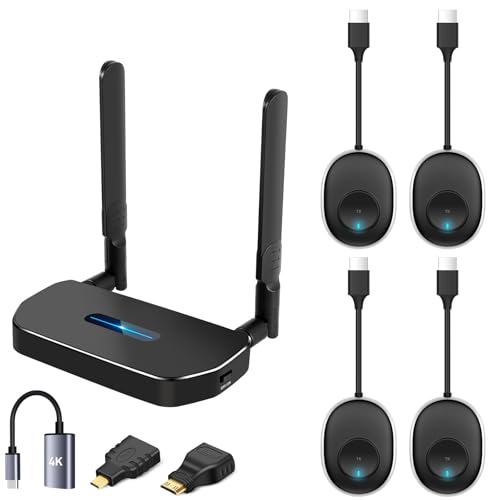
- Includes four transmitters and one receiver
- Pairs with up to eight transmitters
- Supports mirror and extend modes
Best For: Meetings, classrooms, offices, and shared displays
Best for Multi-User Monitoring – Hollyland Pyro H 4K Wireless Video System
For production teams comparing 4k wireless video receivers, the Hollyland Pyro H stands out with 4K30 transmission, dual-band 2.4/5GHz operation, and support for up to four receivers. Its 1,300-foot line-of-sight range and 60ms latency suit collaborative monitoring and live production.
Best For: Film crews, live-streaming teams, ENG/EFP work, and setups requiring multiple viewing points.
Pros:
- Supports up to 3840×2160 at 24/25/30fps over HDMI.
- Long 1,300-foot range with 60ms latency in suitable conditions.
- Smart channel scanning across 2.4GHz and 5GHz bands.
- Includes HDMI loop-out and UVC support for computer live streaming.
Cons:
- 4K transmission is limited to 30fps.
- The listed kit includes one transmitter and one receiver; additional receivers are separate.
The Pyro H is a strong choice when range, flexible monitoring, and team collaboration matter more than ultra-low latency or higher 4K frame rates.
Best for Long-Range HDMI Distribution – Graige 952 4K Wireless HDMI Kit
This Graige 952 kit is a practical option for buyers seeking 4k wireless video receivers for home theaters, classrooms, conference rooms, or studios. It supports 4K at 30Hz, reaches up to 1,000 feet, and can connect one transmitter to as many as three receivers.
Best For: Long-distance HDMI distribution between computers, set-top boxes, game consoles, TVs, projectors, and monitors.
Pros:
- Supports 4K 30Hz and 1080p 60Hz transmission.
- One transmitter can connect with up to three receivers.
- HDMI loop-out enables simultaneous local and remote display.
- Includes IR extension and selectable Wi-Fi bands for interference management.
Cons:
- Supports progressive formats only; 1080i and 720i are not supported.
- Remote controller is not included.
- The listed system uses H.264 encoding and is not presented as a professional camera-transmission platform.
With its loop-out, IR control, cooling system, and multi-receiver capability, the Graige 952 is geared toward fixed HDMI distribution rather than mobile cinema workflows.
Best for Simple DSLR-to-Projector Links – SVBONY ST1 4K Wireless Video Kit
The SVBONY ST1 offers a straightforward choice for shoppers looking for 4k wireless video receivers to connect a DSLR or other HDMI source to a projector. It combines claimed 4K wireless transmission with a 1,000-foot range and approximately 0.06-second latency over a 5.8G band.
Best For: DSLR-to-projector connections and other long-distance HDMI video links where cable-free operation is the priority.
Pros:
- Designed for real-time wireless transmission.
- Provides a claimed range of up to 1,000 feet.
- Advertises ultra-low latency of 0.06 seconds.
Cons:
- The supplied notes provide limited detail about ports, supported frame rates, and receiver expansion.
- The notes do not specify whether the stated range applies only under line-of-sight conditions.
The ST1 may appeal to buyers who want a compact, purpose-focused wireless link, but the limited specification details make it harder to compare with more fully documented production systems.
Best for HDMI and SDI Production Workflows – Hollyland Mars 4K System
For professional buyers comparing 4k wireless video receivers, the Hollyland Mars 4K adds SDI alongside HDMI, making it more versatile for cameras, monitors, and production equipment. It supports 4K30, 1080p60, decimal-point SDI output rates, and app monitoring for on-set viewing.
Best For: Video production crews that need both HDMI and 3G-SDI connectivity, mobile monitoring, and support for broadcast-style frame rates.
Pros:
- Supports up to 3840×2160 at 24/25/30fps via HDMI.
- Provides HDMI and SDI input/output options, including 23.98, 29.97, and 59.94fps SDI output.
- Supports up to 450 feet of range with 66ms latency in stated laboratory conditions.
- Offers app monitoring on iOS and Android devices, with multiple display options.
Cons:
- Its stated range is shorter than the Pyro H and depends on interference-free conditions.
- 4K transmission is limited to 30fps.
- QC/PD charging is not supported.
The Mars 4K is best suited to crews that value SDI compatibility and production-oriented monitoring over maximum wireless range.
Best Plug-and-Play Pick – Wireless HDMI 4K Kit
This wireless HDMI kit is a practical choice among 4k wireless video receivers for everyday presentations, streaming, and screen mirroring. It supports up to 1080p at 60Hz, includes useful adapters, and can transmit up to 165 feet in open conditions.
Best For: Home entertainment, classrooms, business meetings, and users who want a simple setup for laptops, phones, cameras, or other HDMI devices.
Pros:
- Plug-and-play operation without drivers or an app.
- Supports up to 1080p at 60Hz with 3D video support.
- Includes mini HDMI and USB-C-related adapters for broader device compatibility.
- One receiver can pair with up to eight transmitters.
Cons:
- The listed output support is up to 1080p, despite the 4K-oriented product title.
- Concrete walls and separate floors can significantly reduce the transmission range.
- The kit does not include a 5V/2A charger.
This is a flexible, accessible option if convenience and device compatibility matter more than native 4K output. For best results, use it in a relatively open indoor environment.
Best Professional Production System – Accsoon CineView SE 4K
The Accsoon CineView SE 4K is a professional-grade choice among 4k wireless video receivers, designed for camera monitoring, live production, and filmmaking. It supports 4K video at up to 30p, 1080p at up to 60p, and transmission distances up to 1,312 feet in clear line-of-sight conditions.
Best For: Filmmakers, cinematographers, directors, and production teams needing long-range monitoring, low latency, and multi-device viewing.
Pros:
- Supports 4K input and output at 23.98/24/25/29.97/30p via HDMI.
- Offers latency as low as 0.05 seconds at 1080p and 0.1 seconds at 4K.
- Can send video to up to five destinations through wireless and wired connections.
- Includes camera-control support for select Sony and Canon cameras.
Cons:
- Its maximum range and latency figures depend on unobstructed, interference-free conditions.
- USB-C video output is for mobile monitoring and does not support UVC computer capture.
- Mac and PC computers are not supported as monitoring devices.
This system offers the strongest feature set here for professional video workflows. Buyers should confirm camera, phone, tablet, and receiver compatibility before building it into a production setup.
Best Long-Range Home and Event Kit – Dual-Band Wireless HDMI
This dual-band system is a long-range option among 4k wireless video receivers, using 4K decoding while outputting 1080p at 60Hz. Its 2.4GHz and 5.8GHz design, cooling system, and automatic pairing make it suited to larger spaces and quick installations.
Best For: Large homes, offices, classrooms, venues, outdoor events, and users who need wireless HDMI across open areas or around light obstacles.
Pros:
- Decodes 4K input and delivers 1080p output at 60Hz.
- Claims up to 360 feet outdoors and up to 165 feet indoors under stated conditions.
- Uses dual-band 2.4GHz and 5.8GHz connectivity for interference resistance.
- Supports mirror and extend display modes, plus up to eight transmitters per receiver.
Cons:
- It does not provide native 4K output; the stated output is 1080p at 60Hz.
- Walls and other obstacles can reduce range and transmission speed.
- The product notes do not specify compatibility with every HDMI source or display configuration.
With its long stated range and dual-band operation, this kit is appealing for presentations, events, and multi-room setups. Choose it when easy deployment and coverage are more important than a native 4K display signal.
Best with Extra Features – AIMIBO 4K Wireless HDMI Kit
For shoppers comparing 4k wireless video receivers, the AIMIBO kit is a practical choice for sending video and audio from laptops, TV boxes, PS5 consoles, and other HDMI sources to a TV, projector, or monitor. It supports up to 4K at 30Hz for the receiver and offers a stated range of up to 165 feet in an unobstructed setting.
Best For: Home theaters, classrooms, meetings, gaming setups, and users who want a no-app, plug-and-play connection.
Pros:
- Supports 4K@30Hz receiver output and 1080p@60Hz transmission.
- Uses 2.4GHz/5GHz dual-band wireless transmission with claimed 0.1-second latency.
- Can pair up to eight transmitters with one receiver for switching between sources.
- Includes mini and micro HDMI adapters for broader device compatibility.
Cons:
- The 165-foot range applies to barrier-free conditions; walls or floors can reduce it to about 32 feet.
- It is limited to 4K at 30Hz rather than 4K at 60Hz.
This AIMIBO system stands out for flexible source support and easy installation. It is a strong fit when convenience and multi-device switching matter more than maximum 4K refresh rate.
Best Long-Range Option – Vrriis WL095P 4K Wireless System
Among 4k wireless video receivers, the Vrriis WL095P is designed for extended point-to-point transmission. Its supplied specifications support UHD 4K at 30Hz, dual-band wireless operation, and a claimed open-field range of up to 1,150 feet.
Best For: Large open spaces, home theater layouts, presentations, and setups that need multiple receiver outputs or external audio.
Pros:
- Supports UHD 4K@30Hz video and synchronized audio using H.265 encoding.
- Claims transmission up to 1,150 feet in an open field without interference.
- One transmitter can work with up to four receivers, with dual HDMI outputs on the receiver side.
- Includes a 3.5mm audio interface for connecting compatible speakers or soundbars.
Cons:
- Walls, metal, brick, and glass can significantly reduce signal coverage.
- It supports 4K at 30Hz, not 4K at 60Hz.
- The unusually long range depends heavily on clear, interference-free conditions.
The WL095P is best judged by its range and expansion options rather than by compact simplicity. It makes the most sense for buyers who need multi-display support or longer wireless runs in an open environment.
Best Multi-Source Bundle – 4K Wireless HDMI Kit with Four Transmitters
This four-transmitter bundle is a useful option for shoppers seeking 4k wireless video receivers for shared displays. One receiver can pair with up to eight transmitters, allowing users to switch among multiple computers or HDMI sources while sending content to one TV, monitor, or projector.
Best For: Offices, conference rooms, classrooms, and households that regularly switch between several source devices.
Pros:
- Includes one receiver and four transmitters, with support for up to eight transmitters total.
- Supports resolutions up to 4K@30Hz and offers mirror or extend display modes.
- Pre-paired, plug-and-play setup requires no app, Bluetooth, or Wi-Fi.
- Uses 2.4GHz/5GHz dual-band transmission with a stated range up to 165 feet without barriers.
Cons:
- The receiver is intended to combine multiple computers into one display, not distribute one source to multiple TVs.
- Chargers are not included, and each unit requires suitable 5V/1A-or-higher power.
- The stated range can be reduced by walls and other obstructions.
This kit is especially practical when several presenters or computers need access to the same screen. Its included transmitters add value, but buyers should plan for adequate USB power and the one-display receiving setup.
How We Picked the Best 4K Wireless Video Receivers
We focused on the features that most affect real-world wireless video performance: supported resolution and frame rates, transmission range, latency, connection stability, input and output ports, multi-receiver support, power requirements, and setup complexity. We also separated professional camera systems with HDMI and SDI connectivity from simpler plug-and-play kits designed for presentations or home entertainment.
Advertised range is measured in open conditions, so walls, crowded wireless networks, and other interference can reduce performance. A strong pick should match your environment rather than simply claim the longest distance.
Quick Comparison
| Use case | Prioritize | Best feature to look for |
|---|---|---|
| Camera monitoring | Low latency and stable transmission | Dedicated 5 GHz or dual-band wireless operation |
| Professional video production | Flexible video formats | HDMI and SDI support with frame-rate compatibility |
| Presentations | Simple installation | Plug-and-play operation and broad display compatibility |
| Multi-screen distribution | Scalability | One-to-many transmitter or receiver support |
| Home entertainment | Convenience and value | 4K input support, reliable 1080p output, and straightforward controls |
Key Buying Factors for 4K Wireless Video Receivers
Resolution and Frame-Rate Support
Confirm whether 4K refers to input, transmission, or output. Many systems accept a 4K signal but transmit or display it at 1080p. Check supported frame rates as well, especially if you use 4K30, 1080p60, 23.98 fps, or 59.94 fps camera formats.
Latency
Low latency matters for live monitoring, presentations, gaming, and production. A delay around 50 to 60 milliseconds may be workable for many camera workflows, while interactive use benefits from the lowest practical figure. Manufacturer latency claims can vary with resolution and wireless conditions.
Range and Signal Reliability
Choose a system with more range than your minimum requirement, particularly in offices, venues, or homes with multiple walls. Dual-band operation can help manage interference, but it does not eliminate congestion or physical obstructions.
Ports, Compatibility, and Power
Check for the exact HDMI or SDI connections your source and display require. Also verify HDCP behavior, audio support, power adapters, battery options, and whether the transmitter can draw power from a camera or USB port.
Multi-Device Support
If you need several monitors, look for one-to-many transmission or multiple receiver support. For switching among sources, confirm how pairing and channel selection work before buying.
Who Should Buy Which 4K Wireless Video Receivers?
Choose a professional HDMI/SDI system if you work with cameras, production monitors, or live events and need dependable format support, low latency, and better workflow flexibility.
Choose a plug-and-play HDMI kit for presentations, classrooms, conference rooms, or basic living-room video distribution. These systems are usually easier to install but may offer fewer production features.
Choose a multi-receiver model when one source must reach several displays. For streaming or camera monitoring, prioritize latency and connection stability over headline range. Before purchase, confirm every device’s maximum output resolution and the wireless system’s requirements for line of sight.