The best audio interface with MIDI input can connect microphones, instruments, monitors, and external MIDI gear while keeping your setup organized. The right model depends on how many sources you record, which connections you need, and how much room you want to leave for future expansion.
We compared compact two-channel interfaces, versatile home-studio models, and higher-I/O options to help you choose a practical fit for recording, production, streaming, or live performance.
Best 10 Audio Interface with Midi Input Picks for 2026
Expandable Studio Hub

- 18x20 USB audio/MIDI connectivity
- Eight MIDAS mic preamps with phantom power
- ADAT I/O for studio expansion
Best For: Larger recording setups and multi-mic sessions
Modern All-Rounder
Focusrite Scarlett 4i4 4th Gen

- Two mic preamps and two Hi-Z inputs
- MIDI I/O with four line inputs and outputs
- Auto Gain, Clip Safe, Air mode, and 192 kHz support
Best For: Flexible home studios and electronic music setups
Portable Starter Pick

- Two XLR/TRS combo inputs
- USB-C bus power with plug-and-play setup
- 24-bit/192 kHz and zero-latency monitoring
Best For: Solo recording and mobile content creation
Monitoring-Focused Choice

- 4x4 USB-C connectivity with MIDI I/O
- Two mic preamps and hardware monitoring
- LCD screen and loopback for flexible workflows
Best For: Podcasting, streaming, and hands-on studio monitoring
Best Overall
Focusrite Scarlett 2i2 4th Gen

- Two mic preamps and Hi-Z instrument inputs
- 24-bit/192kHz recording with Auto Gain and Clip Safe
- Includes a broad music software bundle
Best For: Two-channel home recording
Best MIDI Connectivity
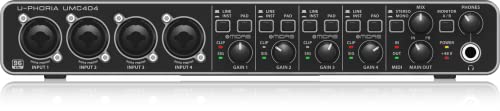
- Includes dedicated MIDI I/O
- Four Midas mic preamps and four inputs
- Supports 24-bit/192kHz recording
Best For: Multi-input MIDI and recording setups
Best for Vintage Tone
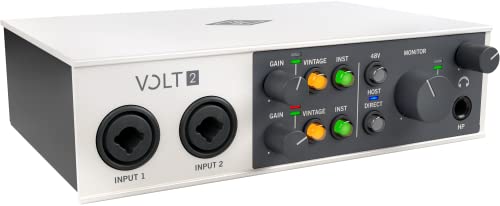
- Vintage mode emulates UA 610 preamps
- 24-bit/192kHz recording in a compact design
- MIDI support and mobile-device compatibility
Best For: Two-channel music, podcast, and streaming setups
Best Simple Two-Channel Option
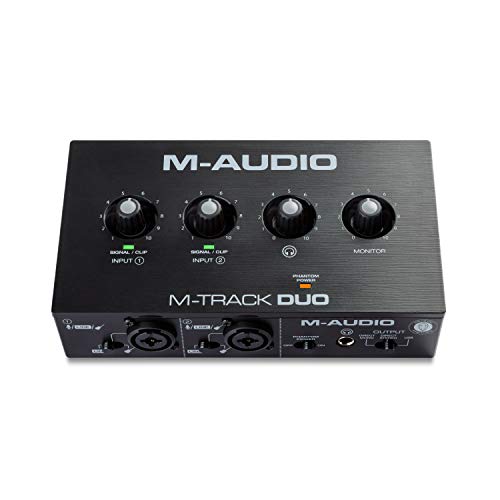
- Two combo inputs handle mic, line, and instrument signals
- USB/direct switch enables zero-latency monitoring
- Includes MPC Beats software
Best For: Beginners recording vocals, guitar, podcasts, or line inputs
Best Effects-Focused Mixer

- 24 preset effects for vocals and instruments
- Multiple mic, guitar, AUX, and RCA inputs
- 48V phantom power with 24-bit/48kHz USB recording
Best For: Performers and beginners wanting built-in effects and flexible analog inputs
Expandable Studio Hub – Behringer UMC1820
The Behringer UMC1820 is a strong choice when an audio interface with MIDI input needs to handle a larger recording setup. Its 18×20 USB connectivity, eight mic preamps, and ADAT I/O provide room for microphones, instruments, and future expansion.
Best For: Larger home studios, bands, and producers recording multiple microphones or instruments.
Pros:
- 18 inputs and 20 outputs support complex recording and routing setups.
- Eight MIDAS-designed mic preamps include +48V phantom power.
- Supports 24-bit/96 kHz audio and ADAT expansion.
- Includes MIDI connectivity and works with popular recording software.
Cons:
- Its larger chassis may be excessive for simple two-channel recording.
- 96 kHz maximum sample rate is lower than some newer compact interfaces.
Choose the UMC1820 if channel count and expandability matter more than portability. It is particularly practical for projects that may grow beyond a basic desktop setup.
Modern All-Rounder – Focusrite Scarlett 4i4 4th Gen
The Focusrite Scarlett 4i4 4th Gen is a versatile audio interface with MIDI input for musicians who record microphones, guitars, synths, and drum machines. It combines two mic preamps, Hi-Z inputs, line connectivity, and USB-C operation in a compact studio hub.
Best For: Home producers and musicians who want flexible inputs, MIDI I/O, and easy level management.
Pros:
- Offers two mic preamps, two Hi-Z inputs, four line inputs, and four outputs.
- Includes MIDI input/output for keyboards, controllers, and other gear.
- Auto Gain and Clip Safe help manage recording levels.
- Air mode and 24-bit/192 kHz support add recording flexibility.
Cons:
- Four-in/four-out connectivity may be limiting for larger ensembles.
- Its feature set may be more than needed for basic two-input recording.
The Scarlett 4i4 is a balanced pick for a growing desktop studio. Its combination of instrument inputs, line connections, MIDI, and recording software makes it adaptable across many workflows.
Portable Starter Pick – PIYONE Q2 Alloy Red
The PIYONE Q2 Alloy Red is a compact audio interface with MIDI input for straightforward vocal, guitar, and mobile recording. Its two combo inputs, USB-C bus power, and class-compliant design suit creators who want a simple setup without an external power supply.
Best For: Solo musicians, mobile creators, and home users recording one or two sources at a time.
Pros:
- Two XLR/TRS combo inputs accommodate microphones and instruments.
- USB-C power and plug-and-play operation simplify setup.
- Supports 24-bit/192 kHz recording.
- Direct monitoring provides zero-latency tracking through the headphone output.
Cons:
- Two input channels offer less capacity than larger interfaces.
- The supplied notes identify Windows support, so users on other platforms should verify compatibility.
The Q2 focuses on accessible two-channel recording rather than extensive routing. It is a practical fit when portability, simple controls, and direct monitoring are the main priorities.
Monitoring-Focused Choice – MOTU M4
The MOTU M4 is a practical audio interface with MIDI input for recording, mixing, and podcasting. Its 4×4 USB-C connectivity, two microphone preamps, hardware monitoring, LCD screen, and loopback support make it useful for both music and spoken-word workflows.
Best For: Producers, podcasters, and musicians who value hardware monitoring and loopback functionality.
Pros:
- Provides 4×4 USB-C connectivity with MIDI I/O.
- Includes two microphone preamps for vocal and instrument recording.
- Hardware monitoring and an LCD screen support hands-on level control.
- Loopback expands its usefulness for podcasting and streaming.
Cons:
- Four-in/four-out connectivity is less suited to large multi-mic sessions.
- The supplied notes do not specify phantom-power details or the exact sample-rate resolution.
The M4 stands out when monitoring and loopback are important parts of the workflow. It offers a useful middle ground between a basic two-channel interface and a larger studio rack unit.
Best Overall – Focusrite Scarlett 2i2 4th Gen
The Focusrite Scarlett 2i2 4th Gen is a strong choice if you want an audio interface with MIDI input alternatives for a compact recording setup. It provides two mic preamps, two Hi-Z instrument inputs, 24-bit/192kHz recording, and helpful features such as Auto Gain and Clip Safe.
Best For: Home recording, vocalists, guitarists, and creators who need two high-quality inputs.
Pros:
- Two mic preamps and two Hi-Z instrument inputs
- Up to 24-bit/192kHz recording with 120dB dynamic range
- Auto Gain, Clip Safe, and Air modes simplify recording
- Includes Pro Tools Intro+, Ableton Live Lite, Cubase LE, and Hitmaker Expansion
Cons:
- Provides two audio inputs rather than four
- The supplied notes list USB connectivity but do not specify built-in MIDI I/O
The Scarlett 2i2 focuses on polished two-channel recording and beginner-friendly controls. If MIDI connectivity is essential, verify your setup requirements before choosing it.
Best MIDI Connectivity – Behringer UMC404HD 4×4
Behringer U-PHORIA UMC404HD 4x4 USB Audio Interface, 24-Bit/192kHz, with 4 Midas Mic Preamps
Check Price On AmazonThe Behringer U-PHORIA UMC404HD stands out when you need an audio interface with MIDI input and several simultaneous audio connections. Its 4×4 USB design combines four Midas mic preamps with MIDI I/O and supports recording up to 24-bit/192kHz.
Best For: Musicians using keyboards or MIDI hardware alongside multiple microphones or instruments.
Pros:
- Built-in MIDI I/O
- Four Midas mic preamps and four audio inputs
- 4-in/4-out USB operation at up to 24-bit/192kHz
Cons:
- Heavier than the other listed interfaces at 2.7 pounds
- The supplied operating-system details emphasize Windows compatibility
With four inputs, four outputs, and dedicated MIDI I/O, the UMC404HD is the most directly suited to expanded instrument and recording setups. It is a practical pick when two inputs would be limiting.
Best for Vintage Tone – Universal Audio Volt 2
The Universal Audio Volt 2 is a compact option for anyone comparing an audio interface with MIDI input for music, podcasting, or streaming. It offers two-channel USB-C connectivity, 24-bit/192kHz conversion, and a Vintage mode modeled on UA’s classic 610 preamps; the supplied notes also identify MIDI support.
Best For: Musicians, podcasters, and streamers who want two-channel recording with Vintage-mode preamp coloration.
Pros:
- Vintage mode provides 610 tube-preamp emulation
- Up to 24-bit/192kHz recording
- Supports MacOS, Windows, iPad, and iPhone with the listed adapter requirements
- Includes access to LUNA and a range of software and learning resources
Cons:
- Limited to two audio channels
- iOS use may require an external power supply and Apple adapter
- One-year manufacturer warranty is listed
The Volt 2 balances portable two-channel recording with a distinctive Vintage mode and MIDI-oriented musician features. It is a good fit when tonal character and mobile flexibility matter more than a larger I/O count.
Best Hybrid Creator Pick – MAONO P2 Dual XLR Interface
The MAONO P2 is a versatile audio interface with midi input alternative for creators who need flexible USB connectivity rather than MIDI hardware. Its dual USB-C ports let you connect a computer and phone or iPad simultaneously, while dual XLR inputs, loopback, and direct monitoring support recording, streaming, and mobile workflows.
Best For: Streamers, podcasters, musicians, and mobile creators recording vocals, guitar, or desktop audio across multiple devices.
Pros:
- Dual USB connectivity supports computer-and-mobile workflows.
- Dual XLR inputs offer 24-bit/192kHz recording and 56dB of gain.
- Loopback, routing software, mute controls, and direct monitoring suit streaming.
Cons:
- It does not provide a dedicated MIDI input.
- Its creator-focused routing features may be more than a basic recording setup needs.
The P2 stands out for creators who prioritize mobile flexibility, loopback, and high-resolution recording. Choose it when your setup centers on microphones, instruments, streaming, and computer audio rather than MIDI controllers.
Best Simple Two-Channel Option – M-AUDIO M-Track Duo
The M-AUDIO M-Track Duo is a straightforward two-channel interface for recording microphones, guitars, and line-level sources. While it is not an audio interface with MIDI input, its combo XLR/line/instrument inputs, phantom power, and zero-latency monitoring make it a practical choice for a compact recording setup.
Best For: Beginners and home users recording vocals, guitar, podcasts, or line inputs on Mac or PC.
Pros:
- Two combo XLR/line/instrument inputs accommodate microphones and instruments.
- USB/direct monitoring provides zero-latency monitoring flexibility.
- Includes MPC Beats software and supports 48kHz recording.
Cons:
- It has no dedicated MIDI input.
- Its maximum sample rate is 48kHz.
The M-Track Duo keeps the essential recording controls simple and portable. It is a sensible pick for two-channel recording, but keyboard players or producers needing MIDI connectivity will need a separate MIDI interface or another model.
Best Effects-Focused Mixer – Pyle PMUX9 USB Interface
The Pyle PMUX9 is a feature-heavy USB recording and mixing unit with microphone, guitar, AUX, and RCA inputs. It is not an audio interface with MIDI input, but its 24 preset digital effects, 48V phantom power, and multiple headphone, phone, stereo, and monitor outputs may appeal to users who want hands-on live sound controls.
Best For: Beginners and performers who want built-in vocal or instrument effects, multiple analog inputs, and computer recording.
Pros:
- Offers 24 built-in effects, including reverb, delay, chorus, and wah-wah.
- Provides multiple input types, including combo jacks, AUX, and RCA stereo.
- Includes 48V phantom power and 24-bit/48kHz USB recording.
Cons:
- It does not include a dedicated MIDI input.
- Its supplied compatibility details list Windows audio software rather than broad platform support.
- The product notes contain an inconsistent included-components listing, so verify package contents before purchase.
The PMUX9 is better suited to effects-driven live use and flexible analog connections than to a streamlined studio interface. Consider it if onboard effects matter more than MIDI integration or advanced computer routing.
How We Picked the Best Audio Interface with Midi Input
We focused on interfaces that suit real-world recording and production workflows, giving priority to useful input and output counts, microphone preamp quality, MIDI connectivity, monitoring options, driver or host compatibility, and overall value. We also considered whether each model makes sense for a beginner, a mobile setup, or a growing studio.
Because the selected range includes both full-featured interfaces and simpler budget models, check the specifications carefully before buying. Not every product offers the same MIDI, I/O, or software capabilities.
Quick Comparison
| Best For | What to Look For |
|---|---|
| Solo recording | Two clean preamps, direct monitoring, and easy USB connectivity |
| Small bands or multi-mic sessions | Four or more analog inputs and independent gain control |
| Electronic music | Reliable MIDI I/O, low-latency monitoring, and flexible line outputs |
| Expansion | ADAT or additional digital connectivity, when supported |
| Mobile recording | Bus power, device compatibility, and a compact enclosure |
Key Buying Factors for an Audio Interface with Midi Input
MIDI Connectivity
Confirm whether the interface includes five-pin MIDI input and output or only USB MIDI compatibility. Traditional MIDI ports are useful for hardware synthesizers, drum machines, and controllers, while USB connectivity may be enough for a computer-based setup.
Inputs, Outputs, and Preamps
Count the sources you expect to record at the same time. Combo XLR/TRS inputs can accept microphones, balanced line-level equipment, or instruments, but some inputs may share controls or operate differently. Check for phantom power if you use condenser microphones and high-impedance instrument inputs for guitar or bass.
Monitoring and Compatibility
Direct monitoring helps reduce the delay performers hear while recording. Look for a headphone output with an appropriate level, balanced monitor outputs, and compatibility with your computer, tablet, or phone. USB-C describes the connector; it does not automatically guarantee every mobile device or power arrangement will work without an adapter.
Resolution and Expansion
24-bit recording is standard for quality home production, while higher sample rates can be useful for specific workflows but are not a substitute for good microphones, gain staging, or room treatment. If your setup may grow, prioritize extra outputs, loopback features, or digital expansion over headline specifications alone.
Who Should Buy Which Audio Interface with Midi Input?
Choose a two-input interface if you mainly record vocals, guitar, podcasts, or one stereo source at a time. A four-input model is more suitable for a small electronic rig, stereo instruments, or occasional multi-microphone sessions. Larger interfaces are the better choice for drum microphones, ensemble recording, and permanent studio wiring.
Musicians using external synthesizers or drum machines should verify dedicated MIDI ports before ordering. Streamers and mobile creators may prefer a compact interface with simple monitoring and device support, while producers planning to add hardware should spend more on dependable I/O and expansion. Whichever model you choose, match its connections to your current equipment rather than paying for channels you will not use.