The right audio interface can make vocals, instruments, podcasts, and streams sound cleaner while giving you dependable control over gain, monitoring, and playback.
We compared 10 popular USB models across entry-level recording, home music production, streaming, and more advanced desktop setups to help you find the best fit.
Best 10 Audio Interface Picks for 2026
Compact Recording Essential
Focusrite Scarlett Solo 3rd Gen

- One mic preamp and one Hi-Z instrument input
- Air mode and 24-bit/192kHz recording
- Includes software and Hitmaker Expansion
Best For: Solo musicians, vocalists, guitarists, and podcasters
Vintage-Style Creator Choice
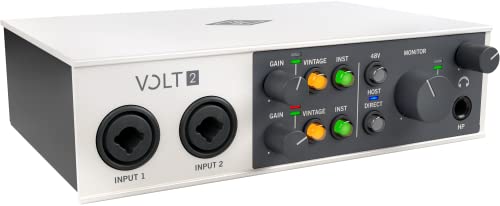
- Two-channel USB-C interface with MIDI
- Vintage mode emulates UA 610 tube preamps
- Supports Mac, Windows, iPad, and iPhone
Best For: Musicians, podcasters, and streamers seeking preamp character
Smart Two-Input Upgrade
Focusrite Scarlett 2i2 4th Gen

- Two mic preamps and two Hi-Z inputs
- Auto Gain and Clip Safe help protect takes
- 120dB dynamic range and 24-bit/192kHz support
Best For: Two-source music, podcast, and home recording
Display-Focused Studio Hub

- Two-in/two-out USB-C design with two preamps
- Hardware monitoring for direct recording feedback
- 24-bit/192kHz support and 6GB+ free content
Best For: Compact computer-based home studios
Best All-Rounder
Focusrite Scarlett 4i4 4th Gen

- Four-in, four-out connectivity with MIDI I/O
- 24-bit/192kHz support and 120dB dynamic range
- Auto Gain, Clip Safe, Air modes, and bundled software
Best For: Growing home studios and multi-instrument setups
Best Compact Recording Pick

- Class-A console microphone preamp
- Durable all-metal USB-C desktop design
- Mac, PC, and iOS compatibility
Best For: Solo recording and portable desktop setups
Best for Streaming Controls

- 80dB gain for XLR microphones
- Onboard voice effects and ultra-low-latency monitoring
- Touch controls, LED feedback, and Wave Link routing
Best For: Streamers and voice-focused creators
Versatile Starter
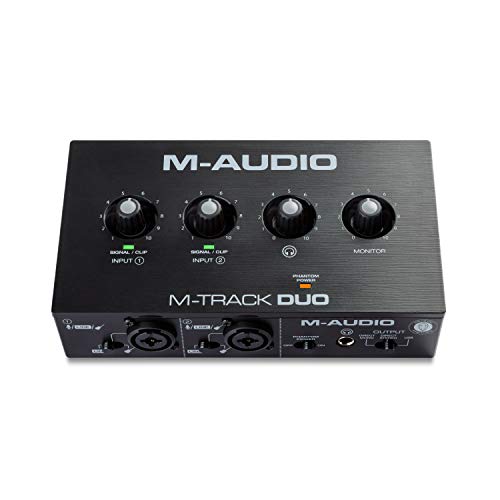
- Two combo inputs for mic, instrument, or line sources
- Zero-latency USB/Direct monitoring switch
- Includes MPC Beats and supports Ableton Live Lite
Best For: Two-source recording, podcasting, and streaming
Studio-Ready Pick
Focusrite Scarlett Solo 4th Gen

- 24-bit/192kHz recording with 120dB dynamic range
- Air mode adds presence to vocals and guitars
- Includes a substantial recording software bundle
Best For: Solo vocalists, guitarists, and songwriters
Compact Essentials
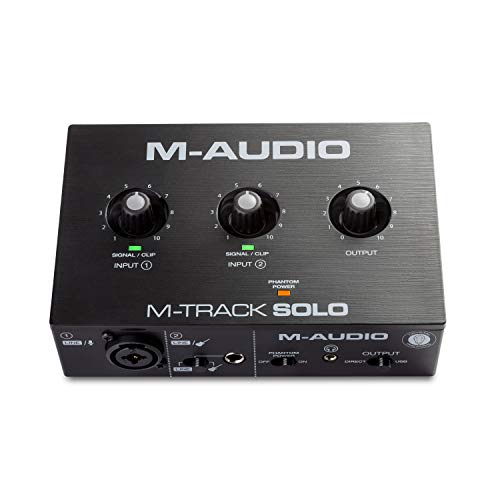
- Combo mic/line input plus separate instrument input
- Direct monitoring switch for low-latency listening
- Compact design with MPC Beats included
Best For: Solo recording, podcasting, and basic streaming
Compact Recording Essential – Focusrite Scarlett Solo 3rd Gen
The Focusrite Scarlett Solo 3rd Gen is a practical audio interface for recording a vocal and guitar or bass setup. Its mic preamp, Hi-Z instrument input, Air mode, and 24-bit/192kHz capability make it a strong starting point for music and podcast production.
Best For: Solo musicians, vocalists, guitarists, and podcasters who need a compact two-channel interface.
Pros:
- Air mode can add clarity to acoustic instruments and presence to recordings.
- Dedicated XLR mic and high-headroom instrument inputs support vocal and guitar recording.
- Includes useful recording software and Hitmaker Expansion content.
Cons:
- Provides one mic preamp and one instrument input, limiting simultaneous microphone setups.
- Its listed warranty details vary between the supplied bullets and specifications.
The Solo keeps the essentials focused and portable while offering high-resolution recording and low-noise monitor outputs. Choose it when a simple one-mic, one-instrument workflow is more important than expandability.
Vintage-Style Creator Choice – Universal Audio Volt 2
The Universal Audio Volt 2 is a two-channel audio interface designed for musicians, podcasters, and streamers who want a more characterful recording workflow. Its Vintage mode emulates UA 610 tube preamps, while 24-bit/192kHz conversion supports detailed capture.
Best For: Creators who want two inputs, Vintage preamp coloration, MIDI connectivity, and desktop or mobile flexibility.
Pros:
- Vintage mode is designed to deliver the rich sound associated with UA 610 preamps.
- Supports recording and mixing at up to 24-bit/192kHz quality.
- Works with Mac, Windows, iPad, and iPhone, with the required mobile accessories and power supply.
Cons:
- Mobile recording requires an external Volt power supply and, for some devices, an Apple Lightning to USB Camera Adapter.
- The supplied specifications list a one-year manufacturer warranty.
Volt 2 is appealing if preamp character and bundled creative tools matter as much as basic connectivity. Its two-channel design suits compact recording, while LUNA and included software support a broader production setup.
Smart Two-Input Upgrade – Focusrite Scarlett 2i2 4th Gen
The Focusrite Scarlett 2i2 4th Gen is a versatile audio interface for recording two microphones, instruments, or a combination of both. Its 120dB dynamic range, Auto Gain, Clip Safe, and Air modes make level-setting and polished capture easier for new and experienced creators.
Best For: Musicians, podcasters, and home recordists who need two mic preamps and dependable recording assistance.
Pros:
- Two mic preamps and two Hi-Z instrument inputs support flexible two-source recording.
- Auto Gain helps set levels, while Clip Safe is designed to help prevent clipping.
- Includes Pro Tools Intro+, Ableton Live Lite, Cubase LE, and Hitmaker Expansion.
Cons:
- It remains a two-channel interface, so larger multi-microphone sessions require additional inputs.
- Its listed 0.6 kg weight is heavier than the compact Solo specification.
The 2i2 4th Gen is the more flexible Scarlett choice for recording two sources at once. Auto Gain and Clip Safe add practical safeguards, while Air modes and the bundled software make it ready for a new recording setup.
Display-Focused Studio Hub – MOTU M2 USB-C Audio Interface
The MOTU M2 is a straightforward two-in/two-out USB-C audio interface with two preamps and hardware monitoring. It supports 24-bit/192kHz recording and includes more than 6GB of free content, making it a practical fit for a compact computer-based studio.
Best For: Home recordists who want two preamps, hardware monitoring, and high-resolution recording in a small interface.
Pros:
- Two preamps provide a basic two-source recording setup.
- Hardware monitoring supports direct monitoring during recording.
- Offers 24-bit/192kHz operation and more than 6GB of free content.
Cons:
- The supplied compatibility details emphasize personal computers and list Windows as the operating system.
- Only two inputs and two outputs are provided for expansion.
MOTU’s M2 focuses on core recording functions rather than a long feature list. It is worth considering when hardware monitoring, two preamps, and high-resolution capture cover your workflow without requiring a larger interface.
Best All-Rounder – Focusrite Scarlett 4i4 4th Gen
The Focusrite Scarlett 4i4 4th Gen is a versatile audio interface for creators who need more than a basic mic input. It combines two mic preamps, Hi-Z instrument inputs, line connectivity, MIDI, and four outputs in a compact USB-C setup.
Best For: Home studios, producers, and musicians recording multiple instruments or external gear.
Pros:
- Four-in, four-out design with two mic preamps, two Hi-Z inputs, four line inputs, and MIDI I/O.
- 24-bit/192kHz operation and a stated 120dB dynamic range support detailed recording.
- Auto Gain, Clip Safe, and Air modes add useful recording and tone-shaping tools.
- Includes Pro Tools Intro+, Ableton Live Lite, Cubase LE, and Hitmaker Expansion software.
Cons:
- Its broader connectivity may be more than needed for a simple one-microphone setup.
- USB-C power supply and adapter requirements may add cable considerations to a compact setup.
Choose the Scarlett 4i4 when expansion and flexible routing matter as much as straightforward recording. Its feature set makes it a strong central hub for a growing home studio.
Best Compact Recording Pick – Audient iD4 MKII
The Audient iD4 MKII is a compact two-channel audio interface built around a Class-A console microphone preamp. Its metal desktop housing, USB-C connection, and compatibility with Mac, PC, and iOS make it a practical choice for portable home recording.
Best For: Solo vocalists, instrumentalists, and creators who want a durable two-channel interface.
Pros:
- Class-A microphone preamp technology is based on Audient’s high-end ASP8024 console.
- USB-C connectivity supports easier handling and improved power supply.
- All-metal housing offers a stable, durable desktop design.
- Compatible with macOS, PC, and iOS, with two headphone outputs listed in the product title.
Cons:
- Two-channel connectivity is less suited to recording several microphones or instruments at once.
- Its maximum sample rate is 96kHz rather than 192kHz.
- The listed supported software is more limited than some larger bundled packages.
The iD4 MKII makes sense if you value a sturdy, focused recording setup over extensive I/O. It is especially well matched to solo recording and mobile-friendly desktop workflows.
Best for Streaming Controls – Elgato Wave XLR MK.2
The Elgato Wave XLR MK.2 is a USB audio interface and DSP mixer designed for streamlined voice production. It pairs 80dB of gain with onboard effects, touch controls, LED feedback, and Wave Link software for routing and monitoring.
Best For: Streamers and voice-focused creators using an XLR microphone with Wave Link.
Pros:
- Up to 80dB of gain is designed to drive a wide range of XLR microphones.
- Built-in voice enhancer, compressor, EQ, and other DSP effects simplify voice processing.
- Touch control, mute functionality, and customizable LED feedback provide quick visual control.
- Wave Link supports routing, effects, monitoring, and Stream Deck integration.
Cons:
- It provides XLR input rather than the broader instrument, line, and MIDI connectivity of a studio hub.
- Wave Link requires Windows 11 or Apple Silicon Mac systems, with specified newer operating-system versions.
- It is limited to 24-bit/48kHz monitoring in the listed feature description despite a 192kHz maximum sample-rate specification.
The Wave XLR MK.2 is a focused choice for creators who want hands-on streaming control and integrated voice processing. It is less about expanding a traditional studio and more about managing a polished live voice workflow.
Versatile Starter – M-AUDIO M-Track Duo
The M-AUDIO M-Track Duo is a practical two-channel audio interface for recording, podcasting, and live streaming. Its two combo inputs accept microphones, instruments, or line-level sources, while phantom power supports compatible condenser microphones.
Best For: Home recording setups, podcasters, and streamers who need two simultaneous inputs.
Pros:
- Two combo XLR/line/instrument inputs with phantom power
- USB/Direct monitoring switch helps provide zero-latency monitoring
- Includes MPC Beats and supports Ableton Live Lite
- Works with macOS, Windows, Android, and iOS
Cons:
- Maximum sample rate is 48kHz
- Uses 1/4-inch headphone and stereo outputs, which may require adapters for some setups
Choose the M-Track Duo if flexible two-input recording and straightforward monitoring matter more than high-resolution sample rates. Its portable design and included software make it a capable entry-level hub.
Studio-Ready Pick – Focusrite Scarlett Solo 4th Gen
The Focusrite Scarlett Solo 4th Gen is a compact audio interface for singers, songwriters, and guitarists. It combines one XLR microphone preamp with a Hi-Z instrument input, 24-bit/192kHz recording, and a 120dB dynamic range.
Best For: Solo musicians who want detailed recording performance and a broad software bundle.
Pros:
- Supports up to 24-bit/192kHz recording
- 120dB dynamic range and improved Air mode for vocals and guitars
- Includes Pro Tools Intro+, Ableton Live Lite, Cubase LE, and Hitmaker Expansion
- Compatible with Mac, Windows, and iPad
Cons:
- Provides one microphone input and one instrument input
- Less suited to recording multiple microphones at once
The Scarlett Solo is the stronger fit when recording quality, high-resolution capture, and music-production tools are priorities. Its single-mic layout keeps it focused on solo performance workflows.
Compact Essentials – M-AUDIO M-Track Solo
The M-AUDIO M-Track Solo is a compact, budget-friendly audio interface for simple recording, podcasting, and streaming. It combines one combo microphone/line input with a separate line/instrument input and offers direct monitoring for low-latency use.
Best For: Solo creators who need basic microphone and instrument connectivity in a small package.
Pros:
- One combo XLR/line input plus a separate line/instrument input
- Phantom power supports compatible condenser microphones
- USB/Direct switch enables zero-latency monitoring
- Includes MPC Beats and supports Ableton Live Lite
Cons:
- Maximum sample rate is 48kHz
- Only one combo microphone input is available
- Uses 1/8-inch headphone and RCA outputs
The M-Track Solo makes sense for straightforward one-microphone setups, especially when portability and simple controls are more important than expanded connectivity or high-resolution recording.
How We Picked the Best Audio Interfaces
We focused on practical features that affect everyday recording: preamp quality, input and output flexibility, latency, monitoring controls, software compatibility, build quality, and overall value. The selection includes compact one-input models for solo creators, two-input interfaces for vocals and instruments, and larger options for multi-microphone or expanded studio setups.
USB connectivity and broad computer compatibility were also important. Features such as direct monitoring, loopback, onboard DSP, MIDI, bundled software, and USB-C support can make a meaningful difference depending on how you work.
Quick Comparison
| Best For | Recommended Model | Why It Stands Out |
|---|---|---|
| Solo recording | Focusrite Scarlett Solo 4th Gen | Simple setup with modern recording features |
| Two-source recording | Focusrite Scarlett 2i2 4th Gen | Flexible inputs for vocals, instruments, or interviews |
| Detailed metering | MOTU M2 | Clear front-panel display and responsive performance |
| Streaming and content creation | Elgato Wave XLR MK.2 | Focused controls and DSP-oriented workflow |
| Expandable home studio | Focusrite Scarlett 4i4 4th Gen | More inputs and outputs for growing setups |
Key Buying Factors for an Audio Interface
Inputs and Recording Needs
Choose a one-input interface if you mainly record a single microphone or instrument. Two inputs are more versatile for stereo instruments, interviews, co-hosts, or simultaneous vocal and guitar recording. If you expect to connect multiple microphones, monitors, headphones, or external hardware, consider a four-input model.
Preamp Quality and Phantom Power
Microphone preamps should provide enough clean gain for your microphones without excessive noise. Phantom power is essential for most condenser microphones. Check whether it is available across the inputs and whether the interface offers convenient gain controls and clear level indicators.
Monitoring, Latency, and Connections
Direct monitoring helps you hear your performance with minimal delay. Look for a dedicated headphone output, balanced monitor outputs, and a useful monitor mix control. USB-C can simplify connection to newer computers, but verify the included cable and your computer’s ports before buying.
Software and Special Features
Bundled recording software can reduce setup time for beginners. MIDI ports matter if you use keyboards or hardware controllers, while loopback, onboard DSP, and dedicated streaming controls may be more valuable for creators than traditional studio users.
Who Should Buy Which Audio Interface?
Choose a compact solo interface such as the Scarlett Solo, Audient iD4 MKII, or M-Track Solo if you record one microphone or instrument and want a small desktop footprint. The Solo 3rd Gen can also be a good value when basic features are enough.
Choose a two-input model such as the Scarlett 2i2, Universal Audio Volt 2, MOTU M2, or M-Track Duo if you want room for two microphones, stereo recording, or a vocal-and-instrument setup. These are the most flexible choices for many home studios.
Choose the Scarlett 4i4 if you need additional inputs and outputs for a more capable home studio. Choose the Elgato Wave XLR MK.2 if streaming, microphone control, and software-based mixing are central to your workflow. Before buying, prioritize the connections and monitoring features you will use every session rather than paying for inputs you may never need.