Choosing among DMX controllers with joystick control can make a major difference in how quickly you program, adjust, and perform live lighting scenes. The right console should match your fixture count, control style, wireless needs, and comfort with manual programming.
This roundup compares 10 selected controllers across compact DJ boards, MIDI-ready systems, wireless options, and larger 384- or 512-channel consoles. Use the guide below to narrow the choices by workflow rather than channel count alone.
Best 10 Dmx Controllers with Joystick Picks for 2026
Versatile Scene Programmer

- 384 DMX channels for detailed control
- Stores up to 240 scenes
- Six programmable chases
Best For: DJs and small stages needing extensive scene programming
Compact 384-Channel Console

- 30 banks with eight scenes each
- 384 DMX512 control channels
- Includes an LED gooseneck light
Best For: Clubs and live operators wanting compact scene control
Wireless DMX Specialist

- Built-in D-Fi 2.4GHz transmitter
- Controls up to 12 intelligent lights
- Supports MIDI and beat-sync features
Best For: DJs using compatible wireless D-Fi lighting
LCD Joystick Controller

- 512 channels and up to 32 fixtures
- Joystick and high-definition LCD display
- Includes lamp, cable, and accessories
Best For: Stages and events needing hands-on joystick control
Best for Software-Driven Shows

- Two DMX universes with inputs, outputs, and Thru option
- Direct Engine DJ integration for compatible Denon DJ and Numark devices
- Touch strip, encoders, RGB pads, and lighting FX control
Best For: DJs running SoundSwitch-based lighting performances
Best for Hands-On DMX Programming

- 512 channels for up to 32 intelligent lights
- Supports 48 scenes and four lights at the same time
- LCD display, faders, scene keys, and music-mode amplifier
Best For: Beginners and event setups using conventional DMX fixtures
Best Wireless DMX Option
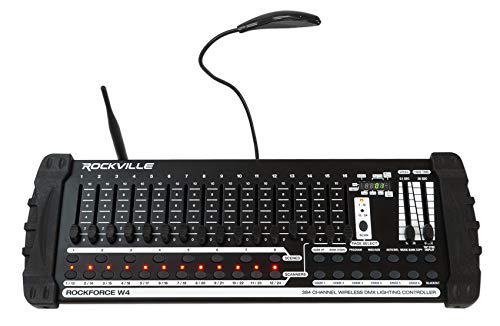
- Built-in 2.4GHz transmitter for up to seven light groups
- 384 channels with banks, scenes, and chases
- MIDI, music sync, manual override, and wired DMX in/out
Best For: Mobile events using compatible wireless DMX fixtures
Best Beginner-Friendly Pick

- Controls up to 12 fixtures
- Supports up to 240 scenes
- Voice control and dedicated sticks
Best For: Amateur DJs and small event lighting
Best Rugged MIDI Option

- 384 channels for up to 24 lights
- MIDI and music-triggered modes
- Durable metal housing with gooseneck lamp
Best For: DJs, clubs, and stage lighting rigs
Best Wireless Flexibility

- 2.4G wireless and wired DMX modes
- 384 channels with 240 scenes
- Sound activation and MIDI control
Best For: Indoor events needing flexible setup options
Versatile Scene Programmer – CHAUVET DJ Obey 70
The CHAUVET DJ Obey 70 is a practical choice among DMX controllers with joystick-style control needs, especially for users who want structured scene and chase programming. It offers 384 DMX channels and can manage up to 12 intelligent lights with up to 32 channels each.
Best For: DJs, small stages, and operators who need extensive scene and chase storage.
Pros:
- Stores up to 240 scenes across 30 banks of eight.
- Controls up to 12 intelligent lights with up to 32 channels each.
- Supports six chases containing up to 240 scenes.
- Allows fade and speed times to be programmed into each step.
Cons:
- It is a corded, rack-mount controller rather than a wireless unit.
- Its 6.9-pound weight and nearly 19-inch width may be substantial for portable setups.
Choose the Obey 70 when programming capacity matters more than wireless operation or compact portability. Its combination of 384 channels, scene banks, and chase storage suits repeatable show control.
Compact 384-Channel Console – DMX512 DJ Controller
This DMX512 DJ controller is a straightforward option for buyers comparing DMX controllers with joystick-style operation and programmable scene control. It provides 384 channels, 30 banks of eight scenes, and a compact console design with an LED gooseneck light.
Best For: Clubs, live-lighting operators, and users seeking a compact 384-channel console.
Pros:
- Offers 30 programmable banks with eight scenes each.
- Provides 384 DMX512 control channels.
- Includes an LED gooseneck light for operation in darker environments.
- Supports 110–240Vac, 50–60Hz power input.
Cons:
- The supplied notes do not specify detailed joystick functions or fixture-channel limits beyond the 384-channel rating.
- Its listed dimensions are inconsistent between the product description and details, so confirm sizing before rack planning.
This controller is worth considering if scene-bank capacity and broad DMX channel access are your priorities. The gooseneck light is a useful addition for live operation, while the compact structure supports club and event applications.
Wireless DMX Specialist – CHAUVET DJ Obey40 D-Fi 2.4
The CHAUVET DJ Obey40 D-Fi 2.4 stands out among DMX controllers with joystick-style controls for setups that need wireless lighting communication. Its built-in D-Fi 2.4GHz transmitter sends wireless DMX signals and controls up to 12 intelligent lights with up to 16 channels each.
Best For: DJs and venues using compatible D-Fi 2.4GHz wireless lighting systems.
Pros:
- Built-in D-Fi 2.4GHz transmitter enables wireless DMX transmission.
- Controls up to 12 intelligent lights with up to 16 channels each.
- Works with D-Fi systems operating on 2.4GHz.
- Supports features including audio activation, beat sync, tap sync, and MIDI triggering.
Cons:
- Wireless operation is limited to compatible D-Fi 2.4GHz systems.
- It handles fewer channels per fixture than controllers rated for 32 channels.
The Obey40 D-Fi 2.4 is the better fit when reducing DMX cable runs is important. Its wireless compatibility and performance-oriented trigger features make it particularly useful for compatible DJ and event lighting systems.
LCD Joystick Controller – DMX512 512-Channel Console
This 512-channel DMX console is a strong match for shoppers specifically seeking DMX controllers with joystick operation. It combines a joystick, LCD display, faders, scene controls, and a metal housing for programming and running lighting setups in venues, events, and performances.
Best For: DJs, stages, nightclubs, KTVs, and event operators who want joystick-assisted control and an LCD interface.
Pros:
- Supports 512 DMX channels and up to 32 fixtures with 16 channels per fixture.
- Includes a joystick, high-definition LCD screen, and dedicated fader and scene sections.
- Stores and runs up to 48 scenes.
- Includes a gooseneck LED lamp, power cable, manual, and 3-pin DMX cable.
Cons:
- Its 17.73-pound weight and large package dimensions make it less convenient for frequent transport.
- The console supports managing up to four fixtures simultaneously, despite its broader 32-fixture capacity.
Choose this console if hands-on joystick control, visual feedback, and a full physical control layout are more important than minimal size. Its included accessories and 512-channel capacity make it a broadly equipped option for fixed or semi-permanent lighting setups.
Best for Software-Driven Shows – SoundSwitch Control One
The SoundSwitch Control One is a strong choice for DJs seeking DMX controllers with joystick-style tactile control, although its interface uses a touch strip, encoders, and performance pads rather than a traditional joystick. It is designed for direct, hands-on control of SoundSwitch lighting software and supports two DMX universes.
Best For: DJs and performers who want software-based lighting control, Engine DJ integration, and quick access to lighting effects.
Pros:
- Provides 1:1 control for SoundSwitch software with two DMX universe inputs and outputs.
- Connects directly to compatible Denon DJ and Numark Engine DJ devices without a computer.
- Offers a touch strip, smooth encoders, customizable RGB pads, and control over moving heads, gobos, color, brightness, and strobe effects.
Cons:
- Its compatibility and advanced functionality are centered on SoundSwitch and supported DJ ecosystems.
- Some setups, including PRO DJ LINK Bridge use, require a laptop running SoundSwitch.
Choose the Control One when responsive software integration matters more than a conventional joystick layout. Its compact 1.76-pound design and dual-USB setup also suit mobile DJ workflows.
Best for Hands-On DMX Programming – SHEHDS DMX512 Controller
The SHEHDS DMX512 Controller is aimed at users who prefer a dedicated console layout over computer-based control. Among DMX controllers with joystick-style operation, it stands out for its channel faders, lighting controls, scene keys, page controls, and LCD display, though the supplied specifications do not list a joystick.
Best For: Beginners and small-to-medium lighting setups needing extensive channel, scene, and fixture control.
Pros:
- Offers 512 channels for controlling up to 32 intelligent lights with 16 channels each.
- Can run four lights and 48 scenes simultaneously and operate up to 32 computer-controlled fixtures.
- Includes an LCD display, channel faders, speed control, scene keys, and a built-in amplifier in music mode.
Cons:
- The console weighs 16.91 pounds and has a large package footprint, making it less convenient for highly mobile setups.
- It uses three-pin connections, so fixture compatibility and cabling should be checked before purchase.
For users learning conventional DMX programming, the clearly separated controls and LCD display can make scene selection and fixture setup more approachable. Its 512-channel capacity leaves room for larger lighting rigs.
Best Wireless DMX Option – Rockville ROCKFORCE W4
The Rockville ROCKFORCE W4 is a practical option for buyers comparing DMX controllers with joystick-style control but needing wireless flexibility instead. It combines a built-in 2.4GHz transmitter with wired DMX, MIDI, music sync, manual override, and 16 channel sliders in a rack-mountable design.
Best For: Mobile DJs, event crews, and installations using compatible wireless lighting groups.
Pros:
- Wireless 2.4GHz control supports up to seven light groups and 25 receivers, with compatibility listed for Rockville, Chauvet, and American DJ lights.
- Provides 384 channels, 30 banks of programmable scenes, six chases, and up to 240 scenes.
- Includes MIDI, music-synchronized effects, manual override, wired DMX in/out, and a USB-powered LED gooseneck light.
Cons:
- The wireless features depend on compatible receivers and fixtures.
- Its 16-slider console and 6.2-pound rack-mountable body may be more equipment than needed for simple lighting rigs.
The ROCKFORCE W4 is compelling when reducing cable runs is a priority while retaining wired DMX as an option. Its scene, chase, MIDI, and manual controls give mobile operators several ways to manage a show.
Best Beginner-Friendly Pick – CO-Z 192 DMX Controller
For shoppers comparing dmx controllers with joystick-style control sticks, the CO-Z 192 offers a straightforward layout with dedicated channel and speed/time controls. It can manage up to 12 intelligent lights, each with up to 16 channels, while supporting up to 240 scenes.
Best For: Amateur DJs, small events, weddings, church gatherings, and users who want voice control and an accessible console layout.
Pros:
- Controls up to 12 fixtures with 192 channel groups.
- Stores and manages up to 240 scenes.
- Includes precision control sticks, voice control, and a three-pin connection for compatible equipment.
- Works with a broad range of stage-lighting fixtures and fog machines.
Cons:
- Its 192-channel capacity is lower than the 384-channel alternatives.
- The supplied notes do not specify wireless operation.
The CO-Z is a practical choice when ease of operation matters more than maximum channel capacity. Its dedicated controls and voice feature make it approachable for basic-to-moderate lighting setups.
Best Rugged MIDI Option – Rockville ROCKFORCE 384
The Rockville ROCKFORCE 384 is a strong candidate among dmx controllers with joystick-style manual controls, combining 16 sliders with 384 channels for detailed fixture adjustment. It also adds MIDI, music-triggered operation, programmable chases, and a durable metal housing.
Best For: DJs, clubs, and stage users who need extensive fixture control, MIDI integration, programmable scenes, and a sturdy console.
Pros:
- Controls up to 24 intelligent lights with 16 channels each.
- Stores 30 banks of eight scenes and six programmable chases.
- Supports MIDI, music mode, manual override, and reversible DMX channels.
- Includes an LED gooseneck lamp and universal 110–240V power supply.
Cons:
- Its larger metal housing may be less convenient for highly portable setups.
- The supplied notes do not mention wireless DMX operation.
Choose the ROCKFORCE 384 when you want more channels and show-programming flexibility than a basic console provides. Its metal construction and included work light further suit demanding, darker environments.
Best Wireless Flexibility – DMX512 384 Channel Controller
For buyers seeking dmx controllers with joystick-style hands-on control plus flexible installation, this DMX512 console supports both 2.4G wireless and traditional three-pin wired operation. Its 384-channel design, sound activation, MIDI support, and programmable scenes cover a range of indoor event applications.
Best For: Weddings, bars, discos, live houses, churches, banquet halls, and indoor stages where wireless or wired setup may be useful.
Pros:
- Offers 384-channel DMX512 control for up to 12 intelligent lights.
- Supports both 2.4G wireless transmission and three-pin XLR wiring.
- Provides sound-activated, automatic, manual, and MIDI control modes.
- Stores 30 banks and 240 static scenes with scene-copy, insert, and delete functions.
Cons:
- The supplied specifications do not state the number of channels per fixture.
- Wireless operation may require compatible 2.4G equipment in the lighting setup.
This controller stands out for installation flexibility: use wireless transmission where cable runs are inconvenient, or switch to wired DMX when preferred. It is a versatile pick for compact indoor productions and event venues.
How We Picked These Dmx Controllers with Joystick Control
We selected these models based on the features that matter most in real lighting setups: DMX channel capacity, fixture and scene support, programming access, wireless or wired connectivity, MIDI compatibility, sound activation, display feedback, and suitability for mobile or installed use.
Because product listings do not always describe joystick controls consistently, verify the exact control layout before buying. Some consoles use a dedicated joystick or jog-style interface, while others rely primarily on faders, buttons, encoders, or software-linked control. The best choice is the one that matches your fixtures and preferred operating method.
Quick Comparison
| Best For | Look For | Why It Matters |
|---|---|---|
| Small DJ rigs | 192 channels, straightforward scenes | Lower learning curve and easier transport |
| Growing stage systems | 384 or 512 channels | More room for moving heads, pars, and effects |
| Wireless installations | 2.4 GHz or wireless DMX | Reduces cable runs when compatible fixtures support it |
| Computer-assisted control | MIDI or software integration | Useful for repeatable shows and automated cues |
| Live busking | Fast-access controls and display feedback | Allows quick changes without navigating menus |
Key Buying Factors for Dmx Controllers with Joystick
Channel and Fixture Capacity
Check both the advertised channel count and the number of fixtures or fixture profiles supported. A 192-channel console may be sufficient for a few basic fixtures, while moving-head-heavy productions generally benefit from 384 or 512 channels and more flexible programming banks.
Control Layout
Joystick-style control can be especially useful for pan and tilt, but it should not be the only consideration. Look for clearly labeled faders, scene buttons, encoders, and blackout controls. A layout that feels intuitive during a live show is often more valuable than a higher specification on paper.
Programming and Playback
Confirm how many scenes, chases, banks, and fixtures can be stored. If you regularly perform different shows, prioritize memory capacity and quick scene recall. LCD feedback can also make addressing and troubleshooting easier.
Connectivity and Compatibility
Choose wired DMX when reliability and predictable setup are priorities. Wireless DMX can simplify mobile installations, but transmitter and receiver compatibility matters. MIDI and software support are worthwhile if you want to trigger lighting from music, a controller, or a computer.
Portability and Power
Mobile DJs and entertainers should consider case size, weight, power requirements, and cable access. A compact controller may be easier to transport, while a larger board can provide more direct hands-on access during complex shows.
Who Should Buy Which Dmx Controllers with Joystick?
Choose a compact 192-channel controller if you run a small DJ setup, a few LED fixtures, or basic static scenes. Choose a 384-channel model if you need more room for moving heads, fog effects, or multiple fixture groups. Choose a 512-channel controller for larger systems and more ambitious programming demands.
Choose a wireless model when fast setup and reduced cabling are priorities, provided your fixtures support the same wireless standard. Choose a MIDI-ready controller if you want lighting cues tied to music or external hardware. For frequent live busking, prioritize responsive joystick-style pan-and-tilt access, dedicated playback controls, and a layout you can operate confidently in low light.