The right microphone preamp for podcasting can make a quiet dynamic microphone sound fuller, cleaner, and easier to record. It can also simplify connection problems when your interface lacks enough gain or phantom-power flexibility.
We selected 10 options ranging from dedicated inline boosters to complete USB interfaces, so you can match your setup, microphone type, and recording workflow without paying for features you will not use.
Best 10 Microphone Preamp for Podcasting Picks for 2026
Best Signal Booster

- Adds up to +25 dB of clean gain
- Works with passive and ribbon microphones
- Compact single-channel XLR design
Best For: Passive microphones needing extra gain in podcast and studio setups
Best Hands-On EQ

- Adds gain, level, and three-band EQ controls
- Includes switchable 48V phantom power
- Compact metal desktop enclosure
Best For: Users who want physical tone controls before the mixer or recorder
Best Full Recording Interface
Focusrite Scarlett Solo 3rd Gen

- Includes a 56 dB XLR mic preamp
- Supports recording up to 24-bit/192kHz
- Adds instrument input and monitor outputs
Best For: Solo podcasters building a versatile USB home-studio setup
Best Low-Noise Value

- 19–66dB gain with claimed -120dBV EIN
- Supports dynamic, condenser, and ribbon mics
- XLR/TRS/TS outputs and Type-C power
Best For: Flexible podcast, vocal, and instrument recording
Best Dynamic-Mic Booster

- Adds 25dB of clean gain
- Works with dynamic and ribbon mics
- Requires external 48V phantom power
Best For: SM7B-style podcast microphones and live speech
Best Compact All-Rounder

- 20dB of balanced, transparent gain
- Supports dynamic and condenser mics
- Compact metal housing for home studios
Best For: Simple podcasting and livestreaming setups
Compact Clean-Gain Pick

- +25dB gain for dynamic and passive ribbon microphones
- Balanced XLR input and output
- Compact metal housing with EMI/RFI shielding
Best For: Compact podcast and home-studio setups using dynamic microphones
Versatile Multi-Input Option
- Up to +60dB of gain
- Supports dynamic and condenser microphones
- XLR, 3.5mm, and 6.35mm connections
Best For: Multi-channel podcasting, streaming, and vocal-recording setups
Dynamic-Mic Noise-Control Pick
StudioMan DPM1 Dynamic Mic Preamp

- +29dB gain for dynamic and ribbon microphones
- Requires 48V phantom power from an interface or mixer
- Compact metal XLR design for reduced noise and interference
Best For: Podcasting with low-output dynamic microphones such as the SM7B
Best Signal Booster – Cloudlifter CL-1
The Cloudlifter CL-1 is a focused choice when you need a microphone preamp for podcasting that adds clean gain to a quiet passive microphone. It uses phantom power to provide up to 25 dB of boost without passing phantom power to the microphone.
Best For: Podcasters, streamers, and home-studio users working with passive microphones that need additional signal strength.
Pros:
- Provides up to +25 dB of microphone gain.
- Designed to reduce noise while improving signal clarity.
- Compatible with passive ribbon microphones and other passive mics.
- Compact, single-channel XLR design for easy integration.
Cons:
- Requires a microphone input with +48V phantom power.
- It is a signal booster rather than a complete USB recording interface.
- Provides one channel.
The CL-1 makes the most sense as an in-line upgrade for an existing recording setup, especially when a passive mic is difficult to drive. It adds gain without requiring software-based processing or changing the microphone itself.
Best Plug-and-Play Interface – Shure MVX2U Gen 2
The Shure MVX2U Gen 2 combines microphone preamp gain with XLR-to-USB-C connectivity, making it a practical microphone preamp for podcasting from a desktop, tablet, or smartphone. It offers up to 60 dB of gain, 48V phantom power, and onboard processing.
Best For: Podcasters and streamers who want to connect an XLR microphone directly to a computer or mobile device.
Pros:
- Provides up to +60 dB of clean gain.
- Supports 48V phantom power for compatible condenser microphones.
- Includes Auto Level Mode, a real-time denoiser, and a Digital Popper Stopper.
- Works with Windows, macOS, iOS, and Android devices.
Cons:
- Provides one XLR input and one channel.
- Its advanced settings rely on compatible MOTIV apps.
- USB-C connectivity may require an adapter for some setups.
This is a strong all-in-one option for creators who want preamp gain and digital convenience in one compact device. Its automatic level and processing features can also simplify spoken-word recording.
Best Hands-On EQ – MIC-60 Mic Preamp
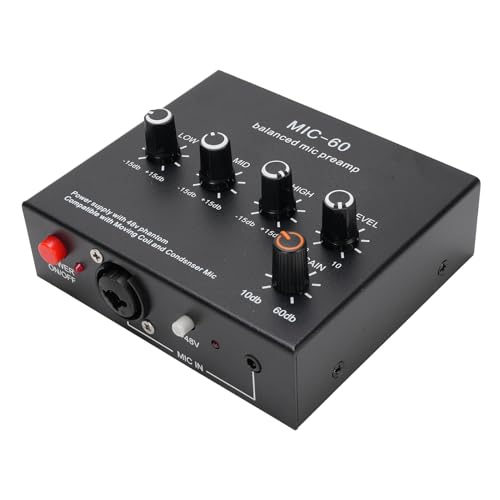
The MIC-60 is a practical microphone preamp for podcasting when you want physical controls for gain and tone. Its dedicated gain, level, and three-band EQ knobs let you shape a microphone signal before sending it to a mixer, recorder, or other audio equipment.
Best For: Desktop recording, streaming, and live setups that benefit from quick, hardware-based tone adjustments.
Pros:
- Includes dedicated gain and level controls.
- Provides low, mid, and high EQ adjustment without software.
- Switchable 48V phantom power supports compatible condenser microphones.
- Uses a compact metal enclosure with XLR and 6.35mm connections.
Cons:
- It is a corded desktop unit rather than a USB interface.
- Provides one output channel.
- Phantom power should remain off when using dynamic microphones that do not require it.
The MIC-60 suits users who prefer tactile control over automated or software-based processing. It is most useful when your existing mixer or recorder needs an added stage for gain and basic microphone EQ.
Best Full Recording Interface – Focusrite Scarlett Solo 3rd Gen
The Focusrite Scarlett Solo 3rd Gen is a versatile microphone preamp for podcasting that also handles USB recording, monitoring, and instruments. Its XLR mic preamp provides a 56 dB gain range, while Air mode can add clarity and the 24-bit/192kHz converters support detailed recording.
Best For: Solo podcasters who want microphone input, headphone and monitor connections, and an additional instrument input in one interface.
Pros:
- Includes a high-performance XLR microphone preamp with a 56 dB gain range.
- Offers Air mode for added clarity.
- Records at up to 24-bit/192kHz.
- Adds a Hi-Z instrument input and low-noise balanced outputs.
Cons:
- Provides one XLR microphone input.
- It is designed for USB recording rather than standalone operation.
- Its included software bundle may be more than a basic podcast setup requires.
The Scarlett Solo is a well-rounded choice when you need more than just microphone gain. It combines a dedicated mic preamp with monitoring and instrument connectivity, making it suitable for podcasts, voice recording, and broader home-studio use.
Best Low-Noise Value – RO03 66dB Mic Preamp
If you need a versatile microphone preamp for podcasting, the RO03 stands out for its broad 19–66dB gain range, claimed -120dBV EIN, and support for dynamic, condenser, and ribbon microphones. Its Type-C power input also suits portable recording setups.
Best For: Podcasters and musicians who want flexible microphone and instrument connectivity with a low-noise signal path.
Pros:
- 66dB of practical gain with an ultra-low-noise design rated at -120dBV EIN.
- Works with dynamic, condenser, and ribbon microphones.
- Includes XLR, TRS, and TS output options, plus a 1MΩ instrument input.
- Type-C power improves portability for mobile recording.
Cons:
- The two input ports cannot be used simultaneously.
- The manufacturer recommends using the interface’s TRS line input for the lowest noise.
The RO03 is the most feature-rich option here, especially if your podcasting setup may also handle instruments or different microphone types. Proper cabling and input selection are important to get its best noise performance.
Best Dynamic-Mic Booster – FC-1 25dB Gain Amplifier
The FC-1 is a focused microphone preamp for podcasting and other setups using low-output dynamic or ribbon microphones. It adds 25dB of clean gain from 48V phantom power supplied by an interface or external source, helping raise input levels without changing the mic’s natural character.
Best For: Podcasters using dynamic microphones such as the Shure SM7B or Electro-Voice RE20 with an audio interface that provides phantom power.
Pros:
- Adds 25dB of gain for low-output dynamic and ribbon microphones.
- Designed for podcasting, broadcasting, studio recording, and live sound.
- Can help reduce line noise over long cable runs and improve gain before feedback.
- Compact, durable design is suited to both studio and stage use.
Cons:
- It does not supply phantom power; the interface or an external power source must provide 48V.
- It is not compatible with condenser microphones.
Choose the FC-1 when your main goal is clean inline gain for a dynamic or ribbon mic. It is less suitable as an all-purpose preamp because it requires external phantom power and excludes condenser microphones.
Best Compact All-Rounder – 20dB 48V Mic Preamplifier
For a simple microphone preamp for podcasting, this compact unit provides 20dB of balanced gain and built-in 48V power. It supports both dynamic and condenser microphones, making it a practical choice for home studios, streaming desks, and basic vocal recording setups.
Best For: Home podcasters and streamers who need a small, straightforward booster for dynamic or condenser microphones.
Pros:
- Provides 20dB of clean, transparent gain.
- Built-in 48V power supports dynamic and condenser microphones.
- Fully balanced circuitry is designed for low noise without added sonic coloration.
- Compact metal housing is lightweight and helps reduce EMC interference.
Cons:
- Its 20dB gain is lower than the gain offered by the other listed options.
- The supplied notes do not specify detailed connector options or power requirements beyond 48V operation.
This preamp prioritizes simplicity and portability over extensive controls or connectivity. It is a sensible fit for a compact podcasting rig when 20dB of gain is sufficient and support for both common microphone types matters.
Compact Clean-Gain Pick – StudioMan CL-100 XLR Preamp
The StudioMan CL-100 is a compact microphone preamp for podcasting setups that use a dynamic or passive ribbon microphone. Its +25dB gain boost can help raise low-level signals while keeping the setup simple with balanced XLR input and output.
Best For: Podcasters and home-studio users with a dynamic or passive ribbon microphone who want a compact, metal-housed signal booster.
Pros:
- Provides up to +25dB of clean gain for dynamic and passive ribbon microphones.
- Uses standard balanced XLR connections for interfaces, mixers, and recording devices.
- Compact metal housing offers portability and EMI/RFI shielding.
- Includes a 10Hz–20kHz frequency response and one-year warranty.
Cons:
- Designed for dynamic and passive ribbon microphones rather than condenser microphones.
- Its gain boost is lower than some multi-function preamp options.
The CL-100 is a focused choice when you need straightforward gain before an interface or mixer. Its small footprint and balanced XLR design make it especially practical for desk-based podcasting and mobile recording.
Versatile Multi-Input Option – VBESTLIFE 3-Input Mic Preamp
This VBESTLIFE unit is a flexible microphone preamp for podcasting, vocal recording, and live streaming when you need multiple inputs and output formats. It offers up to +60dB of gain, three-channel input support, and 48V power for compatible condenser microphones.
Best For: Creators who need a multi-channel preamp with XLR, 3.5mm, and 6.35mm connectivity for recording, mixing, or streaming.
Pros:
- Offers up to +60dB of gain for low-output microphones.
- Supports both dynamic and condenser microphones with 48V power.
- Provides XLR balanced, 3.5mm, and 6.35mm connections for varied setups.
- Compact black metal housing is designed to reduce interference.
Cons:
- The 90-day manufacturer warranty is shorter than the warranties listed for the StudioMan models.
- Its broader connection layout may be more than needed for a simple single-microphone podcast setup.
Choose this model if flexibility matters more than minimalism. Its multiple inputs and outputs can accommodate changing podcast, streaming, and vocal-recording workflows, though a single-purpose XLR booster may be simpler for basic setups.
Dynamic-Mic Noise-Control Pick – StudioMan DPM1 Dynamic Mic Preamp
The StudioMan DPM1 is a microphone preamp for podcasting with low-output dynamic microphones and passive ribbon microphones. Its +29dB gain boost is designed to improve signal level and reduce the need to push a noisy interface preamp, but it requires 48V phantom power from the connected interface or mixer.
Best For: Podcasters using microphones such as the SM7B or SM58 who need extra gain from an interface or mixer that supplies phantom power.
Pros:
- Provides +29dB of clean, transparent gain for dynamic and ribbon microphones.
- Compact plug-and-play XLR design fits between a microphone and interface or mixer.
- Metal casing helps with durability and interference shielding.
- Includes a one-year manufacturer warranty and 24/7 technical support.
Cons:
- Strictly not for condenser microphones.
- Requires 48V phantom power from the connected interface or mixer; the power does not pass to the microphone.
- It cannot be used as a standalone preamp without a compatible XLR setup.
The DPM1 is a targeted upgrade for dynamic-microphone users dealing with limited gain or hiss. Confirm that your interface or mixer supplies phantom power before choosing it, and avoid it if your setup centers on condenser microphones.
How We Picked the Best Microphone Preamp for Podcasting
We compared these models by looking at the features that matter most in spoken-word recording: available gain, noise performance, microphone compatibility, phantom-power handling, connection type, controls, build quality, and setup requirements. The list includes inline preamps for adding clean gain to dynamic microphones, standalone units with tone controls, and USB interfaces that combine preamp, conversion, and computer connectivity.
Because podcasting setups vary widely, no single model is ideal for everyone. A simple booster may be best for a single dynamic microphone, while a USB interface is more practical if you also need headphone monitoring, direct computer recording, or instrument inputs.
Quick Comparison
- Best for adding gain to a dynamic mic: Cloudlifter CL-1 or a comparable inline booster.
- Best for direct USB recording: Shure MVX2U or Focusrite Scarlett Solo.
- Best for basic budget flexibility: MIC-60 and compact multi-output preamps.
- Best for low-noise gain upgrades: RO03, FC-1, StudioMan CL-100, or StudioMan DPM1.
- Best for broader microphone compatibility: Models offering phantom power and support for dynamic, condenser, and ribbon microphones.
Key Buying Factors for a Microphone Preamp for Podcasting
Gain and Noise Performance
Dynamic and ribbon microphones often need substantial clean gain, especially when the speaker is not close to the capsule. Look for enough headroom to reach a healthy recording level without maxing out the control. A low-noise design is equally important because excessive gain can raise hiss along with your voice.
Microphone and Power Compatibility
Check whether your microphone is dynamic, condenser, or ribbon. Condenser microphones generally require 48V phantom power, while passive ribbon microphones require careful handling and should not receive phantom power unless the manufacturer explicitly allows it. An inline booster may also need phantom power from the interface to operate, even when used with a dynamic microphone.
Connections and Workflow
XLR-to-XLR boosters are designed to work between a microphone and an existing interface or mixer. USB models connect directly to a computer and may include headphone monitoring, while multi-output units can support different recording or live-sound configurations. Confirm that the connectors match your current cables and equipment.
Controls and Monitoring
For podcasting, simple gain control is often enough. EQ, multiple outputs, mute controls, and direct monitoring can be useful, but they may add cost and complexity. Prioritize features that solve a real problem in your recording chain.
Who Should Buy Which Microphone Preamp for Podcasting?
Choose an inline gain booster if you already own an audio interface and your dynamic microphone is too quiet. These are compact, affordable, and easy to add between the mic and interface.
Choose a USB interface if you want the cleanest all-in-one computer setup, need headphone monitoring, or expect to add instruments or other microphones later.
Choose a preamp with EQ or multiple outputs if you record live streams, use more than one type of source, or want hands-on control during recording. For a basic single-host podcast, a quieter and simpler unit is usually the better value.