Choosing the right scanner for a library means balancing speed, image quality, durability, and ease of use. The best overhead document scanners for libraries can handle books, bound archives, and oversized materials without damaging delicate pages.
Below, we focus on models that are practical for circulation desks, digitization stations, and shared staff workspaces, with an emphasis on scanning quality, workflow features, and everyday usability.
Best 10 Overhead Document Scanners for Libraries Picks for 2026
Overhead Scanning Made Simple
ScanSnap SV600 Overhead Book Scanner

- Scans books, newspapers, magazines, and documents directly
- Auto Book Correction helps flatten and correct page curves
- Page Turning Detection and Time Mode simplify scanning
Best For: Libraries digitizing fragile bound materials without damaging them
Portable OCR for Shared Spaces
NetumScan 13MP Book Document Camera

- Foldable, lightweight aluminum design for portability
- One-key correction and A3/A4 capture support
- OCR exports editable text in multiple languages
Best For: Libraries needing a portable scanner for OCR and live projection
High-Resolution Archive Work
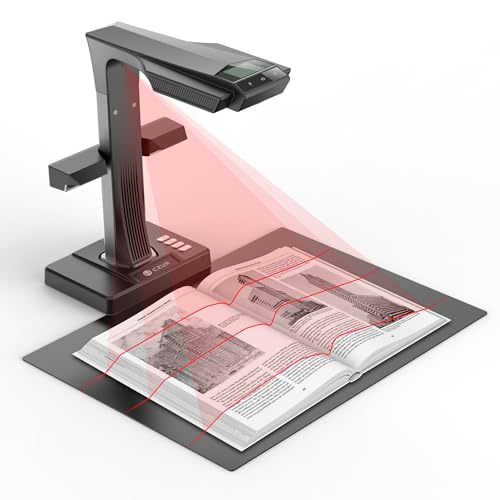
- 24MP camera with high-resolution output
- 3rd gen auto-flatten and deskew for books
- OCR supports 180+ languages and HDMI output
Best For: Libraries building a dedicated digitization station for books and large pages
Fast Portable Book Capture
CZUR Shine Ultra Smart Scanner

- About 1 second per page for flat papers
- Lightweight, foldable 4 lb design
- OCR and smart paging support flexible workflows
Best For: Libraries needing a fast portable scanner for flat pages and thin books
Library Archive Choice
VIISAN DL16 A3 Overhead Scanner

- A3 overhead scanning for books and large documents
- 16MP camera with up to 300 DPI capture
- Anti-glare LED lighting for cleaner page visibility
Best For: Libraries and archives digitizing oversized books and records
Fast Digital Shelf Pick

- Scans in about 2 seconds per page
- AI auto-flatten and deskew for curved books
- OCR supports 180+ languages and searchable PDF output
Best For: Libraries wanting fast scanning with smart page correction
High-Detail Digitization Pick
VIISAN K48 48MP Overhead Scanner

- 48MP capture with up to 600 DPI scanning
- AI page flattening and automatic page splitting
- OCR plus text-to-speech and 4K document camera mode
Best For: Libraries and archives needing sharper scans and accessibility features
Compact Auto-Scan Pick
CZUR Aura Pro Portable Book Scanner

- Laser curve-flattening for curved book pages
- About 2 seconds per page scanning speed
- OCR supports 180+ languages
Best For: Small library workspaces and quick book capture
High-Detail Archive Choice
CZUR ET MAX Professional Book Scanner

- 38MP sensor with 7168 × 5376 resolution
- A3 capture with curve-flattening technology
- OCR for 180+ languages and searchable files
Best For: Libraries digitizing books and oversized pages
Oversized Format Workhorse
VIISAN Large Format Book & Document Scanner

- A2/A3 overhead scanning for large materials
- 26MP capture with up to 600 DPI enhancement
- Auto-flatten, finger removal, and OCR tools
Best For: Oversized documents and special collections
Overhead Scanning Made Simple – ScanSnap SV600 Overhead Book Scanner
If you need overhead document scanners for libraries, the ScanSnap SV600 is built for fast, non-contact digitizing of books, newspapers, magazines, and loose papers. Its overhead design helps protect delicate items while features like Auto Book Correction, Multi Document Detection, and Page Turning Detection streamline everyday scanning.
Best For: Libraries digitizing bound books, newspapers, and fragile reference materials without cutting or flattening them manually.
Pros:
- Scans books, newspapers, magazines, and documents directly without cutting them
- Auto Book Correction helps flatten pages and correct curve distortion
- Multi Document Detection can capture and crop several small items in one pass
- Page Turning Detection and Time Mode support hands-free or timed scanning workflows
Cons:
- Standard sheet capacity is listed as 1, so it is not a batch feeder
- USB-only connection may be less flexible for some setups
Overall, this is a strong choice for library teams that prioritize gentle handling and simple overhead capture over high-volume sheet feeding. It is especially useful when preservation matters as much as speed.
Portable OCR for Shared Spaces – NetumScan 13MP Book Document Camera
For overhead document scanners for libraries that also need portability, the NetumScan 13MP Book Document Camera offers a lightweight, foldable design with OCR and real-time projection. It supports A3/A4 capture, automatic skew correction, and multi-language text recognition, making it a flexible option for scanning, display, and teaching workflows.
Best For: Libraries that want a portable overhead scanner for occasional digitizing, live projection, and OCR-based text conversion.
Pros:
- Foldable aluminum alloy body is easy to carry and set up
- One-key automatic correction helps fix skewed images quickly
- OCR supports editable Word or TXT output with multiple languages
- Can also be used for live projection and video recording
Cons:
- Runs through USB and requires software setup on a computer
- Best suited to manual page turning rather than fully automated feeding
This model works well for library desks, outreach carts, or shared rooms where mobility matters. It is more of a versatile camera-scanner hybrid than a dedicated high-throughput archival system.
High-Resolution Archive Work – CZUR ET24 Pro Book Scanner
Among overhead document scanners for libraries, the CZUR ET24 Pro stands out for its 24MP camera, upgraded flattening tech, and broad OCR support. It is designed for books and large-format materials up to A3, with HDMI support, a real-time preview screen, and side lights that help reduce reflection on glossy pages.
Best For: Libraries that need a higher-resolution overhead scanner for books, large documents, and OCR-heavy digitizing projects.
Pros:
- 24MP camera with 5696 x 4272 resolution for detailed captures
- 3rd gen auto-flatten and deskew technology for curved book pages
- Supports A3 materials and OCR in 180+ languages
- HDMI output and a preview screen help with stable, visible workflows
Cons:
- Very glare-prone paper is not recommended
- It is bulkier and heavier than portable document camera options
If your library is building a serious digitization workflow, this model offers strong image quality and versatile output options. It is better suited to a dedicated scanning station than a grab-and-go setup.
Fast Portable Book Capture – CZUR Shine Ultra Smart Scanner
The CZUR Shine Ultra is a compact option for overhead document scanners for libraries that need quick capture and easy portability. It is designed for A3 and A4 materials, offers about 1 second per page scanning for flat papers, and includes patented flattening tech for thinner books along with OCR and multiple scanning modes.
Best For: Libraries that want a lightweight overhead scanner for fast flat-paper digitizing and occasional thin-book capture.
Pros:
- About 1 second per page scanning for flat papers
- Portable 4 lb design with 90-degree foldable build and adjustable height
- OCR supports 180+ languages for text recognition
- Smart paging, auto cropping, combine sides, and stamp mode add flexibility
Cons:
- Patented flattening is only suitable for thinner books
- Not compatible with Android or iOS
This is a practical pick when speed and portability matter more than heavy-duty book flattening. For thicker volumes, the ET series is the better fit, but the Shine Ultra is appealing for lighter library use cases.
Library Archive Choice – VIISAN DL16 A3 Overhead Scanner
The VIISAN DL16 is a practical option for overhead document scanners for libraries when you need to digitize bound books, oversized pages, and other large-format materials that are awkward on a flatbed. Its 16MP camera and up to 300 DPI output are aimed at clear reference scans, while anti-glare LED lighting helps reduce shadows and reflections on glossy or archival pages.
Best For: Libraries, archives, educators, and offices that need A3 overhead scanning for books and large documents.
Pros:
- A3 overhead design handles books, archives, artwork, and oversized documents.
- 16MP camera with up to 300 DPI supports readable text and organized digital storage.
- Anti-glare LED lighting helps improve page visibility on reflective materials.
- Compatible with both Windows and Mac for flexible desktop use.
Cons:
- 300 DPI is more modest than higher-resolution models for fine-detail capture.
- Built for desktop workflows, so it is not a portable handheld option.
For libraries that want a straightforward overhead scanning workflow, the DL16 covers the basics well: A3 coverage, glare reduction, and clear enough imaging for everyday digitization. It is best suited to collections and records where practical capture matters more than advanced features.
Fast Digital Shelf Pick – CZUR Aura Pro Book Scanner
The CZUR Aura Pro is a strong fit for overhead document scanners for libraries that need fast page handling and broad output options. It scans a page in about 2 seconds, supports JPG, Word, PDF, and searchable PDF, and uses AI tools plus laser-guided flattening to help straighten curved book pages during capture.
Best For: Libraries and workspaces that want quick overhead scanning with OCR and smart page correction.
Pros:
- Very fast scanning at about 2 seconds per page.
- AI-assisted auto-flatten and deskew help with curved book pages.
- Outputs JPG, Word, PDF, and searchable PDF with OCR support for 180+ languages.
- Glare-free, non-flickering smart lamp with multiple color temperature settings.
Cons:
- Thai, Hebrew, and Arabic are not currently supported in OCR.
- Best results depend on using the included software and lamp setup.
For libraries prioritizing speed and workflow flexibility, the Aura Pro is a practical middle-ground choice. It combines quick capture with useful correction tools, making it well suited to routine scanning of books and mixed document sets.
High-Detail Digitization Pick – VIISAN K48 48MP Overhead Scanner
The VIISAN K48 is built for overhead document scanning in libraries where detail matters, offering 48MP capture and up to 600 DPI for books, worksheets, and archive files. It also adds AI-assisted page flattening, automatic page splitting, OCR, and text-to-speech, making it a flexible choice for digitization and accessibility workflows.
Best For: Libraries, classrooms, and archives that need higher-detail overhead scanning plus OCR tools.
Pros:
- 48MP capture and up to 600 DPI support detailed pages and fine text.
- AI-assisted page flattening and automatic page splitting help speed up bound-book scanning.
- OCR creates searchable PDFs and editable digital documents.
- Also works as a 4K@30fps USB document camera for teaching and live sharing.
Cons:
- Heavier than the other options at 2.8 kilograms.
- More advanced feature set may be more than basic occasional scanning needs require.
Among overhead document scanners for libraries, the K48 stands out when image detail and workflow tools are the priority. It is especially useful for larger scanning projects where sharper capture and automation can save time.
Compact Auto-Scan Pick – CZUR Aura Pro Portable Book Scanner
If you want overhead document scanners for libraries that can handle books, handouts, and archive materials without a lot of setup, the CZUR Aura Pro is a practical compact option. It uses laser-based curve flattening, fingerprint removal, and fast auto scanning to help produce cleaner page images from bound items and flat documents.
Best For: Small library workspaces, quick book capture, and mixed document scanning on Mac or Windows.
Pros:
- Three laser lines help flatten curved book pages for more accurate scans.
- Fast scanning speed at about 2 seconds per page for single sheets and double-page books.
- Supports OCR for 180+ languages, with auto-detect page turn and auto scan features.
- Includes supplemental side lights and a 90° foldable design for flexible placement.
Cons:
- OCR does not currently support Thai, Hebrew, or Arabic.
- Best for materials smaller than A3.
- Smart lamp sound control can be affected by environmental noise and distance.
For libraries that need a space-saving overhead scanner with automated page handling, the Aura Pro focuses on speed and ease of use more than bulk-duty specialization. It is a solid fit when you want straightforward digitizing of books and documents without a more complex setup.
High-Detail Archive Choice – CZUR ET MAX Professional Book Scanner
Among overhead document scanners for libraries, the CZUR ET MAX stands out for higher-resolution capture and broad platform support. Its 38MP sensor, patented curve-flattening, and A3 scanning area make it well suited to books and larger reference materials that need clean, detailed digitization.
Best For: Libraries digitizing books, oversized pages, and materials that benefit from high-resolution capture.
Pros:
- 38MP CMOS sensor with 7168 × 5376 resolution for detailed scans.
- Patented curve-flattening technology helps correct bound-book distortion.
- Scans up to A3 size and can capture a page in about 1.5 seconds.
- OCR supports 180+ languages and can create editable/searchable files.
Cons:
- Not recommended for glossy or highly reflective materials.
- Arabic OCR support is limited to ET Series scanners on Windows.
- Linux support is limited to Ubuntu 20.04 to 24.04.
If your library needs more detail from each page and wants a scanner that can handle larger books efficiently, the ET MAX is the strongest fit here. It balances speed, image quality, and workflow flexibility better than a basic document camera.
Oversized Format Workhorse – VIISAN Large Format Book & Document Scanner
For overhead document scanners for libraries that need to handle larger-than-standard materials, the VIISAN S21 is built around A2/A3 scanning flexibility. Its adjustable height, auto-flatten software, and 26MP capture make it a useful choice for journals, newspapers, maps, and other large-format items.
Best For: Libraries scanning oversized documents, special collections, and mixed media.
Pros:
- A2 large-format support is ideal for journals, newspapers, manuscripts, and maps.
- 26MP resolution with software-enhanced output up to 600 DPI.
- Software can flatten curved pages, remove fingers, split spreads, and run OCR.
- Built-in 3-level LED lighting helps when working in darker spaces.
Cons:
- Bundled software is not compatible with ARM-based devices.
- Glossy papers are not recommended.
- Not the simplest choice if your workflow only needs standard book scanning.
The S21 is the most format-flexible option in this group, especially if your library regularly works with large or unusual originals. It leans toward special-collections use rather than basic desktop scanning.
How We Picked the Best Overhead Document Scanners for Libraries
We looked for Overhead Document Scanners for Libraries that are suited to frequent use, mixed material types, and time-saving workflows. Priority factors included optical resolution, capture size, auto-flattening accuracy, glare reduction, OCR language support, and whether the scanner is easy for staff to operate with minimal training.
Quick Comparison: What Matters Most
If your library mainly digitizes bound books, choose a model with strong page curvature correction and stable overhead mounting. If you handle maps, newspapers, or large reference materials, larger capture formats such as A3 or A2 are more important than raw megapixels. For high-volume desk use, fast setup and dependable software can matter more than premium imaging specs.
Key Buying Factors for Overhead Document Scanners for Libraries
Capture Size and Material Type
A3 is the most flexible choice for many library workflows, but larger collections benefit from A2 or wide-format capture. Make sure the scanner can handle the biggest pages you expect to digitize without constant repositioning.
Image Correction and Readability
Auto-flatten, deskew, curve correction, and fingerprint removal help produce cleaner scans from books that do not lie perfectly flat. These features reduce editing time and improve the quality of searchable archives.
OCR and Language Support
For libraries building digital indexes, OCR is essential. Look for broad language recognition if your collection includes multilingual materials, and confirm that exported text formats fit your cataloging or preservation workflow.
Lighting and Glare Control
Anti-glare or controlled LED lighting is especially useful for glossy pages, fragile paper, and older books. Better lighting can improve consistency across different paper stocks and room conditions.
Speed, Portability, and Staff Workflow
Some libraries need a permanent digitization station, while others need a scanner that can move between departments or branches. Foldable designs and USB-powered units are convenient, but fixed systems may offer more stability for daily use.
Who Should Buy Which Overhead Document Scanners for Libraries?
Choose a compact model if you need an easy shared workstation for quick reference scanning. Pick a higher-resolution scanner if preservation quality and archival detail matter most. If your library handles large-format items, prioritize wider capture area over portability. For mixed-use environments, the best overall choice is usually the scanner that combines reliable OCR, strong page correction, and a simple workflow staff can adopt quickly.
In short, the best Overhead Document Scanners for Libraries are the ones that match your collection size, usage volume, and digitization goals—not just the highest spec sheet.