The best portable field recorders make it easier to capture clean dialogue, music, ambience, and interviews away from a studio. The right model depends on whether you prioritize pocket-sized simplicity, interchangeable microphones, professional inputs, or podcast-focused controls.
Our 2026 roundup compares ten practical options, including 32-bit float recorders, XLR-equipped models, stereo handhelds, and a dedicated multi-person podcast recorder.
Best 10 Portable Field Recorders Picks for 2026
Flagship Field Sound

- Large 19.4mm X/Y stereo microphones
- 32-bit float clip-free recording
- Up to four-track, 192kHz WAV recording
Best For: Filmmakers and musicians needing detailed, flexible location audio
Compact Everyday Capture

- 32-bit float and up to 96kHz recording
- Built-in mics support sources up to 125dB SPL
- 2-in/2-out USB-C audio interface
Best For: Portable music, voice, meeting, and video recording
Flexible XLR Starter

- Two locking XLR/TRS combo inputs
- 32-bit/96kHz recording with waveform display
- 3.5mm stereo input and headphone output
Best For: Compact external-mic setups for film, music, and podcasting
Adjustable Stereo Recording

- Adjustable AB/XY condenser microphones
- 32-bit float recording and 125dB SPL handling
- 3.5mm mic input and USB-C interface mode
Best For: Field recording with flexible built-in stereo microphone positioning
Everyday Content Companion

- Clear stereo capture for content, music, and interviews
- Records ambience, nature, room tone, and sound effects
- USB-C microphone mode for calls, streaming, and voiceovers
Best For: Creators and musicians wanting simple, versatile stereo recording
Flexible Multitrack Workhorse
TASCAM DR-40XP 4-Channel Recorder
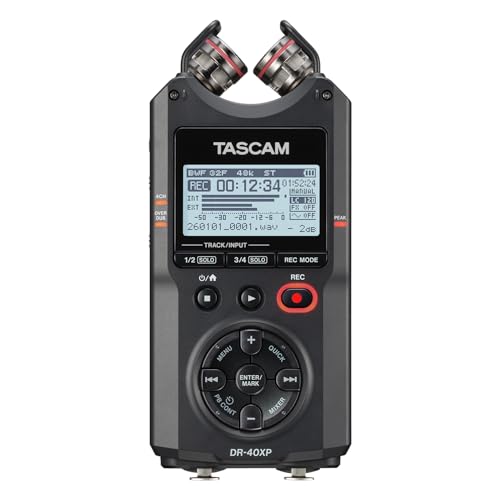
- Four-channel capture combines built-in mics and external inputs
- 32-bit float recording with adjustable A-B or X-Y microphones
- USB-C 2-in/2-out interface for computer or mobile setups
Best For: Creators needing external inputs and flexible multichannel recording
Pattern-Rich Clip-Free Recorder
Zoom H2 Essential Handheld Recorder

- Three microphones and nine patterns for varied recording perspectives
- 32-bit float capture minimizes gain-adjustment concerns
- USB microphone mode, SD backup, and Bluetooth timecode support
Best For: Users needing flexible pickup patterns and dependable clip-free capture
Best Podcasting Hub

- Four XLR inputs with phantom power
- Four headphone outputs with individual volume
- Phone and USB remote-interview support
Best For: Mobile podcast teams and multi-person interviews
Best Flexible Stereo Recorder

- 32-bit float stereo recording
- X/Y microphones support up to 130 dB SPL
- USB microphone mode for computers and mobile devices
Best For: Musicians, filmmakers, and general-purpose stereo recording
Best Ready-to-Go Kit

- Stereo 32-bit float recording
- X/Y microphones with up to 96 kHz recording
- Includes windscreen, case, adapter, and USB-C cable
Best For: Solo creators and straightforward location recording
Flagship Field Sound – Zoom H5 Studio
The Zoom H5 Studio is a strong choice among portable field recorders for filmmakers and musicians who need detailed stereo sound, clip-free capture, and hands-on level control. Its large X/Y microphones, 32-bit float recording, and support for up to four simultaneous tracks make it suited to demanding location work.
Best For: Filmmakers, musicians, and field recording setups that need high-resolution audio and multiple inputs.
Pros:
- Large 19.4mm X/Y microphones provide rich stereo audio and wide dynamic range.
- 32-bit float recording helps capture clip-free takes in changing environments.
- Dedicated gain knobs provide quick, precise level adjustments.
- Records up to four tracks simultaneously at up to 192kHz in WAV format.
Cons:
- Uses four AA batteries, which is more than some smaller handheld recorders.
- Its broader feature set may be more than casual voice-recording users need.
Choose the H5 Studio when recording quality, physical controls, and expandable multi-track capability matter more than the smallest possible footprint.
Compact Everyday Capture – TASCAM DR-05XP
The TASCAM DR-05XP is a practical portable field recorder for music, meetings, dictation, video audio, and podcasting. Its built-in omnidirectional condenser microphones support loud sources up to 125dB SPL, while 32-bit float recording and USB-C connectivity add flexibility for both field and computer-based work.
Best For: Everyday stereo recording, meetings, voice work, audio for video, and users who want a compact USB-C interface.
Pros:
- Supports 32-bit float, 24-bit, 16-bit, high-resolution WAV, and MP3 recording.
- Built-in microphones handle sources up to 125dB SPL.
- Functions as a 2-in/2-out USB-C audio interface.
- Offers up to 17.5 hours of operation with two AA alkaline batteries.
Cons:
- SD card and batteries are not included.
- Its built-in stereo microphones do not provide the adjustable microphone positioning found on the DR-07XP.
The DR-05XP is an appealing general-purpose option when portability, straightforward stereo recording, and USB-C computer connectivity are the priorities.
Flexible XLR Starter – Zoom H1 XLR
The Zoom H1 XLR combines a compact design with two locking XLR/TRS inputs, making it one of the more adaptable portable field recorders for microphones, instruments, interviews, and podcasts. It also offers 32-bit/96kHz recording, a waveform display, and 3.5mm input and headphone connections for monitoring and added device compatibility.
Best For: Filmmakers, podcasters, and musicians who need two external microphone or instrument inputs in a small recorder.
Pros:
- Two locking XLR/TRS combo inputs support microphones, instruments, and other sources.
- 32-bit/96kHz recording delivers detailed audio with clip-free capture.
- OLED waveform display makes level monitoring easier at a glance.
- Supports SDXC cards up to 1TB for extended sessions.
Cons:
- Battery life is listed at up to 10 hours, shorter than some alternatives here.
- The 0.96-inch display is compact and may provide less viewing area during setup.
The H1 XLR is a good fit when external inputs and a small footprint are more important than built-in microphone versatility or longer battery operation.
Adjustable Stereo Recording – TASCAM DR-07XP
The TASCAM DR-07XP adds adjustable AB/XY condenser microphones to a compact portable field recorder, giving users more control over stereo pickup than a fixed microphone arrangement. It supports 32-bit float recording, a 3.5mm mic input with plug-in power, and USB-C interface operation for music, voice, video, and podcasting.
Best For: Users who want adjustable built-in stereo microphones for field recording, audio for video, and general-purpose capture.
Pros:
- Adjustable AB/XY condenser microphones support different stereo recording perspectives.
- 32-bit float recording helps handle changing loudness without clipping.
- Supports external microphones through a 3.5mm input with plug-in power.
- Works as a 2-in/2-out USB-C audio interface and runs up to 17.5 hours on two AA batteries.
Cons:
- Memory card and batteries are sold separately.
- Its 512GB microSD-family limit is lower than the Zoom H1 XLR’s stated 1TB SDXC support.
The DR-07XP stands out for buyers who want a small recorder but still value the ability to adjust the built-in microphones for different stereo recording situations.
Everyday Content Companion – Zoom H1 Essential
The Zoom H1 Essential is a straightforward choice among portable field recorders for creators who need better sound than a phone or camera typically provides. It suits quick recordings for video, music, podcasts, interviews, and real-world ambience, while USB-C connectivity adds microphone functionality for computers and compatible setups.
Best For: Musicians, podcasters, content creators, interviewers, and anyone capturing clear stereo audio on the go.
Pros:
- Captures clear stereo audio for videos, voiceovers, reels, and tutorials.
- Handles songwriting, rehearsals, lessons, acoustic performances, and live music.
- Records voices, ambience, nature, room tone, and sound effects for varied projects.
- Works as a USB-C microphone for livestreams, calls, meetings, and desktop recording.
Cons:
- The supplied notes do not specify advanced multichannel recording or external-input features.
- The supplied notes do not provide battery-life or storage details.
Choose this model when ease of use and flexible stereo capture matter more than a larger production setup. Its USB-C microphone mode also makes it practical for both mobile recording and desk-based work.
Flexible Multitrack Workhorse – TASCAM DR-40XP 4-Channel Recorder
The TASCAM DR-40XP is a capable option among portable field recorders for musicians, video creators, and location-production users. Its adjustable microphones, two XLR/TRS inputs, four-channel recording, 32-bit float support, and USB-C interface provide room for more involved recording workflows.
Best For: Musicians, filmmakers, interview crews, and creators who need built-in microphones plus external inputs.
Pros:
- Offers four-channel recording from the built-in microphones and external inputs simultaneously.
- Supports 32-bit float recording for clip-free capture, along with 24-bit and 16-bit WAV options.
- Adjustable A-B or X-Y condenser microphones handle up to 125 dB SPL.
- Functions as a 2-in/2-out USB-C audio interface with long battery life.
Cons:
- microSD card and batteries are not included.
- Its broader input and multitrack feature set may be more than casual users need.
The DR-40XP stands out for expandable field workflows: use the built-in stereo mics alone or combine them with external sources. It is a strong fit when a compact recorder needs to support music, video, and interview setups.
Pattern-Rich Clip-Free Recorder – Zoom H2 Essential Handheld Recorder
The Zoom H2 Essential brings unusual microphone flexibility to portable field recorders, with three built-in microphones and nine selectable recording patterns. Its 32-bit float recording, simultaneous USB microphone and SD recording, and wireless Bluetooth timecode options make it useful for everything from interviews to wide soundscapes and coordinated multi-recorder sessions.
Best For: Journalists, podcasters, musicians, filmmakers, and users who need varied pickup patterns or clip-free recording.
Pros:
- Provides three built-in microphones and nine selectable patterns for mono, stereo, and surround recording.
- 32-bit float recording reduces the need for manual gain adjustment and supports clip-free capture.
- Can operate as a USB microphone while recording to an SD card for backup.
- Supports wireless control and timecode synchronization of multiple H2 Essential units via Bluetooth.
Cons:
- Requires two AA batteries, according to the supplied specifications.
- The supplied notes do not indicate that a memory card is included.
- Its wider pattern selection may require more setup than a basic stereo recorder.
This is the most pattern-focused option in the group. Choose it when recording flexibility, clip-free 32-bit float capture, accessibility features, or synchronized multi-unit recording are priorities.
Best Podcasting Hub – Zoom PodTrak P4
The Zoom PodTrak P4 is a strong choice for portable field recorders when your priority is recording interviews, podcasts, or group conversations. It provides four XLR microphone inputs with phantom power, four individually controlled headphone outputs, and dedicated options for phone or USB-based remote interviews.
Best For: Mobile podcast teams, panel discussions, and interview setups needing multiple microphones and headphones.
Pros:
- Four XLR inputs with phantom power support multiple microphones.
- Four headphone outputs include individual volume control.
- Mix-minus supports phone and remote interviews through TRRS or USB.
- Includes programmable sound pads and multitrack recording.
Cons:
- Battery life is listed at up to 3.5 hours on two AA batteries.
- Its feature set is more podcast-focused than a simple stereo recorder.
The P4 is the most specialized option here for multi-person spoken-word production. Choose it if flexible connections and participant monitoring matter more than a minimal, pocket-sized design.
Best Flexible Stereo Recorder – Xvive XV1-R
The Xvive XV1-R is a versatile pick among portable field recorders, combining built-in X/Y microphones with 32-bit float recording, high sample rates, and USB microphone functionality. Its compact design and automatic recording features suit musicians, podcasters, filmmakers, and general-purpose capture.
Best For: Creators recording concerts, speeches, ambient audio, meetings, or USB-based live audio.
Pros:
- 32-bit float recording reduces the need to adjust gain during capture.
- X/Y microphones handle sound levels up to 130 dB SPL without distortion.
- Supports WAV recording up to 96 kHz plus space-saving AAC formats.
- Works as a USB microphone with PC, Mac, iOS, and Android devices.
Cons:
- There is no headphone jack for direct monitoring.
- USB microphone mode uses a fixed 48 kHz sample rate.
The XV1-R offers broad format and connectivity flexibility in a lightweight package. Its lack of a headphone jack is worth considering, but auto-record, pre-record, noise reduction, and long stated battery life make it adaptable for many portable recording tasks.
Best Ready-to-Go Kit – Zoom H1essential Bundle
The Zoom H1essential bundle is a practical entry point into portable field recorders for users who want the recorder and key accessories together. It combines a stereo 32-bit float recorder with X/Y microphones, a hairy windscreen, padded case, AC adapter, and USB-C cable.
Best For: Solo creators, location sound capture, and users who want wind protection and carrying accessories included.
Pros:
- Stereo 32-bit float recording avoids the need to set gain manually.
- X/Y microphones capture sound levels up to 120 dB SPL.
- Records at up to 96 kHz to an SD card.
- Bundle includes a windscreen, case, adapter, and USB-C cable.
Cons:
- It is a two-track stereo recorder rather than a multichannel podcast mixer.
- The supplied notes do not specify battery life or storage capacity.
This bundle is especially convenient if you need protection and wind-noise reduction immediately. It keeps the core setup simple while adding useful accessories for outdoor and on-the-go recording.
How We Picked These Portable Field Recorders
We focused on the features that matter most in real-world recording: microphone quality, input flexibility, recording formats, portability, monitoring options, battery or USB power, and ease of use. The selection includes straightforward recorders for beginners as well as models with XLR/TRS inputs, multitrack capability, remote-interview support, and 32-bit float recording.
Because recording needs vary widely, we considered the intended workflow rather than treating one specification as universally best. A compact stereo recorder may be ideal for travel or ambience, while a filmmaker or musician may need external microphones and adjustable gain control.
Quick Comparison
| Best For | Look For | Recommended Type |
|---|---|---|
| Travel and everyday notes | Small size, simple controls, built-in microphones | Basic handheld stereo recorder |
| Filmmaking and interviews | External mic inputs, headphone monitoring, wind protection | XLR or 3.5mm-capable recorder |
| Music and live sound | Adjustable stereo microphones, high SPL handling, overdub or multitrack features | Advanced handheld recorder |
| Podcasts and remote guests | Multiple XLR inputs, separate headphone outputs, phone or USB connectivity | Podcast production recorder |
Key Buying Factors for Portable Field Recorders
Microphones and Inputs
Built-in X/Y microphones are convenient for stereo ambience, rehearsals, and quick interviews. Choose XLR or combo inputs if you plan to use lavaliers, shotgun microphones, dynamic vocal mics, or mixers. Adjustable microphone capsules can provide more control over stereo width and placement.
32-Bit Float Recording
32-bit float can offer valuable protection against recording levels that are set too low or too high, especially for unpredictable dialogue and location work. It does not fix background noise, poor microphone placement, or clipping before the signal reaches the recorder, so good positioning still matters.
Connectivity and Monitoring
Check whether the recorder works as a USB audio interface and whether it supports the connections in your setup. Headphone monitoring is essential for catching cable noise, distortion, handling noise, and unwanted background sounds before the take is over.
Power, Storage, and Outdoor Use
Confirm the battery type, expected runtime, memory-card requirements, and USB power options. For outdoor recording, budget for a furry windscreen, protective case, spare batteries, and a suitable stand or grip. A compact recorder is only useful if it remains easy to carry and operate in the field.
Who Should Buy Which Portable Field Recorders?
Choose a simple Zoom H1 or similar stereo recorder if you want an affordable, lightweight tool for notes, rehearsals, meetings, or basic content. Choose a TASCAM DR-05XP or DR-07XP for portable stereo recording with 32-bit float features, with the DR-07XP offering more microphone-placement flexibility.
Choose the Zoom H5 Studio or TASCAM DR-40XP when external microphones, instruments, or multiple input sources are central to your work. These are better suited to filmmakers, musicians, and more demanding location sessions. Choose the Zoom H1 XLR when you want a compact recorder with a direct path to compatible external microphones.
Choose the Zoom H2 Essential or Xvive XV1-R for flexible stereo capture, songwriting, ambience, and creator workflows that benefit from 32-bit float recording. Choose the Zoom PodTrak P4 for podcasts, roundtable discussions, and remote interviews where multiple microphones and separate headphone monitoring matter most.