Reliable power management matters when your rack includes mixers, wireless systems, amplifiers, processors, and other equipment that must start up in the right order. The best stage power conditioners with switched outlets combine surge protection, organized distribution, and convenient control for live performances and installed rigs.
This roundup compares 10 options ranging from compact rack units to higher-capacity sequencers, with attention to outlet count, switching zones, charging ports, rack compatibility, and practical stage use.
Best 10 Stage Power Conditioners with Switched Outlets Picks for 2026
Stage Right Sequencing Control
Monoprice 15 Amp Power Conditioner
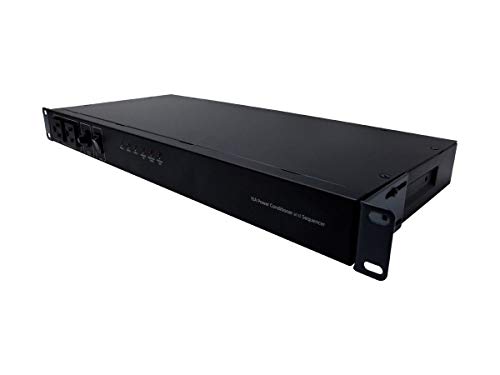
- Eight outlets with three-zone sequencing
- 15A, 120V operation and surge protection
- 1U rack-mount metal enclosure
Best For: Rack-mounted audio and AV systems needing zone-based power sequencing
Noise-Filtering Rack Power
Radial Power-1 Power Conditioner

- 11-outlet power supply
- Noise filtering and surge protection
- Rack-oriented 23-inch product length
Best For: Audio racks needing multiple outlets and basic power conditioning
Three-Zone Stage Protection
Soundavo PMX-1100 Power Sequencer

- 10 protected outlets, including eight switched outlets
- Three-stage sequencing with EMI/RFI filtering
- USB charging and front-panel status indicators
Best For: Audio racks requiring controlled startup for amplifiers and speakers
Independent Outlet Management
FMUSER 10-Outlet Power Sequencer

- Eight rear outlets with independent switches
- Sequential power control and surge protection
- Voltage display with 110V–240V input support
Best For: Stage and DJ systems needing flexible individual outlet control
Best Overall

- 12 outlets with four front and eight rear
- Extreme Voltage Shutdown and 126 J surge protection
- RFI/EMI filtering plus USB-C and USB-A charging
Best For: Mixed stage, studio, and AV racks
Best for Power Sequencing

- 10 outlets with eight switched rear outlets
- Two front always-on outlets and LCD voltage display
- 1U rack design with surge and overload protection
Best For: Compact studio, stage, and home theater racks
Best for Voltage Monitoring

- Eight switched rear and two unswitched front outlets
- LCD voltage display and rear-channel LED indicators
- RFI/EMI filtering with USB-C and USB-A charging
Best For: Compact racks needing clear power status
Studio Voltage Watch
10-Socket Rack Power Conditioner

- Eight rear and two always-on front sockets
- LCD voltage monitoring with surge protection
- 1U rack design rated for 2000W
Best For: Compact DJ, studio, and home theater racks
Maximum Outlet Flexibility
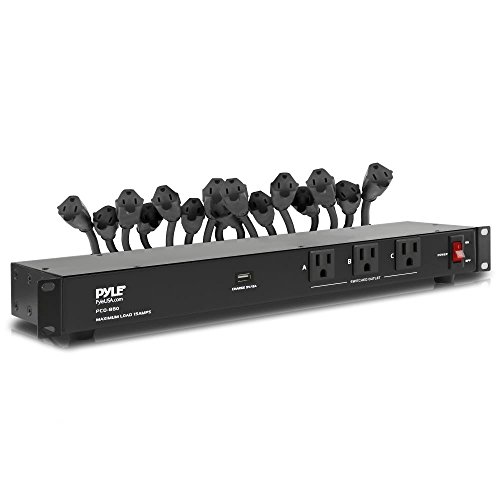
- 19 outlets with front and rear spacing
- Switched front outlet and 15A breaker
- 15-foot cord with flexible mounting options
Best For: Large racks and installations needing many outlets
Channel-by-Channel Control

- Independent channel switches plus sequential startup
- LCD voltage display and eight LED indicators
- USB, Type-C, and 10 rack-mounted sockets
Best For: Audio racks requiring sequenced and independent power control
Stage Right Sequencing Control – Monoprice 15 Amp Power Conditioner
For stage power conditioners with switched outlets, the Monoprice Stage Right combines 15-amp power handling with eight outlets and three zones in a 1U rack-mount design. Its surge protection and sequencer format suit organized audio and AV setups.
Best For: Rack-mounted stage, home theater, and audio systems that need zone-based power sequencing.
Pros:
- Eight outlets provide connections for amplifiers, speakers, computers, and other electronic devices.
- Three zones support sequenced power management.
- 15-amp, 120-volt operation with surge protection.
- Metal enclosure and 1U rack-mount format.
Cons:
- Only eight outlets are provided.
- The supplied notes do not specify individual outlet switches or USB charging.
This is a practical choice when rack space and staged power-up are priorities. It offers a focused combination of sequencing, surge protection, and standard North American outlets without adding features not listed in the specifications.
Noise-Filtering Rack Power – Radial Power-1 Power Conditioner
The Radial Power-1 is a straightforward option among stage power conditioners with switched outlets, offering an 11-outlet supply with noise filtering and surge protection. Its rack-oriented dimensions make it suitable for centralized equipment power.
Best For: Audio racks that need many outlets with basic noise filtering and surge protection.
Pros:
- Provides 11 outlets for connected equipment.
- Includes noise filtering for the power supply.
- Includes surge protection.
- Weighs 7.55 pounds and has a rack-oriented 23-inch length.
Cons:
- The supplied notes do not identify outlet switching or sequencing controls.
- The notes do not specify voltage, amperage, or outlet layout.
The Power-1 is best evaluated as a high-outlet-count conditioner with filtering and surge protection. Buyers specifically seeking independently switched or sequenced outlets should verify those controls before choosing it.
Three-Zone Stage Protection – Soundavo PMX-1100 Power Sequencer
The Soundavo PMX-1100 is a strong fit for stage power conditioners with switched outlets, with eight switched rear outlets, two unswitched front outlets, and three-stage sequencing. It also adds EMI/RFI filtering, status indicators, and a front USB charger.
Best For: Audio systems with amplifiers, active speakers, preamps, and mixers that benefit from delayed zone startup and shutdown.
Pros:
- Ten protected outlets include eight switched rear outlets and two unswitched front outlets.
- Three-stage sequencing powers zones on and off in a controlled order.
- EMI/RFI filtering and surge protection support cleaner, more stable system power.
- Front USB charging and LED status indicators add convenience.
Cons:
- Its 15-amp, 1800-watt rating limits total connected load.
- Only one USB charging port is included.
With clearly defined switched and unswitched outlet groups, the PMX-1100 is well suited to structured audio racks. Its sequencing and monitoring features make it especially useful where amplifier and speaker startup order matters.
Independent Outlet Management – FMUSER 10-Outlet Power Sequencer
The FMUSER 10-Outlet Sequencer stands out among stage power conditioners with switched outlets because its eight rear-panel sequence outlets each have an independent power switch. It also provides surge protection, voltage monitoring, and a broad 110V–240V input range.
Best For: Stage, DJ, laboratory, home theater, and sound-system setups needing flexible outlet-by-outlet control.
Pros:
- Eight rear sequence outlets have independent power switch controls.
- Sequential startup and shutdown helps reduce power-on noise and equipment stress.
- Voltage monitoring displays input status in real time.
- Supports 110V–240V input and up to 3000 watts of total output power.
Cons:
- The supplied notes do not specify the total number or layout of front-panel outlets.
- Its universal outlet format may require buyers to confirm compatibility with their plugs.
This model is a compelling choice for users who want both sequencing and direct control over individual rear outlets. The voltage display and wide input range add useful monitoring flexibility, while the 5.3-pound design keeps it relatively manageable for rack-based setups.
Best Overall – Furman M-8z Merit Z Series
The Furman M-8z is a strong all-around choice among stage power conditioners with switched outlets. It combines 12 outlets, surge protection, voltage shutdown, RFI/EMI filtering, and front-panel charging in a rack-ready steel chassis.
Best For: Stage, studio, and AV setups that need broad outlet capacity plus protection against extreme voltage conditions.
Pros:
- Provides 12 outlets, including four front outlets and eight rear outlets with extra spacing for bulky adapters.
- Extreme Voltage Shutdown disconnects equipment below about 85 V or above about 140 V and reconnects when power stabilizes.
- Includes 126 J surge protection, over 20 dB of RFI/EMI attenuation, USB-C and USB-A charging, and a Protection OK indicator.
Cons:
- The listed voltage is 120 V, so it is not presented as a universal-voltage unit.
- Its 4.6-pound steel construction may be heavier than a basic power strip.
With its combination of switched rack power, voltage monitoring features, filtering, and charging, the M-8z is a well-rounded option for protecting a mixed equipment rack.
Best for Power Sequencing – Pyle PCO875 Power Conditioner
The Pyle PCO875 is a practical pick for stage power conditioners with switched outlets when rack space and outlet organization matter. Its 1U chassis provides eight rear outlets, two front always-on outlets, a digital voltage readout, USB charging, and one-button operation.
Best For: Home theater, studio, and stage users who want a compact rack-mounted conditioner with a front-panel display and always-on outlets.
Pros:
- Offers 10 outlets: eight on the rear panel and two front-panel outlets that are always powered.
- Provides a 2000 W capacity, built-in spike and surge overload protection, and protection against voltage fluctuations and noise interference.
- Uses a rugged 1U metal housing and includes a USB port, digital LCD display, and front power switch.
Cons:
- The supplied notes describe 13 A operation, which may limit total load compared with higher-capacity distribution equipment.
- The product has a 1-year warranty, shorter than some competing options.
The PCO875 emphasizes convenient rack integration and straightforward control. Its two always-on front outlets are useful for devices that should remain powered while the switched rear outlets handle the main system.
Best for Voltage Monitoring – SW-Epsilon Power Sequencer
SENWOSI SW-Epsilon 10 Socket Power Conditioner/Surge Sequencer USB Type-C/Type-A Charger
Check Price On AmazonThe SW-Epsilon is worth considering if you want stage power conditioners with switched outlets and clear operating feedback. It has eight switched rear sockets, two unswitched front sockets, an LCD voltage monitor, rear channel indicators, and USB-C/USB-A charging in a 1U metal enclosure.
Best For: Rack users who want individually indicated rear power channels, voltage monitoring, and flexible 100–240 V input support.
Pros:
- Provides eight switched rear sockets and two unswitched front sockets with a 15 A, 1800 W total rating.
- Displays real-time voltage on a large LCD and shows rear-channel power status with LED indicators.
- Includes RFI/EMI filtering, USB Type-C and Type-A charging, and a fully rack-mountable 1U metal design.
Cons:
- It has fewer total outlets than the 12-outlet Furman M-8z.
- The supplied notes do not specify a joule rating or an extreme-voltage shutdown range.
- At 6.39 pounds, it may add noticeable weight to a portable rack.
The SW-Epsilon stands out for visibility and channel feedback rather than a published surge-energy rating. Its switched rear outlets and LCD readout make it a useful control center for a compact rack system.
Studio Voltage Watch – 10-Socket Rack Power Conditioner
For shoppers comparing stage power conditioners with switched outlets, this 1U rack-mount model focuses on straightforward power control, voltage visibility, and surge protection. It provides eight rear sockets plus two front always-on sockets, along with a large LCD voltage display and USB/international power connectivity.
Best For: Home studios, DJ setups, and compact racks that need real-time voltage monitoring and flexible outlet access.
Pros:
- 10 total sockets with eight rear outlets and two always-on front outlets
- Large LCD provides real-time voltage monitoring
- Includes surge, overload, and noise-protection features
- Compact 1U metal rack design with USB/international power interface
Cons:
- The notes do not specify individual outlet switching
- Listed voltage is 110V, which may limit compatibility in some regions
This is a practical choice when rack space and monitoring matter more than extensive outlet-by-outlet control. Its 2000W rating and 2-year manufacturer warranty add useful context for smaller audio and production systems.
Maximum Outlet Flexibility – Pyle 19-Outlet Rack PDU
The Pyle PCO860 is a strong option among stage power conditioners with switched outlets when outlet count and installation flexibility are priorities. Its 1U chassis offers 19 outlets, a switched front-panel AC outlet, a 15-amp circuit breaker, USB charging, and a long 15-foot power cord.
Best For: Larger rack, office, and stage-adjacent setups that need many outlets and flexible mounting options.
Pros:
- 19 total outlets, including three front-facing and 16 rear-facing outlets
- Switched front-panel AC outlet with covered power switch
- Built-in 15-amp circuit breaker helps guard against overloads
- Detachable flanges support rack-, wall-, or under-counter mounting
Cons:
- Only one USB port is specified
- The notes identify a switched front outlet rather than independent switching for every outlet
- Plastic enclosure may be less rugged than an all-metal chassis
Choose this model when maximum outlet capacity and a long reach are more important than detailed voltage display or channel sequencing. The worldwide 110/240V specification also adds flexibility, though the included Type B plug is North American.
Channel-by-Channel Control – 3300W Audio Power Sequencer
This 1U unit stands out among stage power conditioners with switched outlets by combining sequential startup with independent channel switching. It has eight rear sockets, two front normally open sockets, USB and Type-C charging, LCD voltage monitoring, and LED indicators for eight-channel status.
Best For: Audio racks and music-production systems that need sequential power-up, channel control, and clear front-panel status information.
Pros:
- Main switch sequences all channels, while each channel has an independent switch
- Professional filtering is designed to reduce RF and electromagnetic interference
- LCD voltage display and eight LED indicators support real-time monitoring
- Includes USB and Type-C charging ports in a 1U metal rack chassis
Cons:
- The notes list a maximum total output of 3000W despite the 3300W product description
- Specified AC range is 100V-125V, limiting use outside compatible systems
- Only 10 total power sockets are provided
For complex audio systems, the independent switches and sequenced startup offer more hands-on control than a basic rack power strip. Verify the applicable wattage and voltage limits before connecting a full stage rig.
How We Picked These Stage Power Conditioners with Switched Outlets
We selected products that provide more than basic power distribution. Each model offers some combination of switched outlets, power sequencing, surge protection, rack-mount construction, voltage monitoring, or USB charging. We also considered how useful the control layout is during setup and teardown, whether the unit suits a compact touring rack or a larger production system, and how clearly its specifications communicate electrical limits.
Because features vary substantially, verify the manufacturer’s current specifications before purchase. Outlet counts, total wattage, sequencing zones, connector types, and protection ratings should all match your equipment and local electrical requirements.
Quick Comparison
- For compact racks: Choose an 8- or 10-outlet unit with straightforward front-panel control.
- For staged startup: Look for multiple independently switched or sequenced zones.
- For larger systems: Consider a 19-outlet distribution unit, provided the total load remains within its rating.
- For modern touring needs: USB-A and USB-C charging can reduce the need for separate chargers.
- For visual monitoring: A voltage readout helps you check incoming power before powering sensitive gear.
Key Buying Factors for Stage Power Conditioners with Switched Outlets
Outlet Count and Switching Layout
Count every device you expect to connect, then leave some spare capacity for future additions. A high outlet count is useful only if the outlets are positioned and switched in a way that suits your rack. Independent switches or separate zones can make troubleshooting easier, while sequenced zones help prevent a large inrush of current from hitting the system simultaneously.
Electrical Capacity and Protection
Check the amperage, wattage, circuit-breaker rating, and plug type. Never treat a power conditioner as permission to exceed the capacity of a wall circuit or extension cable. Surge protection can help defend connected equipment from transient voltage events, but it does not replace proper venue wiring, grounding, or an appropriate uninterruptible power supply where continuous operation is required.
Rack Fit and Controls
Confirm the unit’s rack height, mounting depth, ventilation needs, and rear-panel clearance. Front-panel switches and indicators are convenient, but protected or recessed controls may be preferable in busy touring environments. Voltage displays are helpful for checking questionable venue power, while USB charging is most useful when ports are placed where cables can reach safely.
Who Should Buy Which Stage Power Conditioners with Switched Outlets?
Small bands, DJs, and mobile presenters should prioritize a compact unit with enough outlets, simple switching, and a manageable rack footprint. Live-sound engineers and installers will generally benefit from multiple zones or sequencing, especially when powering digital consoles, wireless systems, and processors together. Larger production racks may favor a high-outlet PDU-style model, but only after confirming the combined load and circuit requirements. Users charging phones, tablets, or accessories on site should choose a model with convenient USB-A or USB-C ports without sacrificing the primary power specifications.