The best standalone DMX controllers make it easier to run lighting scenes, fades, chases, and live changes without relying on a computer during every performance. The right choice depends on your fixture count, programming needs, portability, and preferred control method.
This roundup compares 10 options ranging from compact controllers and basic fader boards to recorder-style units and software-enabled interfaces. Use the buying guide below to narrow the field by channel capacity, playback flexibility, and venue requirements.
Best 10 Standalone Dmx Controllers Picks for 2026
Best for Hands-On Control

- 37 backlit silicone buttons
- Four rotary encoders
- Supports up to four universes
Best For: DJs and lighting operators needing tactile multi-universe control
Best for ShowXpress Playback
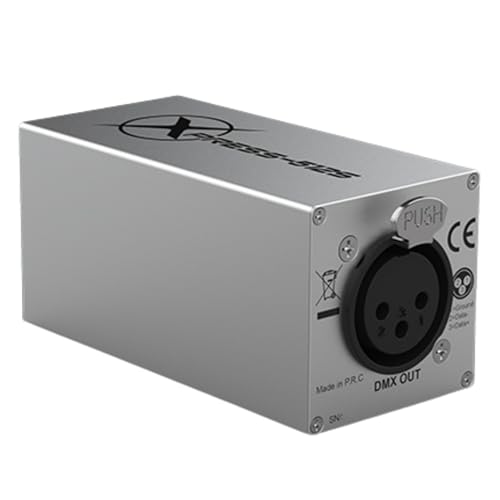
- Standalone playback of one show
- DMX and Art-Net support
- Windows and Mac OS X compatible
Best For: ShowXpress users needing compact computer-assisted or standalone playback
Best Full-Size Console

- 512 channels for up to 32 fixtures
- Stores 48 scenes
- LCD, faders, joystick, and chase controls
Best For: Stage, club, and event setups needing a traditional console
Best for Recording and Playback

- Records up to 255 programs
- Removable 32GB microSD storage
- Packet-loss detection mode
Best For: One-universe installations needing repeatable DMX playback
Software-Ready Control
SoundSwitch Control One DMX Lighting Controller

- Two DMX universes with inputs, outputs, and thru option
- Direct Engine DJ compatibility without a computer
- Touch strip, encoders, and RGB performance pads
Best For: DJs creating synchronized, software-driven light shows
Simple Fader Control
ADJ SDC12 12-Channel DMX Controller

- 12 channel faders plus a master fader
- Compact design supports portable or wall-mounted use
- 3-pin and 5-pin DMX outputs
Best For: Basic demos and small lighting setups needing manual control
Scene-Based Stage Control
CO-Z 192 DMX 512 Stage Light Controller

- 192 channels control up to 12 intelligent fixtures
- Supports up to 240 programmable scenes
- Voice control for switching lighting scenes
Best For: Events and shows using multiple intelligent lights and scenes
Best USB Standalone Controller

- 32-channel DMX output
- USB-C with included software
- Internal memory for standalone playback
Best For: Compact rigs using computer programming and onboard playback
Best Compact Chase Controller

- Controls up to eight intelligent lights
- 96 DMX channels
- Six chases with 999 steps each
Best For: DJs and small shows using programmed lighting chases
Best High-Capacity Standalone Console

- 384 DMX control channels
- 30 banks of eight scenes
- Supports up to 24 fixtures
Best For: Clubs and live stages needing extensive scene programming
Best for Hands-On Control – ADJ WMX1 Mk2
The ADJ WMX1 Mk2 is a practical choice among standalone DMX controllers for users who prefer dedicated physical controls. It combines 37 backlit silicone buttons, four rotary encoders, support for up to four universes, and four output sockets in a compact black unit.
Best For: DJs, performers, and lighting operators who want tactile, multi-universe control without relying solely on a computer.
Pros:
- Supports up to four DMX universes.
- Includes 37 backlit buttons and four rotary encoders.
- Provides four output sockets in a compact 10 x 9.25 x 3.5-inch design.
Cons:
- The supplied notes do not specify fixture capacity or scene-storage details.
- Its physical control layout may require a learning period for new users.
Choose the WMX1 Mk2 if hands-on operation and multi-universe connectivity matter more to you than a minimal interface. Its dedicated controls and backlighting suit active live-use environments.
Best for ShowXpress Playback – CHAUVET DJ Xpress-512S
The CHAUVET DJ Xpress-512S is a compact standalone DMX controller interface designed for ShowXpress workflows. It supports DMX and Art-Net control, works with Windows and Mac OS X, and can store and play one show without a computer connected.
Best For: ShowXpress users who need a small interface with basic standalone playback and the option to expand to additional universes.
Pros:
- Plays back one stored show without a computer.
- Supports Windows and Mac OS X with ShowXpress software.
- Multiple interfaces can be connected for additional universes.
- USB-powered aluminum enclosure weighs just 3.2 ounces.
Cons:
- Standalone playback is limited to one show according to the supplied notes.
- Its functionality is closely tied to ShowXpress software.
The Xpress-512S is a strong fit when portability and ShowXpress compatibility are priorities. It is less suited to buyers seeking a fully featured, button-based lighting console.
Best Full-Size Console – DMX512 512-Channel Controller
This DMX512 console is one of the more traditional standalone DMX controllers, with 512 channels, an LCD display, faders, a joystick, and dedicated scene and chase controls. It can control up to 32 fixtures at 16 channels per fixture, while storing and running 48 scenes.
Best For: DJs, stages, clubs, parties, and event setups that need a full-size console for conventional fixture and scene control.
Pros:
- Offers 512 DMX channels and supports up to 32 fixtures.
- Stores and runs up to 48 scenes.
- Includes an LCD screen, faders, joystick, and chase-speed control.
- Comes with a gooseneck LED lamp, power cable, manual, and 3-pin DMX cable.
Cons:
- At 17.73 pounds, it is much less portable than compact interfaces.
- The large console format requires more setup space.
- The supplied notes do not specify standalone show playback without external operation.
This controller makes sense for buyers who want visible, physical controls and generous scene capacity. Its substantial size is a tradeoff for the expanded console-style layout and included accessories.
Best for Recording and Playback – Pknight DMX Recorder
The Pknight 1-Universe DMX Recorder is a focused option among standalone DMX controllers for capturing and replaying lighting programs. It records up to 255 programs, stores them on a removable 32GB microSD card, and supports manual or external-device playback.
Best For: Installations and performers who need repeatable one-universe playback with removable storage and simple controls.
Pros:
- Records and plays back up to 255 programs.
- Supports playback from DMX consoles, computers, or mobile apps.
- Includes a removable 32GB microSD card for storage and transfer.
- Provides packet-loss detection to test DMX signal reliability.
Cons:
- It is limited to one 512-channel DMX universe.
- Its OLED screen and button interface are more focused than a full lighting console.
- The supplied notes do not identify a built-in multi-universe control layout.
The Pknight is a good match when reliable recording and repeat playback are the main requirements. Choose a larger console instead if you need extensive live fader-based programming or multiple universes.
Software-Ready Control – SoundSwitch Control One DMX Lighting Controller
For DJs who want standalone DMX controllers with deeper software integration, the SoundSwitch Control One combines tactile hardware control with SoundSwitch lighting workflows. It offers two DMX universes, dual USB connections, and direct compatibility with Engine DJ devices for computer-free performances.
Best For: DJs and performers building scripted or synchronized light shows with SoundSwitch, Engine DJ, or supported AlphaTheta setups.
Pros:
- Provides two DMX universe inputs and outputs, with a thru option for installations.
- Works directly with Denon DJ and Numark hardware running Engine DJ OS.
- Offers a touch strip, smooth encoders, and customizable RGB performance pads.
- Supports live audio BPM detection and control of effects such as color, brightness, strobe, moving heads, and gobos.
Cons:
- Advanced compatibility features require SoundSwitch software, and PRO DJ LINK Bridge use requires a laptop.
- More specialized than a basic fader-based DMX controller.
The Control One is the most feature-rich option here for music-led lighting control. Choose it if software integration and hands-on performance controls matter more than simple manual dimming.
Simple Fader Control – ADJ SDC12 12-Channel DMX Controller
ADJ Products SDC12, 12 Channel Basic DMX Controller, Easily Fade and Dim Multiple Lights
Check Price On AmazonThe ADJ SDC12 is one of the more straightforward standalone DMX controllers for users who need direct manual control. Its 12 channel faders and master fader make it suitable for basic demos, portable setups, or permanent installations where uncomplicated fading and dimming are the priority.
Best For: Small lighting systems, demos, basic stage control, and users who prefer physical faders over software-based operation.
Pros:
- Provides 12 channel faders plus a master fader for accessible control.
- Compact, lightweight construction supports travel and quick setup.
- Can run from a 9V battery for handheld use, with the battery sold separately.
- Includes standard 3-pin and 5-pin DMX outputs for connecting lighting devices.
Cons:
- Its 12-channel layout is less suited to complex fixtures or elaborate programmed shows.
- Does not offer the software, scene, or performance-oriented features found on more advanced controllers.
The SDC12 favors simplicity and portability. It is a practical pick when you need dependable manual channel control without the learning curve or added complexity of a larger lighting console.
Scene-Based Stage Control – CO-Z 192 DMX 512 Stage Light Controller
The CO-Z 192 is a standalone DMX controller for users who need more fixture capacity and scene storage than a basic fader board provides. It controls up to 12 intelligent lights with up to 16 channels each and supports up to 240 scenes for more involved DJ, event, and stage setups.
Best For: DJs, clubs, weddings, churches, and event users programming multiple intelligent lights and repeatable lighting scenes.
Pros:
- Offers 192 channel groups for controlling up to 12 fixtures with up to 16 channels each.
- Stores up to 240 scenes for building more complex shows.
- Includes dedicated areas for fixture selection, scenes, channels, speed/time, and functions.
- Voice control enables switching among different lighting scenes.
Cons:
- The larger control layout may take more time to learn than a simple 12-channel board.
- Its corded-electric design is less convenient for battery-powered portable operation.
- Uses a 3-pin connection, which may require compatibility planning for some fixtures.
The CO-Z 192 sits between basic manual controllers and more specialized software systems. Its combination of fixture capacity, scene storage, and voice control makes it a flexible choice for event lighting with repeatable sequences.
Best USB Standalone Controller – Club 32 USB DMX Controller
The Club 32 is a practical choice among standalone dmx controllers when you want both computer-based programming and onboard playback. It provides 32 DMX output channels in standalone mode, USB-C connectivity, and internal memory for recorded lighting sequences.
Best For: Compact lighting setups that need USB programming and standalone DMX playback.
Pros:
- Supports DMX In/Out, DMX recording, and DMX triggering.
- Internal 200 KB memory stores approximately 200 to 2,000 DMX steps.
- Strong aluminum housing and a lightweight 1-pound design.
- Includes software and a one-year international warranty.
Cons:
- Limited to 32 DMX output channels in standalone mode.
- Requires a computer connection for USB-based operation and programming.
Choose this model if portability, computer integration, and simple onboard playback matter more than high channel capacity. Its 32-channel design is best suited to smaller rigs.
Best Compact Chase Controller – CHAUVET DJ Obey 10
The CHAUVET DJ Obey 10 is one of the more straightforward standalone dmx controllers for managing multiple intelligent lights without a computer. It controls up to eight fixtures, offers 96 DMX channels, and supports programmed chases with sequential linking.
Best For: DJs and small performance setups running several intelligent lights and repeated chase sequences.
Pros:
- Controls up to eight intelligent lights.
- Provides 96 DMX channels and up to 12 channels per fixture.
- Offers six chase sets with up to 999 steps each.
- Supports sequential linking of chases for extended sequences.
Cons:
- Its 96-channel capacity is lower than larger 384-channel consoles.
- The 22.2-inch chassis is less compact than smaller interface-style controllers.
The Obey 10 makes sense when chase programming and fixture control are the priority. It offers more fixture capacity than a basic small controller while remaining focused on compact show setups.
Best High-Capacity Standalone Console – 384CH DMX512 Controller
This 384-channel console is designed for users who need substantial fixture and scene capacity from standalone dmx controllers. It provides 30 banks of eight programmable scenes, supports 24 fixtures, and includes an LED gooseneck light for console operation.
Best For: Clubs, bars, and live stages requiring extensive scene programming and 384-channel control.
Pros:
- Provides 384 DMX control channels.
- Supports 30 banks with eight programmable scenes each.
- Designed to control up to 24 fixtures.
- Includes gel handles and an LED gooseneck light for operation.
Cons:
- At 6 pounds, it is heavier than compact interface-style controllers.
- Its approximately 20.71-inch-wide console footprint needs dedicated space.
- The supplied notes do not indicate included software or internal memory capacity.
This controller is the strongest fit for larger lighting programs where channel count and scene organization are more important than minimal size. Its bank-and-scene layout is suited to repeatable live-show programming.
How We Picked the Best Standalone Dmx Controllers
We focused on controllers that can manage DMX lighting in practical live environments, including DJ booths, small stages, clubs, houses of worship, event venues, and mobile entertainment setups. The selection includes traditional hardware consoles, compact fader-based boards, standalone playback devices, and interfaces designed to work with lighting software.
Our comparison considers channel and fixture capacity, scene and chase programming, playback options, portability, display and control layout, connectivity, and the learning curve. Because lighting systems vary widely, a higher channel count is not automatically better; usable controls and reliable playback can matter more for a small rig.
Quick Comparison
- Best for flexible hardware control: ADJ WMX1 Mk2
- Best for software-based two-universe control: Chauvet DJ Xpress-512S
- Best for simple dimming: ADJ SDC12
- Best for recorded standalone playback: Pknight 1-Universe DMX Recorder
- Best for integrated DJ lighting workflows: SoundSwitch Control One
- Best for compact traditional consoles: Chauvet DJ Obey 10
- Best for basic 192-channel control: CO-Z 192 DMX Controller
Key Buying Factors for Standalone Dmx Controllers
Channel and Fixture Capacity
Check both the total DMX channel count and the number of fixtures the controller can address. A 512-channel unit may support many simple fixtures but fewer complex moving lights, since each fixture can use multiple channels. Leave room for future expansion if your lighting system is growing.
Programming and Playback
Look for the scene, bank, chase, and fixture controls you actually need. Basic fader boards are quick to operate but may offer limited automation. Recorder-style controllers can replay programmed looks, while software interfaces may provide deeper editing and multiple universes.
Live Control Layout
Dedicated faders, buttons, encoders, and an LCD can make live changes faster than menu-based controls. Consider whether you will operate the board in a dark booth, trigger cues during a performance, or hand it to a less experienced operator.
Connectivity and Compatibility
Confirm the controller uses the DMX connections and signal format required by your fixtures. If choosing a USB or software-oriented product, verify operating-system support, included software, computer requirements, and whether the setup can run independently when needed.
Portability and Reliability
A mobile DJ may prioritize a compact enclosure and straightforward setup, while a permanent venue may benefit from more controls and expansion capacity. Also consider power requirements, cable access, physical durability, and whether saved programs can be backed up or transferred.
Who Should Buy Which Standalone Dmx Controllers?
Choose a compact basic controller if you run a small number of LED fixtures and mainly need manual dimming, color changes, or simple scenes. The ADJ SDC12 is suited to straightforward control, while compact 192- or 384-channel boards offer more programming room without requiring a full software rig.
Choose a programmable standalone console if you need repeatable scenes and chases for parties, bands, or small venues. The ADJ WMX1 Mk2, Chauvet DJ Obey 10, and similar hardware units are appropriate when dependable hands-on operation matters.
Choose a recorder or software interface if you want detailed show design, automated playback, or more advanced fixture management. The Pknight recorder is useful for replaying prepared material, while the Chauvet DJ Xpress-512S and SoundSwitch Control One are better fits for users comfortable building shows with software or integrated DJ workflows.
Before buying, list your fixtures, calculate their channel usage, identify the scenes you need, and decide whether the controller must operate without a computer. That checklist will usually narrow these Standalone Dmx Controllers to one or two practical choices.