Reliable signal distribution is essential when a live stream must reach multiple displays, recorders, switchers, or monitoring positions without introducing dropouts or unnecessary conversion steps.
This roundup covers 10 options across HDMI, SDI, composite video, and integrated live-production workflows, helping you match distribution hardware to your cameras, resolution, cable runs, and production scale.
Best 10 Video Distribution Amplifiers for Live Streaming Picks for 2026
Best SDI Signal Splitter
Blackmagic Design Mini Converter SDI Distribution

- Eight re-clocked SDI outputs
- Automatic SD, HD, and 3G-SDI switching
- Supports embedded audio and ASI
Best For: Multi-device SDI broadcast and live-event setups
Best HDMI 2.1 Splitter
1x2 HDMI 2.1b Distribution Amplifier
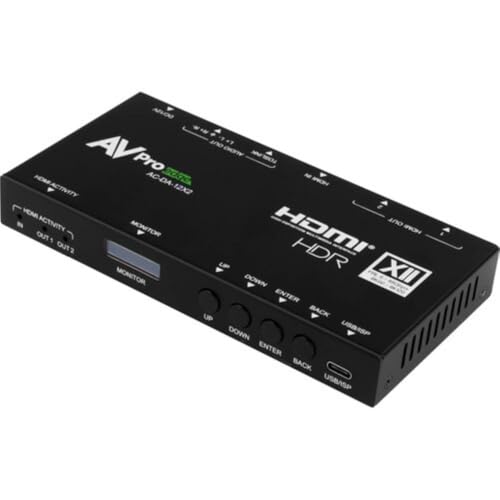
- Duplicates one HDMI source to two outputs
- Supports up to 8K60 resolution
- Includes EDID and multichannel audio support
Best For: Compact high-bandwidth HDMI streaming systems
Best All-in-One Live Production Hub
Blackmagic ATEM Television Studio HD8 ISO

- Eight standards-converted 3G-SDI inputs
- Hardware streaming and eight-input ISO recording
- Integrated Fairlight audio mixer and multiview
Best For: Portable multi-camera live production
Best Long-Distance SDI Splitter
AVMATRIX SD1141 1x4 Distribution Amplifier

- Four re-clocked SDI outputs
- Supports SD, HD, and 3G-SDI
- Long-distance ratings up to 400m for SD
Best For: Extended-cable SDI live-event installations
Versatile Live Production Hub

- Handles SDI, HDMI, USB-C, NDI HX, and playback sources
- Supports effects, transitions, portrait, and landscape formats
- Streams to up to three platforms via Ethernet or hotspot
Best For: Multi-camera live productions needing switching and direct streaming
Professional SDI Distribution

- Splits one SDI input into nine buffered outputs
- Supports SD, HD, 3G-SDI, and DVB-ASI with reclocking
- Extends cable reach with automatic equalization
Best For: Broadcast and live-production SDI installations
Compact Analog AV Splitter

- Sends composite video and stereo audio to four outputs
- Built-in amplifier supports longer analog connections
- Compact metal case includes a 9V AC adapter
Best For: Legacy RCA-based displays, speakers, and capture setups
Compact HDMI Splitter

- Compact 7.38 x 4.53 x 1-inch design
- Lightweight at 14.1 ounces
- Designed for audio/video distribution
Best For: Small HDMI streaming and monitoring setups
All-in-One Production Hub

- Connects up to eight HDMI or 3G-SDI cameras
- Routes sources to four HDMI/SDI outputs
- Adds ISO recording, graphics, replay, and streaming
Best For: Multi-camera events, sports, churches, and webinars
Cross-Format Distribution

- One HDMI or 3G-SDI input with eight outputs
- Converts and splits signals up to 1080p60
- Includes SDI re-clocking and equalization
Best For: Mixed SDI/HDMI 1080p live-streaming systems
Best SDI Signal Splitter – Blackmagic Design Mini Converter SDI Distribution
For live streaming setups built around SDI, this Blackmagic Design Mini Converter is a practical choice among video distribution amplifiers for live streaming. It accepts SD, HD, and 3G-SDI signals automatically and distributes one input to eight re-clocked outputs, with embedded audio and ancillary data support.
Best For: Broadcast, live-event, and multi-device SDI installations that need dependable signal duplication.
Pros:
- Supports SD, HD, and 3G-SDI with automatic format switching.
- Provides eight re-clocked SDI outputs for multiple connected devices.
- Supports embedded audio, ancillary data, and ASI signals.
- Includes a redundant SDI input for mission-critical applications.
Cons:
- Designed for SDI workflows rather than HDMI-based systems.
- Portable mounting may be less convenient for permanent rack installations.
Its combination of broad SDI compatibility, signal reclocking, and eight outputs makes it a strong fit when a streaming or broadcast chain needs to feed several SDI destinations at once.
Best HDMI 2.1 Splitter – 1×2 HDMI 2.1b Distribution Amplifier
This compact HDMI distribution amplifier is suited to video distribution amplifiers for live streaming when one modern HDMI source must feed two displays or downstream devices. It offers HDMI 2.1b connectivity, support for resolutions up to 8K60, and 48 Gb/s of video bandwidth.
Best For: HDMI 2.1 systems that need to duplicate a source to two outputs while retaining advanced display compatibility.
Pros:
- Splits one HDMI input to two HDMI outputs.
- Supports resolutions up to 8K60.
- Provides 48 Gb/s video bandwidth for high-performance HDMI workflows.
- Includes EDID management and multichannel digital audio support.
Cons:
- Offers only two outputs.
- Requires a 12V power supply.
- Best suited to HDMI 2.1b equipment rather than SDI-centered installations.
For a small streaming studio or presentation system using current HDMI hardware, this unit keeps the signal path straightforward while adding EDID control and high-bandwidth format support.
Best All-in-One Live Production Hub – Blackmagic ATEM Television Studio HD8 ISO
Unlike a simple splitter, the ATEM Television Studio HD8 ISO combines switching, streaming, recording, audio mixing, and monitoring in one portable production system. It is worth considering alongside video distribution amplifiers for live streaming when your workflow needs full production control rather than signal duplication alone.
Best For: Portable professional productions requiring multi-camera switching, streaming, ISO recording, and integrated audio control.
Pros:
- Provides eight standards-converted 3G-SDI inputs.
- Includes hardware streaming and independent recording of all eight SDI inputs.
- Offers two Aux outputs, reference I/O, MADI I/O, and 16-way multiview.
- Features a Fairlight audio mixer with processing tools on input channels.
Cons:
- Much larger and more complex than a dedicated distribution amplifier.
- Its 6.8 kg weight may reduce portability compared with compact converters.
- The listed model does not include storage.
This is a production centerpiece rather than a basic distribution box. Choose it when live streaming involves several cameras, switching, audio mixing, multiviewing, and ISO capture in a portable studio-style package.
Best Long-Distance SDI Splitter – AVMATRIX SD1141 1×4 Distribution Amplifier
The AVMATRIX SD1141 is a compact option for video distribution amplifiers for live streaming where SDI signals must travel to several destinations over substantial cable runs. It automatically detects HD, SD, and 3G-SDI, then delivers four re-clocked outputs for more reliable long-distance distribution.
Best For: Live-event and broadcast installations needing four SDI outputs and extended cable transmission.
Pros:
- Accepts HD, SD, and 3G-SDI signals automatically.
- Re-clocks all four outputs to support signal integrity over long runs.
- Rated for transmission distances up to 400m SD, 200m HD, and 120m 3G-SDI.
- Includes a detachable bracket for wall mounting.
Cons:
- Provides four outputs, fewer than some eight-output distribution amplifiers.
- Only outputs 2 and 4 support DVB-ASI according to the supplied notes.
- Uses a listed 17V DC input rather than a more common 12V supply.
With automatic signal detection and output reclocking, the SD1141 is a sensible choice for distributing SDI across a venue or production space where cable distance is a primary concern.
Versatile Live Production Hub – GoStream Duet
Osee GoStream Duet Multiple Camera SDI and HDMI Live Stream Video Mixer Switcher
Check Price On AmazonThe Osee GoStream Duet is a flexible choice for creators comparing video distribution amplifiers for live streaming alongside full production hardware. It combines SDI, HDMI, USB-C, NDI HX, media playback, switching, keying, and direct streaming in a compact unit.
Best For: Multi-camera productions that need extensive input support, portrait or landscape output, and streaming to up to three platforms.
Pros:
- Accepts four SDI, four HDMI, USB-C, NDI HX, and SD/SSD playback sources.
- Supports MIX, DIP, WIPE, T-bar, chroma key, PIP, DSK, and other production effects.
- Can stream through Ethernet or a smartphone hotspot and works with OBS and vMix.
- Offers GUI, computer software, and Bitfocus Companion control options.
Cons:
- Its broad feature set may be more than needed for simple signal duplication.
- NDI HX requires the latest firmware to unlock the included license.
Choose this model when you need switching and streaming capabilities rather than a dedicated one-input distribution amplifier. Its varied connectivity and control methods make it a practical all-in-one option for more involved live setups.
Professional SDI Distribution – SD1191 1×9 SDI Amplifier
The SD1191 is a dedicated option for buyers seeking video distribution amplifiers for live streaming and broadcast workflows. It takes one SDI input and delivers nine buffered, reclocked outputs while supporting SD, HD, 3G-SDI, and DVB-ASI signals.
Best For: Broadcast carts, live production systems, and AV installations that need multiple stable SDI feeds over long cable runs.
Pros:
- Provides nine independent outputs from one input without signal degradation.
- Automatically detects and retimes SD, HD, and 3G-SDI signals.
- Adaptive equalization supports up to 400m for SD, 200m for HD, and 120m for 3G-SDI.
- Preserves ancillary data including audio, captions, and timecode.
Cons:
- It is designed for SDI and DVB-ASI distribution rather than HDMI or composite sources.
- The one-input design does not provide source switching or mixing.
For professional SDI infrastructure, the SD1191 prioritizes signal integrity, reach, and dependable replication. Its wide 6–24V DC input range and detachable mounting brackets also suit mobile and fixed installations.
Compact Analog AV Splitter – DTECH 4-Way RCA Splitter
The powered DTECH 4-way splitter is a straightforward choice for analog setups comparing video distribution amplifiers for live streaming. It duplicates one composite video and stereo audio source to four RCA-connected displays, speakers, or capture devices.
Best For: Legacy gaming, monitoring, dubbing, and small AV systems using composite RCA connections.
Pros:
- Distributes one 3-RCA source to four outputs for video and left/right audio.
- Built-in amplification helps maintain image and audio quality over longer connections.
- Compact metal housing includes anti-skid feet and an LED power indicator.
- Includes a 9V AC power adapter and requires no additional software.
Cons:
- Composite RCA connectivity is intended for analog video, not SDI or HDMI workflows.
- It has no switching controls and supports one source at a time.
- The supplied notes do not specify a maximum transmission distance.
This DTECH unit makes sense when your equipment already uses yellow, white, and red RCA connections. It is inexpensive and easy to install, but modern digital live-streaming systems may require a more advanced distribution format.
Compact HDMI Splitter – Kramer VM-2H2
The Kramer VM-2H2 is a compact option for straightforward HDMI signal distribution. For buyers comparing video distribution amplifiers for live streaming, its small footprint and dedicated audio/video design suit setups that need a simple, space-efficient distribution component.
Best For: Compact HDMI-based streaming, presentation, and monitoring setups.
Pros:
- Compact 7.38 x 4.53 x 1-inch product dimensions.
- Lightweight design at 14.1 ounces.
- Purpose-built for audio or video distribution.
Cons:
- The supplied notes do not specify supported resolutions or output counts.
- Its HDMI-focused design may be less suitable for mixed SDI workflows.
The VM-2H2 is best considered when physical space and simple HDMI distribution matter more than advanced routing details. Verify the required inputs, outputs, and resolution support before integrating it into a larger live-streaming system.
All-in-One Production Hub – Osee GoStream Omni 12 ISO
The Osee GoStream Omni 12 ISO is a full hardware production platform rather than a basic splitter. For video distribution amplifiers for live streaming, it stands out when a production team needs extensive camera connectivity, routing, recording, graphics, audio mixing, and multi-platform streaming in one unit.
Best For: Events, churches, sports, webinars, and other multi-camera live productions.
Pros:
- Supports up to eight HDMI or 3G-SDI camera connections, plus four AUX channels.
- Routes inputs, preview, program, and multisource views to four assignable HDMI/SDI outputs.
- Provides program and eight ISO recording, three-platform streaming, graphics, replay, and a 16-channel audio mixer.
- Dedicated FPGA processing is designed for stable operation under full load.
Cons:
- At 2.5 kg, it is less portable than a basic distribution amplifier.
- The power cord is not included.
- Its broad feature set may be more than a simple signal-splitting workflow requires.
The GoStream Omni 12 ISO is a strong fit for production-heavy environments where switching and distribution are only part of the job. Its extensive capabilities can reduce the need for separate replay, recording, graphics, and audio equipment, but plan for a more involved setup.
Cross-Format Distribution – AVMATRIX SD2080
The AVMATRIX SD2080 combines SDI and HDMI conversion with four outputs for each format. Among video distribution amplifiers for live streaming, it is a practical choice for workflows that need to split either an SDI or HDMI source while also supporting cross-format output up to 1080p60.
Best For: Live broadcasts, OB vans, security systems, and mixed SDI/HDMI installations.
Pros:
- Accepts one HDMI or one 3G-SDI input and provides four SDI plus four HDMI outputs.
- Supports SDI-to-HDMI and HDMI-to-SDI conversion up to 1080p60.
- Includes SDI re-clocking and equalization for long-distance signal transmission.
- DIP switches enable quick SDI/HDMI input selection without driver installation.
Cons:
- Maximum supported resolution is 1080p60, so it is not intended for 4K distribution.
- It handles one selected input at a time rather than functioning as a multi-source switcher.
The SD2080 is well suited to installations that bridge HDMI and SDI equipment without adding separate converters and splitters. Its eight total outputs offer useful flexibility, while the 1080p60 ceiling should be checked against the rest of your streaming chain.
How We Picked the Best Video Distribution Amplifiers for Live Streaming
We selected products for different live-streaming environments rather than treating every splitter as interchangeable. The lineup includes compact HDMI distribution amplifiers, SDI units with reclocking and signal equalization, composite-video hardware, and larger switchers that combine routing with live production features.
Our main considerations were supported signal standards, input and output count, compatibility with common cameras and capture devices, signal integrity over longer runs, ease of deployment, and whether the hardware suits a home studio, event setup, control room, or multi-camera production.
Quick Comparison
| Best For | Recommended Type | What to Look For |
|---|---|---|
| Simple HDMI duplication | HDMI distribution amplifier | Resolution, HDMI version, HDCP, EDID, and power requirements |
| Professional camera networks | SDI distribution amplifier | SD/HD/3G-SDI support, reclocking, equalization, and buffered outputs |
| Many SDI destinations | High-output SDI unit | Output count, connector layout, rack suitability, and signal regeneration |
| Legacy gaming or AV equipment | Composite distribution box | RCA compatibility, audio handling, and included power adapter |
| Multi-camera streaming | Integrated video switcher | Input formats, ISO recording, streaming tools, multiview, and control options |
Key Buying Factors for Video Distribution Amplifiers for Live Streaming
Signal Format and Resolution
Start with the output from your camera, switcher, or playback device. HDMI and SDI are not interchangeable without conversion, while composite video is intended for older equipment. Confirm support for your target resolution and frame rate, including 1080p, 4K, or 3G-SDI where applicable.
Output Count and Signal Quality
Choose enough outputs for every display, recorder, encoder, and confidence monitor, with room for expansion. Buffered outputs are preferable for live work because each destination receives a more reliable signal. For longer SDI runs, reclocking and equalization can help maintain stability and compensate for cable loss.
Compatibility and Workflow
Check connector types, HDCP behavior, EDID management, embedded audio support, and whether the device passes or converts signals. If you need switching, streaming, multiview, or isolated recording, an integrated production system may be more practical than adding a basic splitter to a separate setup.
Power, Mounting, and Reliability
Live-streaming hardware should be easy to power and secure. Consider included adapters, rack or desktop placement, ventilation, status indicators, and access to spare cables. A compact unit may be ideal for mobile production, while a rugged rack-friendly model is better for permanent installations.
Who Should Buy Which Video Distribution Amplifiers for Live Streaming?
Choose a compact HDMI amplifier for a straightforward camera-to-monitor, capture-device, or display distribution task. Select an SDI model when your cameras and infrastructure use broadcast-style cabling, especially if you need several buffered outputs or dependable longer cable runs.
For multi-camera productions, an integrated switcher such as an ATEM or GoStream system may deliver more value than a standalone distributor by combining source management with switching and streaming functions. Choose a composite RCA unit only when supporting legacy video or gaming equipment. Finally, prioritize output count and signal regeneration for venues, studios, and control rooms that must feed many destinations simultaneously.