Wireless video can simplify a home studio by removing long HDMI runs between cameras, monitors, capture cards, and streaming computers. The right transmitter system can improve setup flexibility without sacrificing image quality or adding distracting delay.
We selected 10 options spanning budget 1080p HDMI extenders, low-latency live-production kits, multi-receiver systems, and professional 4K wireless monitoring tools. Use the guide below to match range, resolution, connectivity, and workflow features to your studio.
Best 10 Video Transmitters for Home Studios Picks for 2026
Best for Professional Monitoring

- Dual-band transmission with up to 1,200-foot stated range
- UVC output for computer-based live streaming
- Supports up to four monitoring devices
Best For: Home studios with multi-device monitoring and streaming needs
Best Simple HDMI Setup

- Plug-and-play operation without Wi-Fi or apps
- 1080p at 60Hz output with 4K decoding
- Up to 165 feet indoors or 328 feet outdoors
Best For: Studios needing a simple wireless display connection
Best for Channel Control
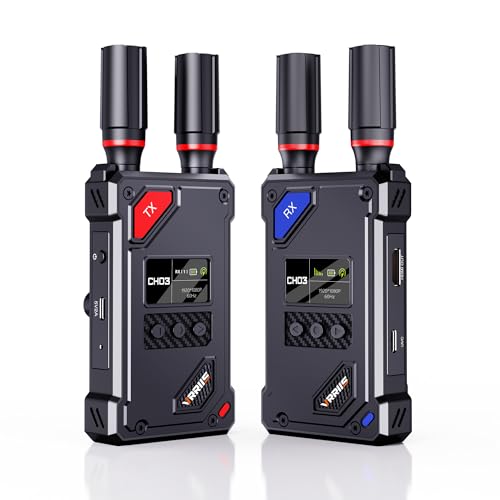
- 20 manually selectable channels with LCD interference display
- UVC output and HDMI loop-out included
- 1,500-foot stated line-of-sight range and 0.05-second latency
Best For: Studios needing channel management and direct OBS streaming
Best for Expandable Displays

- Up to 400 feet of stated transmission range
- Supports mirrored and extended display modes
- One receiver can support up to 12 transmitters
Best For: Studios using multiple wireless displays or video sources
Premium Studio Monitor

- 3-in-1 7-inch monitor, transmitter, and receiver
- REC.709-calibrated display with 1000 nits brightness
- Camera control, LUT processing, and SRT/RTMP streaming
Best For: Color-critical home studios and advanced streaming workflows
Long-Range HDMI Link

- 1080p at 60Hz with 0.05-second stated latency
- HDMI loop-out and dual receiver outputs
- Supports one transmitter with up to five receivers
Best For: Multi-display 1080p monitoring in open studio layouts
On-Set Collaboration Hub
Wireless HDMI System with 7-inch Monitor
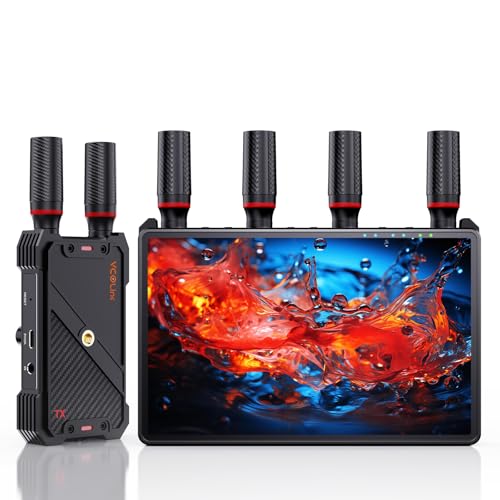
- Built-in 7-inch receiver monitor
- 1080p60 transmission with less than 0.05-second latency
- One transmitter supports up to five receivers
Best For: Small crews needing built-in and shared monitoring
Premium 4K Choice

- 4Kp30 10-bit HDR HDMI transmission
- 750-foot range with under 0.01-second latency
- 6GHz connectivity with app control
Best For: Demanding home studio monitoring and capture workflows
Mobile Monitoring Pick
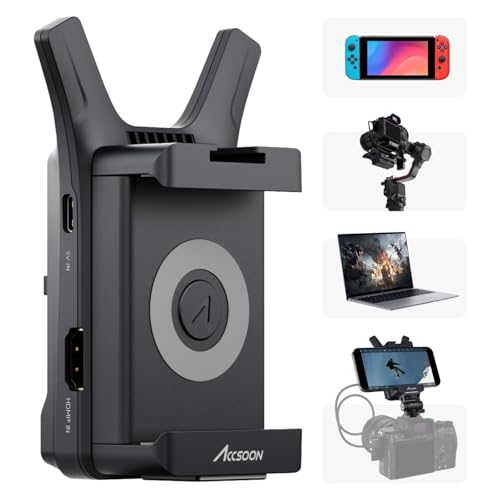
- 1080p60 HDMI transmission up to 500 feet
- Feeds up to four iOS or Android devices
- Pocket-sized design with USB or NP-F power
Best For: Portable multi-device camera monitoring
Simple Display Extender

- 4K decoding with 1080p60 output
- Dual-band 2.4GHz and 5.8GHz transmission
- Plug-and-play mirroring or extended display modes
Best For: Basic wireless HDMI display connections
Best for Professional Monitoring – Accsoon CineView HE
For home studios that need dependable monitoring and live-streaming flexibility, the Accsoon CineView HE is one of the more feature-rich video transmitters for home studios. Its dual-band transmission, low stated latency, long line-of-sight range, and receiver-side UVC output make it suitable for camera-to-computer workflows.
Best For: Home-studio creators, small production teams, and live streamers who need multi-device monitoring and direct UVC output to platforms such as OBS.
Pros:
- Dual-band 2.4GHz and 5GHz transmission is designed for stable, interference-resistant connections.
- Supports up to 1,200 feet of range with stated latency below 0.06 seconds.
- Receiver UVC output can connect to a computer without a separate video capture device.
- One transmitter can feed up to four receivers or mobile devices, with HDMI loop-out for local monitoring.
Cons:
- Battery and charging cables are not included.
- Its broader feature set may be more than a simple point-to-point studio setup requires.
The CineView HE stands out when a home studio doubles as a streaming or small production space. It costs more in complexity than a basic HDMI extender, but UVC output, multi-device monitoring, and flexible power options can simplify a more demanding workflow.
Best Simple HDMI Setup – Wireless HDMI 328ft Extender
If you want a straightforward way to send camera, laptop, or set-top-box video to a display, this kit keeps the setup simple. It does not require Wi-Fi, an app, or Bluetooth, making it a practical entry-level choice among video transmitters for home studios.
Best For: Home studios, presentation spaces, and home-theater setups that need wireless 1080p display connections with minimal configuration.
Pros:
- Plug-and-play design works without Wi-Fi, apps, or Bluetooth.
- Supports 4K decoding and 1080p output at 60Hz.
- Offers a stated range of up to 165 feet indoors or 328 feet outdoors.
- Compact, lightweight design includes Micro HDMI and Mini HDMI adapters.
Cons:
- Walls and other obstacles can reduce transmission distance and speed.
- Both the transmitter and receiver must be connected to power.
- The supplied notes do not indicate UVC output for direct computer streaming.
This is a sensible fit when your priority is getting a clean HDMI signal from one room or device to another without adding network configuration. For computer-based streaming, a model with explicit UVC support may be a better match.
Best for Channel Control – Vrriis Wireless Video System
The Vrriis wireless video system is aimed at creators who want more control over wireless interference than a basic extender provides. Its 20 manually adjustable channels, LCD signal information, UVC output, and HDMI loop-out make it a strong contender among video transmitters for home studios with active wireless environments.
Best For: Home-studio streamers and small crews that need manual channel selection, direct OBS connectivity, and simultaneous local monitoring.
Pros:
- Provides 20 adjustable channels and an LCD display for signal and interference information.
- Offers a stated 1,500-foot line-of-sight range with 0.05-second latency.
- Includes UVC output for streaming and HDMI loop-out for a local monitor.
- Supports 1080p at 60Hz and multiple power options, including NP-F batteries and USB-C.
Cons:
- Walls, metal, brick, and glass can significantly reduce coverage.
- Batteries are not included.
- Adding more receivers can reduce the transmission distance.
For a studio where neighboring wireless devices or crowded frequencies are a concern, the manual channel controls are particularly useful. It offers a more hands-on setup than simple plug-and-play systems, but that control can pay off in stability and streaming flexibility.
Best for Expandable Displays – Wireless HDMI 400ft Extender
Designed for flexible screen sharing and wireless display expansion, this extender supports both mirrored and extended displays. Its dual-band connection, stated 400-foot range, and multi-transmitter support make it a useful option for home studios that also serve as presentation, gaming, or multi-display spaces.
Best For: Home studios and creative workspaces that need wireless display extension, dual-band stability, and the option to connect multiple transmitters.
Pros:
- Supports a stated range of up to 400 feet, or 120 meters.
- Dual-band 2.4GHz and 5.8GHz transmission is designed to improve stability.
- Offers both wireless mirroring and extended-display modes.
- Supports one receiver with up to 12 transmitters and up to five sets in the same environment.
Cons:
- Outputs 1080p at 60Hz, despite supporting 4K decoding.
- The supplied notes do not specify UVC output for direct live-streaming software.
- Its multi-transmitter capabilities may be unnecessary for a single-camera studio.
This model makes the most sense when wireless HDMI is being used for more than one screen or source. It is less specifically focused on camera-production workflows than the UVC-equipped systems, but its display modes and expansion capacity offer useful workspace flexibility.
Premium Studio Monitor – CineView M7H Pro 4K60
Accsoon CineView M7H Pro 4K60 Wireless Video Transmitter Receiver&Camera Monitor, 7" Camera Control
Check Price On AmazonFor home studios that need monitoring, wireless transmission, and camera control in one device, the Accsoon CineView M7H Pro is a versatile choice among video transmitters for home studios. Its 7-inch, 1000-nit display, HDMI connectivity, and TX/RX modes support both production monitoring and wireless video workflows.
Best For: Creators who want a color-accurate monitor with wireless transmission, reception, camera control, LUT tools, and direct SRT/RTMP streaming.
Pros:
- Combines a monitor, transmitter, and receiver in one compact unit.
- Offers 1920×1080 resolution, 1000 nits brightness, REC.709 calibration, and Delta E < 2 accuracy.
- Supports wireless or USB-C camera control with selected Sony, Canon, and Nikon cameras.
- Can stream through SRT/RTMP without a capture card or PC when in Monitor Mode.
Cons:
- Camera control and live streaming are limited to Monitor Mode.
- Compatibility varies by camera model, and some Nikon models lack Focus Control.
- Its advanced feature set may be more than a basic home-studio setup requires.
The M7H Pro is the most feature-rich option here for a studio that values accurate image evaluation and an integrated workflow. It is particularly appealing when color consistency, camera control, and direct streaming matter as much as wireless video transmission.
Long-Range HDMI Link – 1080p Wireless HDMI System
This Vrriis kit is a straightforward option for video transmitters for home studios when you need to send a 1080p HDMI feed between a camera, computer, set-top box, display, or projector. It emphasizes plug-and-play setup, long open-field range, and flexible monitoring connections.
Best For: Home studios needing a simple 1080p point-to-point HDMI link with local loop-out, IR control, and multiple power options.
Pros:
- Transmits up to 1080p at 60Hz with stated latency of 0.05 seconds.
- Includes transmitter-side HDMI loop-out and dual HDMI output on the receiver.
- Supports up to one transmitter and five receivers.
- Can use NP-F batteries, USB-C power, adapters, or compatible portable power sources.
Cons:
- The stated 1300-foot range applies to open-field conditions; walls and other obstacles can reduce coverage.
- It is limited to Full HD rather than 4K video.
- Batteries are not included.
For a home studio focused on reliable 1080p monitoring rather than advanced camera features, this kit offers useful routing flexibility. Its loop-out and multi-receiver support can help share a feed across displays, though room layout will affect real-world range.
On-Set Collaboration Hub – Wireless HDMI System with 7-inch Monitor
The defining feature of this system is its built-in 7-inch receiver monitor, making it a practical pick among video transmitters for home studios that want immediate viewing without adding a separate screen. It also supports external HDMI output, local transmitter loop-out, and up to five receivers for collaborative monitoring.
Best For: Small production teams, livestreamers, and home studios that need built-in monitoring plus flexible client or crew display options.
Pros:
- Receiver includes a built-in 7-inch HD screen with brightness, volume, headphone, and sleep controls.
- Transmits 1080p at 60Hz over a stated 1312-foot line-of-sight range with less than 0.05-second latency.
- One transmitter can send to up to five receivers for multi-viewer collaboration.
- Supports HDMI loop-out, IR remote control, and NP-F battery, power-bank, or USB-C power.
Cons:
- It is a 1080p system, not a 4K transmitter.
- The long-range claim is specified for line-of-sight use.
- A Type-C-to-HDMI cable is required for smartphone or tablet compatibility.
This system stands out when the receiver’s integrated screen can replace an extra field monitor. For a home studio that regularly shares a camera feed with clients or crew, its multi-receiver design and external HDMI output add practical flexibility.
Premium 4K Choice – Teradek Ace 750
For home studios that need dependable, high-quality wireless monitoring, the Teradek Ace 750 is a strong option among video transmitters for home studios. It supports up to 4Kp30 10-bit HDR over HDMI, uses 6GHz transmission, and is designed for near-zero-delay workflows.
Best For: Home studios using mirrorless cameras, camcorders, or HDMI-based monitoring and capture setups.
Pros:
- Supports up to 4Kp30 10-bit HDR video over HDMI.
- Offers a stated 750-foot range with less than 0.01 seconds of latency.
- Includes automatic channel selection, Bluetooth app control, and out-of-box pairing.
- Provides AC and D-Tap power options for studio or camera use.
Cons:
- The receiver and second AC adapter setup may require additional accessories for some studio configurations.
- Its advanced 4K and 6GHz features may be more than basic monitoring setups need.
The Ace 750 stands out when image quality, range, and minimal delay matter most. Its HDMI connectivity and flexible power options make it adaptable, though its premium feature set is best suited to more demanding studio workflows.
Mobile Monitoring Pick – Accsoon CineView Nano
The Accsoon CineView Nano is a compact choice for creators who want flexible phone or tablet monitoring. As one of the more portable video transmitters for home studios, it sends 1080p60 HDMI video to up to four iOS or Android devices through the Accsoon SEE app.
Best For: Small studios, photographers, and camera operators who want portable multi-device monitoring or mobile streaming features.
Pros:
- Supports 1080p60 transmission with a stated range of up to 500 feet.
- Can send the same camera feed to four iOS or Android devices.
- Weighs about 72.3 grams and uses a compact aluminum housing.
- Supports NP-F battery power or 5V USB input, with a USB-C output for charging other devices.
Cons:
- It is limited to Full HD output rather than 4K transmission.
- HDMI cables, NP-F batteries, and charging cables are sold separately.
- Live streaming through the app requires using a 5G network because the phone’s Wi-Fi is occupied by the video feed.
The CineView Nano is a practical fit when portability and app-based monitoring are more important than maximum resolution. Its ability to feed multiple mobile devices can simplify small production teams and home studio setups.
Simple Display Extender – Wireless HDMI Kit
This wireless HDMI transmitter and receiver kit is aimed at straightforward room-to-room display connections. For buyers comparing video transmitters for home studios, it offers plug-and-play operation, 4K decoding with 1080p60 output, and dual-band 2.4GHz and 5.8GHz transmission without requiring Wi-Fi, apps, or software.
Best For: Home studios, offices, presentations, and entertainment setups that need simple wireless HDMI mirroring or extending.
Pros:
- Decodes 4K input and outputs 1080p at 60Hz.
- Claims up to 360 feet of range in open spaces and up to 165 feet indoors.
- Supports duplicate and extended display modes with automatic plug-and-play pairing.
- Includes Micro HDMI and Mini HDMI adapters and an LED status display.
Cons:
- Its output is limited to 1080p60, even with 4K input decoding.
- Indoor range can be reduced by walls, furniture, or other obstacles.
- The supplied notes do not specify a precise latency figure despite describing operation as near-zero latency.
This kit is best viewed as a convenient wireless display bridge rather than a high-end production transmitter. It makes sense for uncomplicated home studio presentations, monitoring, or media playback where 1080p output is sufficient.
How We Picked These Video Transmitters for Home Studios
We focused on systems that suit common home-studio jobs: camera-to-monitor monitoring, wireless streaming, remote recording, video calls, and multi-display setups. The comparison considers advertised resolution, transmission range, latency, connection types, receiver flexibility, setup simplicity, and whether the system provides useful extras such as UVC output, loop-through, channel selection, or camera-control support.
Specifications vary by environment. Walls, neighboring Wi-Fi networks, USB power quality, antenna placement, and line of sight can reduce real-world range, so advertised distances should be treated as best-case figures rather than guarantees.
Quick Comparison
- Best for professional 4K monitoring: Choose a system such as the Teradek Ace 750 or Accsoon CineView M7H Pro when image quality, dependable operation, and production features matter most.
- Best for streaming: Models with UVC output can connect directly to a computer or compatible streaming device without requiring a separate HDMI capture workflow.
- Best for basic HDMI extension: Budget 1080p transmitter-and-receiver kits are suitable for connecting a camera, laptop, or media source to a nearby display.
- Best for multiple viewers: A system supporting several receivers or monitors can serve a director, presenter, operator, and confidence display at the same time.
Key Buying Factors for Video Transmitters for Home Studios
Resolution and Frame Rate
Confirm the complete signal path, not just the transmitter’s headline resolution. A 1080p60 system is often sufficient for livestreaming and talking-head production, while 4K support is more useful for detailed monitoring, cropping, and higher-end cameras. Check whether 4K is supported at 30 or 60 frames per second and whether HDR or 10-bit signals are preserved.
Latency and Reliability
Low latency is important when talent must respond to a monitor or when camera movement needs to feel immediate. For casual monitoring, modest delay may be acceptable; for live switching, focus pulling, or interactive performances, prioritize systems with clearly stated low-latency performance. Stable transmission is more valuable than maximum advertised range in most small studios.
Inputs, Outputs, and Power
Check HDMI connector type, camera compatibility, receiver outputs, and power requirements before buying. Loop-out is useful when the source must feed both a wireless receiver and a local monitor. UVC output can simplify computer-based streaming, while battery, USB, or mains power affects how easily the system fits into a portable setup.
Wireless Environment and Placement
Busy 2.4GHz and 5GHz networks can cause interference. Dual-band systems, manual channel selection, clear line of sight, and elevated antenna placement can improve performance. Avoid hiding transmitters behind metal equipment or stacking them directly beside wireless routers.
Who Should Buy Which Video Transmitters for Home Studios?
Choose an affordable 1080p extender if you need a straightforward connection between one source and one display for lessons, presentations, or basic studio monitoring. Choose a UVC-equipped system if your priority is sending camera video to a computer for streaming or recording. Choose a multi-receiver kit when several people need the same live feed. Choose a professional 4K system for cinema cameras, detailed focus monitoring, HDR workflows, or frequent paid production work.
Before ordering, verify compatibility with your camera’s output format, monitor resolution, mounting method, and available power. A slightly shorter-range system with the right ports and dependable latency will usually outperform a longer-range kit that does not match your studio workflow.