Portable book scanners can save researchers hours when digitizing chapters, archival pages, notes, and reference materials. The best models balance image quality, OCR accuracy, and ease of use without demanding a full desktop setup.
In this roundup, we focus on practical options for academic work, from compact handheld units to smarter camera-style scanners that help preserve pages while producing searchable files.
Best 10 Portable Book Scanners for Researchers Picks for 2026
Desktop Research Scanner
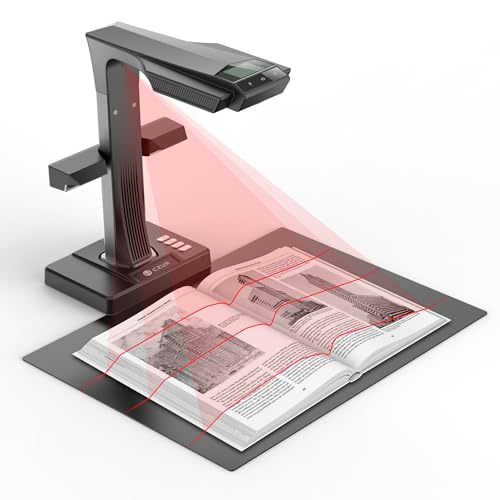
- 24MP camera with A3 capture support
- Auto-flatten and deskew for book pages
- 180+ language OCR with editable exports
Best For: Researchers scanning bound books and oversized documents at a desk
Travel Wand Scanner
MUNBYN 900 DPI Portable Wand Scanner

- 900 dpi handheld scanning up to A4
- Very light and easy to pack
- 16G SD card plus USB transfer
Best For: Researchers who need a lightweight scanner for travel or field use
Compact USB Scanner
Brother DS-640 Mobile Document Scanner

- Up to 16 ppm scanning speed
- USB-powered and easy to travel with
- OCR software with Windows, Mac, and Linux support
Best For: Researchers who mainly scan single sheets and want a compact USB device
Foldable Camera Scanner
NetumScan 13MP Foldable Book Document Camera

- 13MP camera with A3/A4 support
- One-key correction and LED lighting
- OCR export plus live projection
Best For: Researchers who want a foldable desk scanner for books and presentations
Portable Book Camera
NetumScan 13MP Document Camera for A4 Pages

- 13MP overhead capture with LED light
- Auto correction and OCR-friendly formats
- Foldable body for easy transport
Best For: Researchers and educators scanning books and A4 pages from above
Handheld Travel Scanner

- Handheld, rechargeable, and highly portable
- Up to 1050 dpi with SD card support
- Includes Readiris OCR and PDF tools
Best For: Researchers and travelers needing a mobile book scanner with OCR
Foldable AI book scanner
CZUR Aura Pro Book & Document Scanner

- A3/A4 scanning with 2-second pages
- Auto-flatten, deskew, and AI processing
- Searchable PDF, Word, and OCR support
Best For: Researchers scanning curved books and mixed documents
Speed-first portable scanner
CZUR Shine Ultra Smart Portable Document Scanner

- About 1 second per page scanning
- Works as scanner and document camera
- Portable 4 lb foldable design
Best For: Researchers who scan flat papers and thinner books quickly
Desk lamp-style book scanner
CZUR Aura Pro Portable Book Scanner

- Auto-flatten and fingerprint removal
- About 2 seconds per page scanning
- Dual-use scanner with built-in lamp
Best For: Researchers wanting a desk-friendly scanner for books and papers
Desktop Research Scanner – CZUR ET24 Pro A3 Book Scanner
If you need portable book scanners for researchers that can handle books, documents, and larger research materials, the CZUR ET24 Pro is built for desk-based digitizing. Its 24MP camera, A3 support, and upgraded flattening and deskew tech make it a strong fit for turning bound pages into cleaner digital files with less manual correction.
Best For: Research workflows that need fast capture of books, papers, and oversized source material at a desk.
Pros:
- 24MP camera with 5696×4272 resolution for detailed captures.
- Auto-flatten and deskew technology helps with curved book pages.
- Supports A3 scanning and 180+ OCR languages for editable output.
- HDMI support and real-time preview screen add flexibility during use.
Cons:
- Not ideal for very glare-heavy papers.
- Requires a desk setup rather than true handheld portability.
- Arabic OCR support is limited by operating system.
For researchers who scan lots of bound material, this model offers a good balance of image quality, automation, and format support. It is better suited to a dedicated workspace than an on-the-go bag scanner, but it brings more convenience to page flattening and OCR than simpler portable options.
Travel Wand Scanner – MUNBYN 900 DPI Portable Wand Scanner
Among portable book scanners for researchers, this MUNBYN wand scanner stands out for true grab-and-go use. It is lightweight, battery powered, and can scan up to A4 pages at 900 dpi, making it useful when you need a simple way to digitize pages, photos, or documents without a bulky desktop device.
Best For: Researchers who want a lightweight scanner for travel, field work, or occasional page capture.
Pros:
- Very light and compact for easy carrying.
- 900 dpi capture with A4 support for detailed scans.
- No driver required and USB transfer is straightforward.
- Includes a 16G SD card for storing many files.
Cons:
- AA batteries are required and must be bought separately.
- Needs a flat surface and works best on flat pages.
- OCR editing depends on separate software.
This is a practical pick when portability matters more than automation. It is not the fastest choice for dense book projects, but for researchers who need a compact scanner in a small bag, it offers a simple and flexible workflow.
Compact USB Scanner – Brother DS-640 Mobile Document Scanner
If you are comparing portable book scanners for researchers and want something fast for documents, the Brother DS-640 is a compact mobile scanner with practical software support. It is small enough to fit in a bag, runs from USB power, and scans at up to 16 ppm, which makes it a solid option for quick digitizing on a laptop.
Best For: Researchers who need a compact USB-powered scanner for documents and reference pages.
Pros:
- Up to 16 ppm scanning speed for efficient capture.
- Very compact and lightweight for travel.
- USB-powered, so no outlet is needed.
- Supports Windows, Mac, and Linux with OCR software included.
Cons:
- Designed more for single-sheet documents than books.
- One-sheet capacity limits batch handling.
- 300 resolution is less suited to high-detail imaging needs.
The DS-640 is best viewed as a mobility-first document scanner rather than a book imaging specialist. For researchers who mainly need quick document scans and OCR on the move, it is a very practical compact choice.
Foldable Camera Scanner – NetumScan 13MP Foldable Book Document Camera
For researchers looking at portable book scanners for researchers with a camera-style design, the NetumScan 13MP model is a flexible desktop option. It supports A3/A4 capture, one-key automatic correction, and real-time projection, so it can double as a scanning tool and presentation camera in study or teaching settings.
Best For: Researchers who want a foldable scanner for books, notes, and live projection.
Pros:
- 13MP CMOS sensor with A3/A4 capture support.
- One-key automatic correction helps fix skewed images.
- Built-in LED lighting supports clearer images.
- OCR supports editable text exports and multiple languages.
Cons:
- Requires software installation and a computer connection.
- Best suited to a desk setup rather than handheld use.
- Windows support is the only minimum system requirement listed.
This model is a strong fit if you want one device for scanning and live projection. It does not behave like a pocket scanner, but it offers useful flexibility for researchers who handle books, notes, and presentation content in one place.
Portable Sheet-Feeder Scanner – Canon imageFORMULA R10 for Mobile Users
If you need a portable book scanners for researchers-style workflow that also handles stacks of handouts, the Canon imageFORMULA R10 is a practical USB-powered option. It is built for quick duplex scanning, offers a 20-sheet automatic feeder, and can convert papers into searchable PDFs, JPEGs, and other digital formats without a complicated setup.
Best For: Researchers, students, and mobile workers who want a compact, fast document scanner for mixed paper files.
Pros:
- Scans both sides at once and reaches up to 12 pages per minute.
- 20-sheet automatic feeder helps speed through small document batches.
- Works with Windows and Mac, with built-in software that requires no installation.
- Supports receipts, business cards, legal documents, reports, and more.
Cons:
- Not intended for scanning photographs on photo paper or photographic media.
- Sheet-fed design is better for documents than full-page book copying.
- Daily volume is suggested at 500 scans, so it is not a heavy-duty archival machine.
For researchers who mainly need a portable, dependable scanner for paper documents rather than a dedicated overhead book camera, the R10 is easy to justify. Its strength is simple, fast capture in a compact body, especially when you want searchable files with minimal setup.
Portable Book Camera – NetumScan 13MP Document Camera for A4 Pages
For portable book scanners for researchers who need overhead capture, the NetumScan 13MP document camera is designed around manual page turning and real-time projection. It uses a 13MP sensor, built-in LED lighting, and automatic correction to help produce clean page images for OCR, PDF, Word, and text workflows.
Best For: Researchers, teachers, and remote presenters who want a foldable overhead scanner for books, notes, and A4 materials.
Pros:
- Foldable aluminum-alloy body makes it easy to carry and set up.
- Automatic correction helps fix skewed images quickly.
- Supports mass automatic scanning plus Word, PDF, and text formats.
- Works with Windows, Mac OS, and Linux.
Cons:
- Manual page turning is required.
- Captures up to A4 size, so larger originals may not fit.
- Requires software installation and USB connection to use.
This model makes sense if your research work involves books, teaching materials, or documents you want to project and record as well as scan. It is less of a high-volume office scanner and more of a flexible overhead capture tool for mixed academic use.
Handheld Travel Scanner – IRIScan Book 7 White with OCR
The IRIScan Book 7 White is a handheld option for portable book scanners for researchers who want to scan on the move without a desk-bound feeder. It offers 300, 600, and 1050 dpi modes, saves to SD card or USB, and includes OCR and PDF software for turning scans into editable files.
Best For: Researchers, archivists, and travelers who need a compact handheld scanner for books, documents, and photos.
Pros:
- Very portable handheld design with rechargeable battery power.
- Supports up to 1050 dpi for more detailed scans.
- Can scan to SD card or via USB, with Word, PDF, and XLS output support.
- Includes Readiris OCR and PDF software, plus Windows and Mac compatibility.
Cons:
- No Wi-Fi support, despite the wireless wording in the product name.
- Handheld scanning takes more technique than a sheet-fed machine.
- AC adapter is not provided.
For researchers who need a truly mobile scanner and value OCR tools, the IRIScan Book 7 offers a lot of flexibility in a small package. It is especially appealing when portability, file storage options, and image resolution matter more than scan speed or automation.
Foldable AI book scanner – CZUR Aura Pro Book & Document Scanner
For portable book scanners for researchers, the CZUR Aura Pro is built to handle both books and documents with fast capture and AI-assisted cleanup. It supports A3 and A4 materials, offers auto-flatten and deskew features, and outputs to JPG, Word, PDF, and searchable PDF for easier archiving and citation work.
Best For: Researchers who need a foldable scanner for curved books, articles, and mixed-format notes on Windows or Mac.
Pros:
- Scans A3 and A4 materials with 2-second-per-page capture.
- AI technology, auto-flatten, and deskew help improve curved book pages.
- Outputs JPG, Word, PDF, and searchable PDF, with OCR for 180+ languages.
- Includes glare-free, non-flickering smart lamp lighting with four color temperature settings.
Cons:
- Thai, Hebrew, and Arabic are not currently supported in OCR.
- Requires USB connection and desktop software; no Wi-Fi or Bluetooth.
- Mac Apple Silicon support requires macOS 13 or later.
This is a strong pick if your research workflow depends on quick scans and searchable files from books that do not lie perfectly flat. The foldable design and smart lighting make it practical for desk-based use without taking up much space.
Speed-first portable scanner – CZUR Shine Ultra Smart Portable Document Scanner
If you want portable book scanners for researchers that prioritize speed, the CZUR Shine Ultra is designed for fast capture of A3 and A4 materials at about 1 second per page. It doubles as a document camera, and its OCR plus AI cropping tools make it useful for turning paper references into organized digital files.
Best For: Researchers who want a lightweight scanner for flat papers, thinner books, and desktop use with video-call compatibility.
Pros:
- Very fast scanning at about 1 second per page.
- Works as both a document scanner and a document camera for Zoom and Google Meet.
- Supports OCR in 180+ languages for searchable text.
- Portable 4 lb design with a 90-degree foldable body and foot pedal operation.
Cons:
- Only suitable for thinner books; thicker books are better handled by CZUR ET series models.
- Not compatible with Android or iOS.
- Intended for flat papers and objects smaller than A3 size.
This model makes sense when speed and portability matter more than heavy-duty book flattening. For researchers handling flat handouts, article pages, and lighter book scanning, it offers a practical two-in-one setup.
Desk lamp-style book scanner – CZUR Aura Pro Portable Book Scanner
Among portable book scanners for researchers, the CZUR Aura Pro focuses on fast book capture with auto-flattening, fingerprint removal, and sound-controlled operation. It scans any material smaller than A3, handles single sheets and double-page books in about 2 seconds per page, and adds side lights to reduce reflection on glossy paper.
Best For: Researchers who want a portable scanner-lamp combination for quick book archiving and desk use.
Pros:
- Auto-flatten and fingerprint removal improve book-page image quality.
- Scans single sheets and double-page books at about 2 seconds per page.
- Includes 2 supplemental side lights to help reduce reflection.
- Multi-language OCR supports 180+ languages, with searchable output workflows.
Cons:
- Thai, Hebrew, and Arabic are not currently supported in OCR.
- Sound-control features can be affected by noise and distance.
- Requires USB-based setup and desktop software rather than wireless operation.
This is a good choice if you want a scanner that can sit on a research desk and also function as a lamp. Its auto-detection and fast page turns are especially handy for repeated scanning sessions.
How We Picked These Portable Book Scanners for Researchers
We focused on scanners that make research workflows easier: strong OCR for searchable text, reliable capture across mixed page sizes, and features that reduce rework like auto-flatten, deskew, and glare correction. We also considered portability, software compatibility, and whether the device is better for quick citation capture or larger digitizing jobs.
Quick Comparison
For fast scanning on the go, handheld and compact sheet-fed models are the most travel-friendly. For books, journals, and bound archives, camera-style scanners are usually the better choice because they handle fragile pages and larger formats more comfortably. If you need a balance of speed and document management, duplex mobile scanners can be ideal for loose pages and handouts.
Key Buying Factors for Portable Book Scanners for Researchers
OCR Quality and Language Support
Researchers often need more than images; they need searchable text. Look for dependable OCR that handles multiple languages, accented characters, and mixed layouts without frequent manual cleanup.
Page Handling and Flattening
Books with tight bindings benefit from auto-flatten, curvature correction, and finger-removal tools. These features can make scanned pages easier to read and cite accurately.
Resolution and Color Accuracy
Higher resolution helps preserve small print, marginalia, charts, and footnotes. For archival work, consistent color and sharp detail matter more than raw speed alone.
Portability and Setup
Consider whether you need a scanner that fits in a bag, runs over USB, or works independently with an SD card. Portable Book Scanners for Researchers vary widely, so the best choice depends on whether you scan in the lab, library, field, or home office.
Software and Compatibility
Make sure the scanner works with your operating system and file formats. Easy PDF export, cloud syncing, and simple batch management can save time during large literature reviews or archive projects.
Who Should Buy Which Portable Book Scanners for Researchers?
If you mainly scan bound books, choose a camera-style or auto-flatten model. If you scan loose pages, receipts, or handouts as well, a compact duplex mobile scanner may be more efficient. For field researchers and travelers, handheld or SD-card-enabled scanners offer the most flexibility. If your top priority is clean OCR and minimal editing, favor models with mature software and strong image correction features.